Double-Factor Asymptote Cases
Summary: When the highest member factors as — multiplicity 2 — chapter 8 refines the parabolic-asymptote analysis. After axis rotation, two leading-equation alternatives survive at infinity: I. (a parabola, figure 38) or II. (parallel-line family, complex, or double). Case II splits further by discriminant: real distinct roots give two parallel straight asymptotes, each refinable individually; a double root demands refinements. The most general form is with and three sub-cases on vs ; the shapes are catalogued by parity of (figures 39, 40).
Sources: chapter8 (§§204–209), figures35-39 (figures 38, 39), figures40-43 (figure 40).
Last updated: 2026-04-28
Setup
§204. With , the rotation , from curvilinear-asymptote-refinement takes the members to
and so on. (Reused letters denote different coefficients in different members.) The leading -coefficient of is .
The leading equation at infinity has two possibilities depending on which of contributes their first term:
Equation I — ‘s leading term is present ():
Equation II — (so ‘s leading term is absent), and ‘s leading term takes its place; also may contribute (relabel that coefficient ):
Equation I: parabolic asymptote (§204)
is a parabola in . The two branches of this parabola coincide with two branches of the original curve at infinity, lying in quadrants and (figure 38) — for and this is , two branches in the right half plane .
This case reproduces the parabolic asymptote of parabolic-asymptote and is the canonical “asymptote without straight line” — the first species of hyperbolic-and-parabolic-branches parabolic family.
Equation II: parallel-line family (§§205–207)
has discriminant . Three sub-cases:
Distinct real roots: two parallel straight asymptotes (§205)
Roots and with . Each root gives a straight-line asymptote parallel to the new axis . To refine the asymptote , factor
then in the full equation substitute everywhere except in the factor :
Dividing by the leading factor produces the same refinement chain as the simple-factor case in curvilinear-asymptote-refinement: for the first non-vanishing . The refinement of proceeds analogously with replaced by .
Complex roots: no real branches (§205)
If , the equation has no real roots; no branch goes to infinity in this direction.
Double root: refinement to (§206)
If , the equation reduces to . Substituting everywhere except the factor :
Dividing by :
The refinement is for the smallest with . If all vanish, the curve contains as a complex factor (see complex-curves).
Mixed forms when the next coefficient also vanishes on (§207)
If the coefficient of above happens to be divisible by , then setting kills it as well, and we must keep the next term in the position with its own . This produces equations of the form
If the third term is also divisible by , push to the fourth, etc. The general refined equation has up to three powers of :
The general form (§208)
Substituting :
The behavior at infinity depends on how compares to :
Case 1: — two distinct curvilinear asymptotes, four branches
The two roots of the quadratic in are
When , the term is much smaller than at infinity, so the two roots separate into
Both equations and hold at . So the original curve has two distinct curvilinear asymptotes — each a form — making four branches approach the straight line at different rates.
Case 2: — discriminant condition
becomes , a true quadratic in . Roots:
- If : complex roots, no real asymptote.
- If : two real distinct roots , giving two similar asymptotes and (same exponent, different constants).
- If : a double root, leading to higher-order refinement.
Case 3: — middle term negligible
When , the term vanishes faster than the others at infinity (since as well). The leading equation reduces to
i.e. an asymptote of pure form.
Shape catalogue: (§209)
§209. Take the straight-line asymptote as the axis , set as the new ordinate, and consider the curvilinear asymptote for an integer less than . The four quadrants from and the perpendicular through are labelled (upper-right), (upper-left), (lower-right), (lower-left) as in figure 39.
Odd : two branches in opposite quadrants
For , only gives real (assuming ); gives one branch above and one branch below the asymptote, both for . So branches lie in quadrants and — figure 39. Same pattern for any odd .
Even with : four branches in all four quadrants
For , both signs of give real : . Four branches: (quadrant ), (quadrant ) for , and (quadrant ), (quadrant ) for — figure 40.
Even with : no real branches
with and even has no real solutions; no branch goes to infinity in this direction.
Summary of cases
| Leading equation | Multiplicity profile | Asymptote | Branches | Figure |
|---|---|---|---|---|
| (eq I) | parabolic | parabola | 2 in | 38 |
| distinct real roots | two parallel lines | each line refinable | 2 + 2 | — |
| complex roots | no asymptote | — | 0 | — |
| double root | one line, refined as | per parity below | — | |
| , odd | — | — | 2 in | 39 |
| , even, | — | — | 4 in all quadrants | 40 |
| , even, | — | — | 0 | — |
Figures
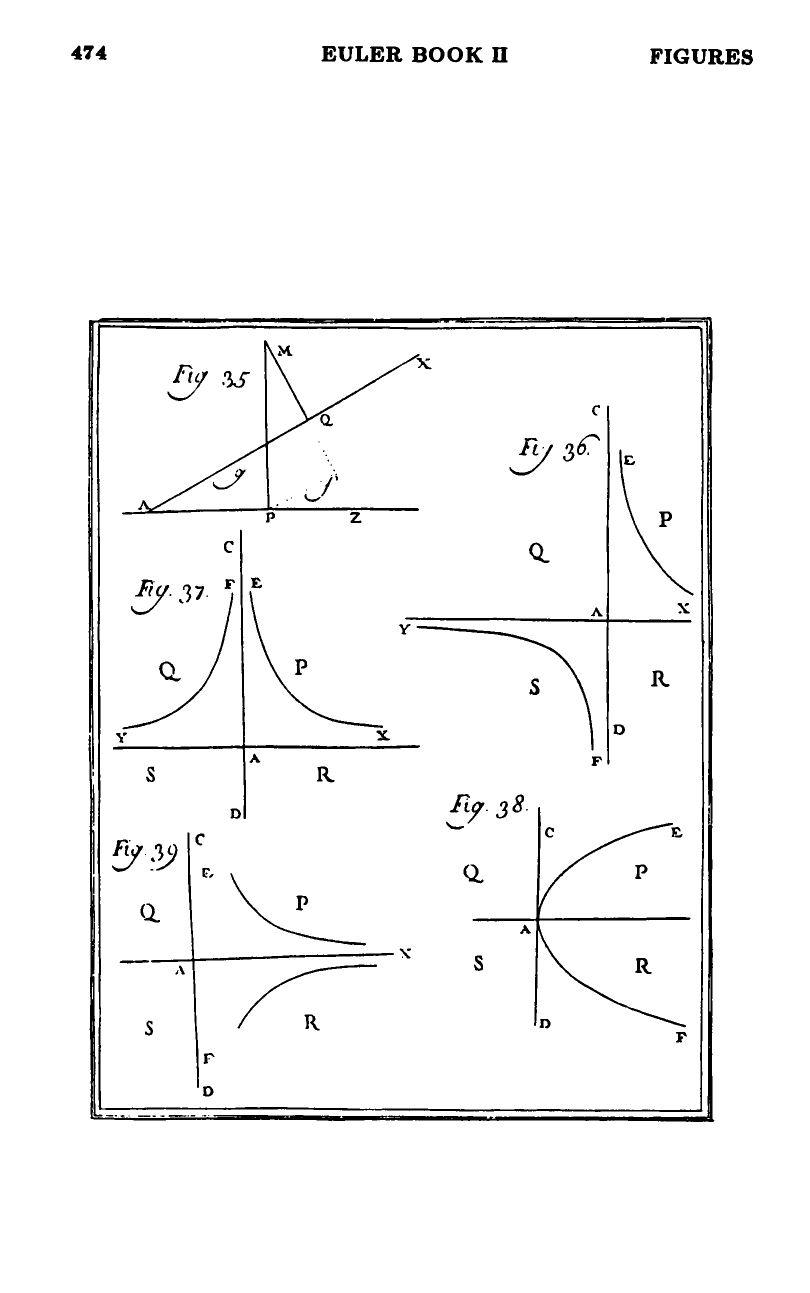 Figures 35–39
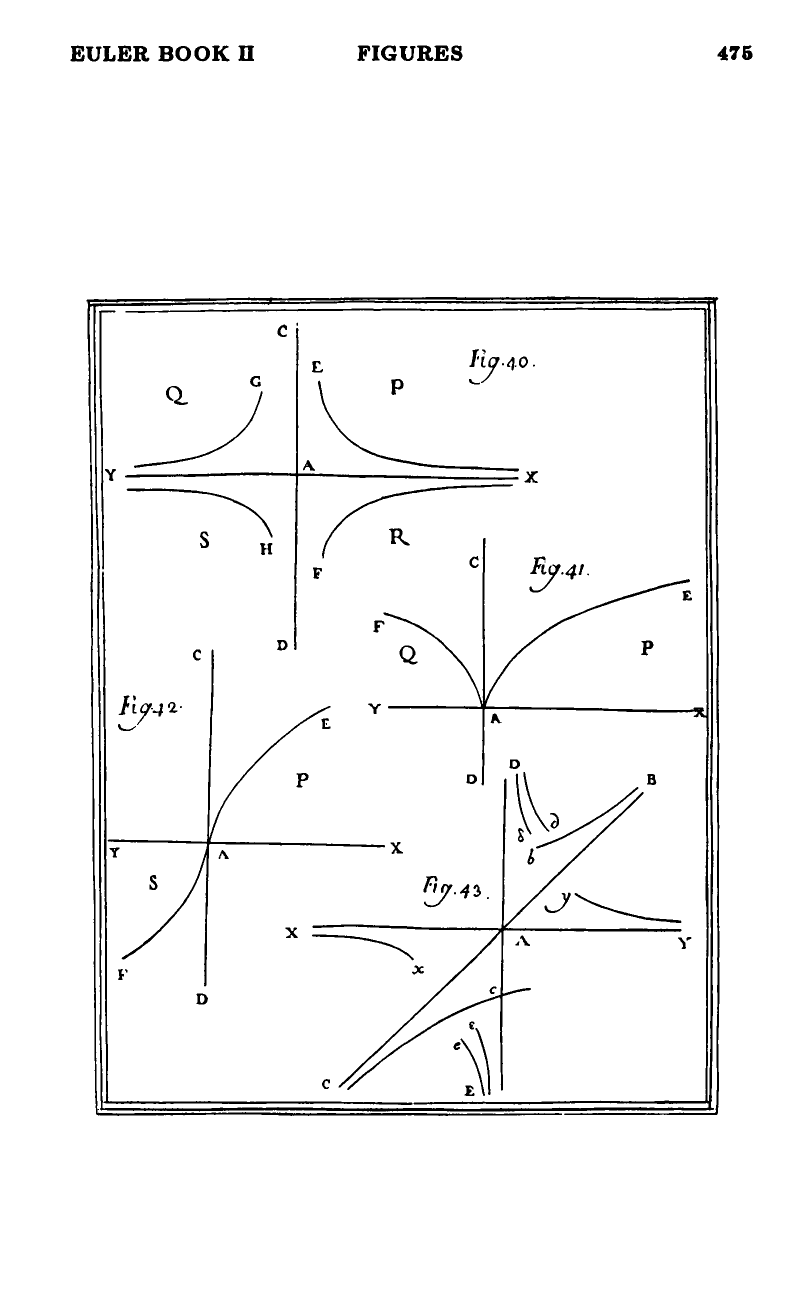 Figures 40–43