Classification of Curves with Multiple Equal Parts
Summary: A completeness theorem for the chapter (§§361–363): every algebraic curve with two or more similar and equal parts is either (a) a curve with one or more diameters, classified by n-diameters-by-cos-ns, or (b) a curve with several alternately equal parts but no diameter, classified by equal-parts-without-diameter. There is no third case. The proof is a continuity argument: if a putative equal-pair in figure 75 did not fit either classification, the law of continuity would force infinitely many such equal pairs — which is impossible for an algebraic curve.
Sources: chapter15 (§§361–363); figures 75, 76 in figures72-75 and figures76-80.
Last updated: 2026-05-11.
The bootstrap by equilateral triangle (§361, figure 75)
Suppose a continuous curve has two similar and equal parts and , both emanating from points on the curve. Construct the equilateral triangle with apex at , where equals the angle subtended at the shared endpoint (or any consistent angular pair the curve provides). Then:
- The parts on opposite sides of the triangle are equal and similar to the original pair (since the triangle is equilateral and the curve is symmetric under that triangle’s symmetry).
- More generally, draw at the same angle from . These give new equal-and-similar arcs alongside the original .
The construction iterates indefinitely. The result is a sequence of equal arcs around the point , separated by the angle .
Termination. The bootstrap closes (returns to its starting arc) iff is a rational multiple of — equivalently, iff for some integer . Then the curve has exactly similar equal parts arranged about , fitting into one of the two classifications above. Otherwise the bootstrap generates infinitely many distinct equal arcs — but no algebraic curve can have infinitely many equal parts, since the bootstrap line would meet the curve in infinitely many points, violating the line-curve-intersection-bound.
Hence:
The curve is contained in those [classes] without a diameter which we have investigated. (source: chapter15, §361)
Handling oblique placements (§§362–363, figure 76)
The §361 argument needed the two arcs to be related by a rotation about some center — symmetric in the sense that the perpendicular bisector of passes through the rotation center. The §362 step handles the case where the arcs are not arranged this way, e.g., when the arcs are on opposite sides of two parallel straight lines .
The construction: draw so that the angle , making . Then draw parallel to through the midpoint of . The arcs are then equal and similar with respect to — but unless (i.e., unless ), does not split the original curve into two equal halves: the construction creates arcs on the other side that match , and arcs to match on the opposite side, etc. The iteration generates infinitely many similar arcs — impossible for an algebraic curve.
The exceptional case (§363): then is perpendicular to , and the bisector passes through . The point coincides with (after reflection), and the curve is symmetric across — meaning is a diameter of the curve. This case reduces to the §361 diameter classification.
The two classifications are therefore exhaustive:
It follows that absolutely all algebraic curves with two or more equal parts fall under the classification given in this chapter. (source: chapter15, §363)
The dichotomy in summary
For an algebraic curve with two or more similar and equal parts:
| Case | Characterization | Where to find the equation |
|---|---|---|
| At least one diameter | Reflective symmetry; equation involves only in polar form | n-diameters-by-cos-ns |
| Center but no diameter | Rotational symmetry only; equation involves both and | equal-parts-without-diameter |
The chapter has thus achieved a complete invariant-theoretic description of all algebraic curves with multiple-part symmetry. The structural ingredients — equal angles between diameters, as the invariant under reflection, as the rotational supplement — anticipate the modern theory of dihedral and cyclic group actions on the plane.
Comparison with the diameter / center theory of conics
Chapter 5 derived “diameter” and “center” purely from algebra — sum-of-roots on the quadratic-in- form of the conic. Chapter 15 derives the same notions from symmetry of the equation, generalized to all algebraic orders. The two routes converge for conics:
- Conic with one diameter (parabola) ↔ §338 form .
- Conic with two perpendicular diameters and a center (ellipse, hyperbola) ↔ §342 form .
Chapter 15 generalizes this to ” diameters and a center” for all , and adds the ” equal parts and a center but no diameter” family. For , the curves are of order , and the conic theory does not see them.
Figures
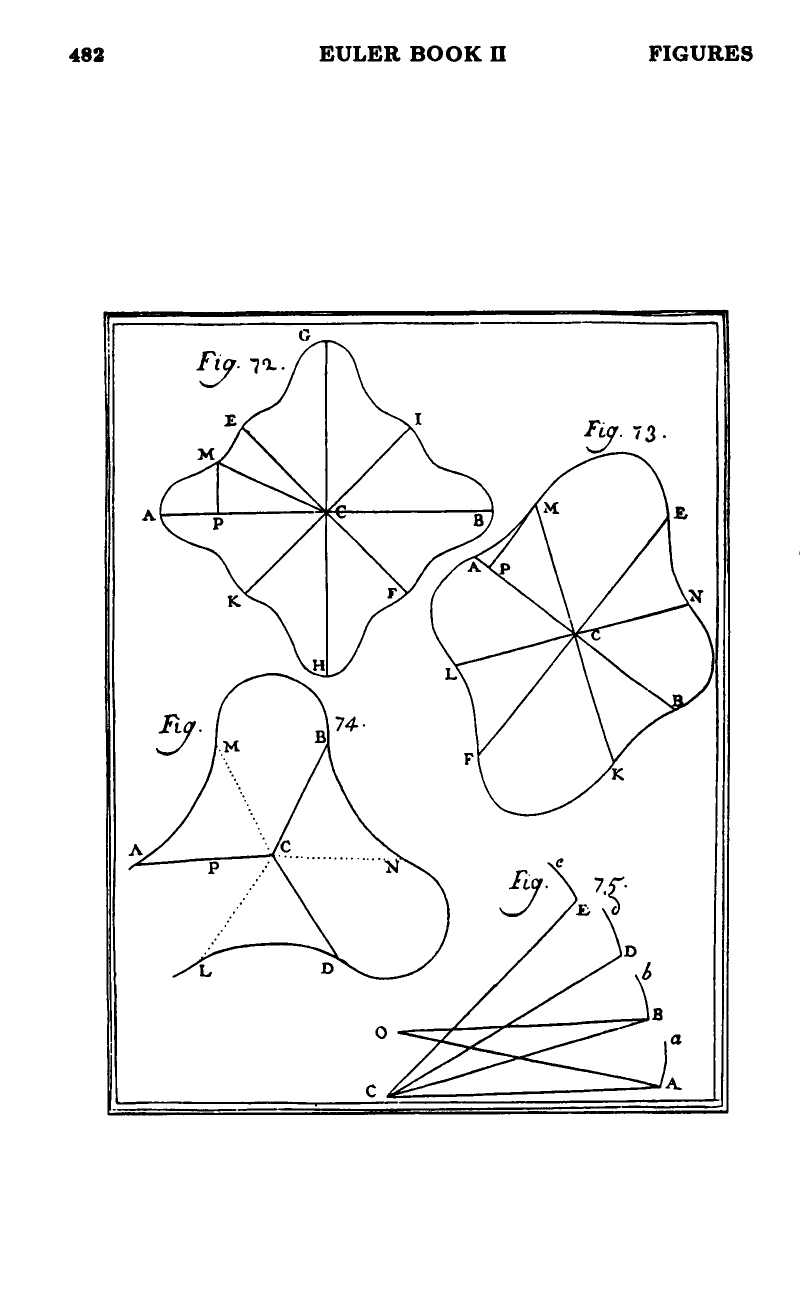 Figures 72–75
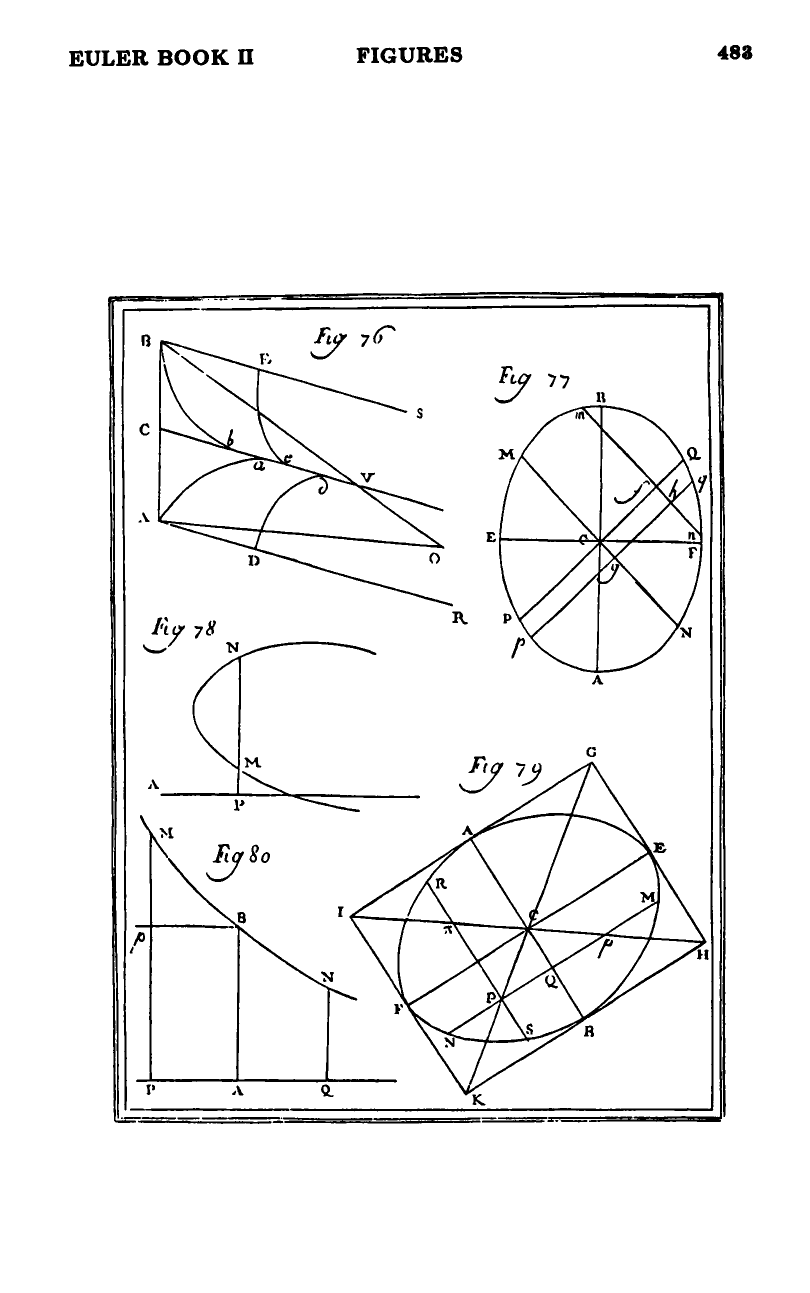 Figures 76–80
Related pages
- chapter-15-on-curves-with-one-or-several-diameters
- n-diameters-by-cos-ns — the diameter side of the dichotomy.
- equal-parts-without-diameter — the no-diameter side of the dichotomy.
- concurrence-of-diameters — the angle quantization, of which this is the equal-parts counterpart.
- line-curve-intersection-bound — the algebraic-curve constraint that rules out infinitely many equal parts.
- continuous-and-discontinuous-curves — the “law of continuity” Euler invokes in §361.