Equations for Curves with Diameters via
Summary: A curve has diameters meeting at with angle between adjacent diameters iff, in polar coordinates centered at , the equation depends on only through (§§347–354). Converting back to rectangular coordinates via and — the Chebyshev expansion — the equation becomes a non-irrational function of and the “Chebyshev real part” : for , for , for , for , etc. The “simplest” curve in each family — order with asymptotes bounding a regular -gon centered at — falls out as (§351 for , §353 for ).
Sources: chapter15 (§§347–354); figures 70 (), 71 (), 72 () in figures68-71 and figures72-75.
Last updated: 2026-05-11.
The polar reformulation (§347)
Take rectangular coordinates centered at , and let
For a diameter to be an axis of reflective symmetry, replacing by should leave the equation unchanged. Hence as a function of must depend on only through (the simplest function invariant under ). The equation becomes a non-irrational function of and — equivalently, since , of and , equivalently of and (§348). The single-diameter case is recovered.
Two perpendicular diameters: (§349)
If the curve has a second diameter perpendicular to , then must also leave unchanged. The simultaneous invariants under and are functions of , since (Note that is invariant under but not under , so it doesn’t work.) Using the equation becomes a non-irrational function of and — matching the §342 form (function of and ). The two routes agree.
Three diameters at : (§§350–351, figure 71)
Three diameters at means . The simultaneous invariants under and are functions of : From the triple-angle formula, Hence the equation is a non-irrational function of and . Letting and , the general equation is
The simplest three-diameter curve. A third-order line with three diameters: This curve has three asymptotes bounding an equilateral triangle centered at . Each asymptote is of the species (cf. curvilinear-asymptote), so the curve belongs to the fifth species in the chapter-9 cubic enumeration (cf. cubic-species-classification).
Four diameters at : (§352, figure 72)
For four diameters at , invariants are functions of : The equation is a non-irrational function of and . Equivalently — and Euler points this out — it can be written as a function of and , since
Five diameters at : (§353)
The Chebyshev real part of is The simplest fifth-order curve with five diameters: Five asymptotes bound a regular pentagon centered at . The pentagonal pattern echoes the equilateral triangle of the cubic case.
General diameters (§354)
The pattern continues. For diameters at angle , the equation is a non-irrational function of and the Chebyshev real part This is the real part of , alternating signs on the even powers of . With and this polynomial, the general -diameter curve has the form
It follows that we can always find a curve with any desired number of diameters which meet in a single point with equal angles. Conversely, all algebraic curves with a given number of diameters are obtained in this way. (source: chapter15, §354)
This is a complete classification: every algebraic curve with exactly orthogonal diameters arises from this construction, and every such construction gives an -diameter curve.
The circle absorbed into every family
The equation is a circle (provided have opposite signs). Setting in any of the general equations above recovers it — consistent with the fact that the circle has infinitely many diameters (and so satisfies the -diameter equation for every simultaneously). §351 makes the point explicitly.
Connections
- Chebyshev polynomials. The polynomial is the bivariate homogenization of the Chebyshev polynomial of the first kind: . Euler arrives at it via the trigonometric multiple-angle identities of Book I (Chapter 8) without naming it.
- Regular polygon of asymptotes. Each “simplest” curve of order has rectilinear asymptotes through at the same angular spacing as the diameters, but offset — bounding the regular -gon centered at . The diameters bisect the sides (or pass through the vertices, depending on parity).
- Equal parts. A curve with diameters has equal and similar parts of the curve — each diameter divides into two equal halves, and the -fold rotational symmetry multiplies this further. See chapter-15-on-curves-with-one-or-several-diameters §355.
Figures
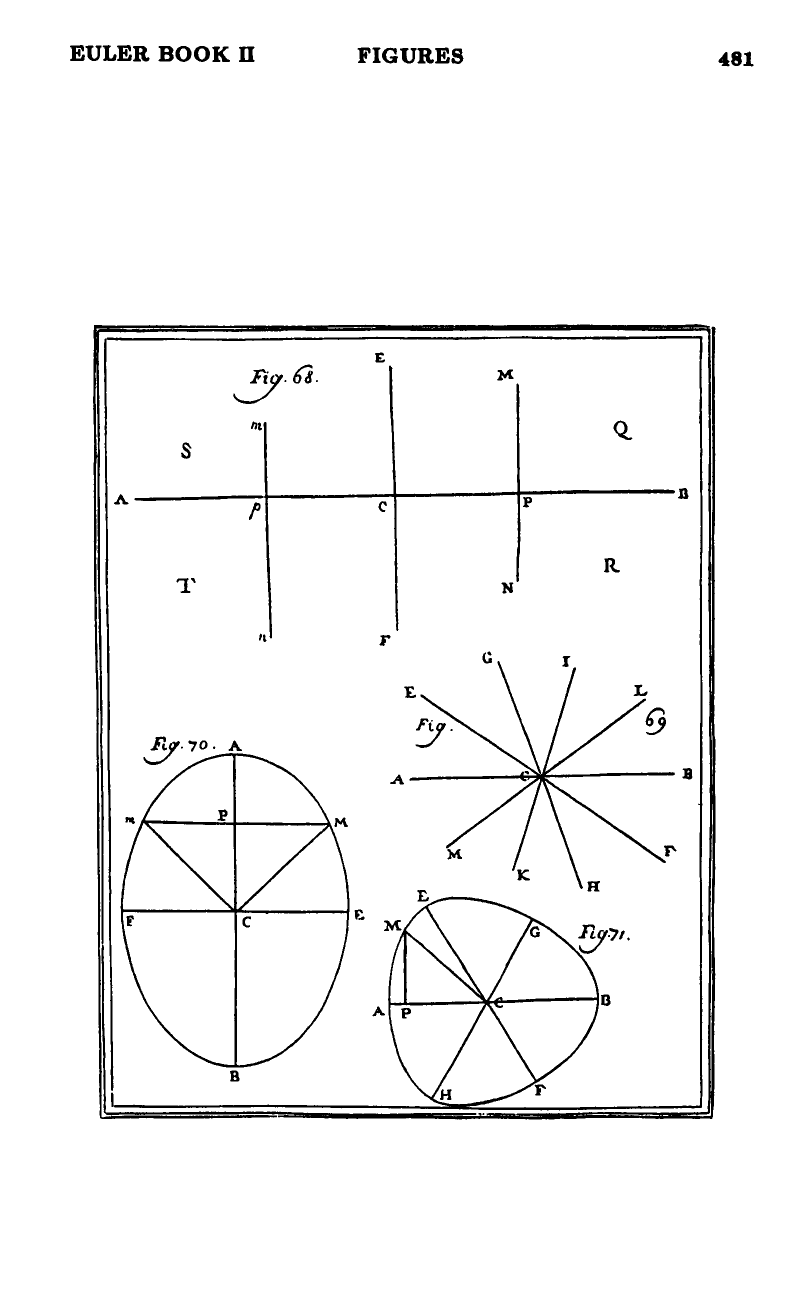 Figures 68–71
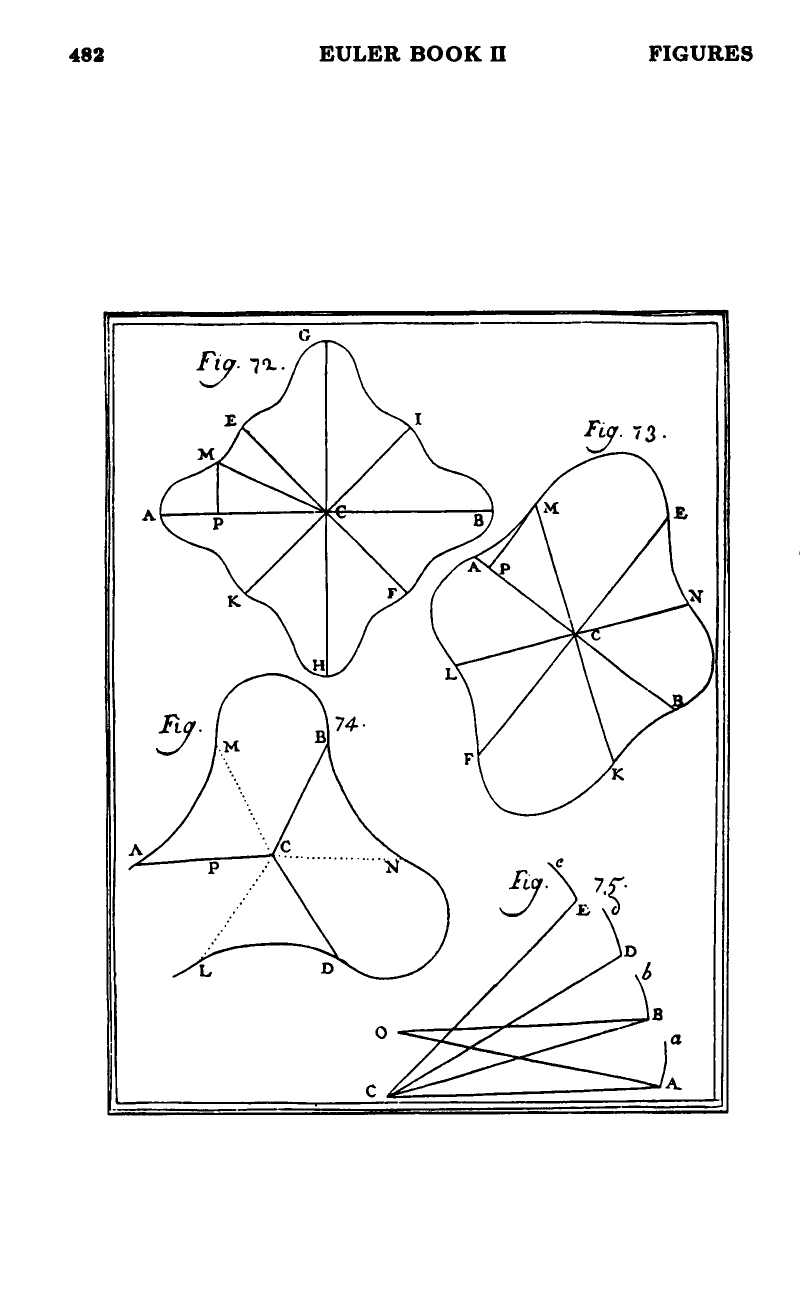 Figures 72–75
Related pages
- chapter-15-on-curves-with-one-or-several-diameters
- diameter-and-center-from-equation — the predecessor.
- concurrence-of-diameters — why all diameters must meet at a common with equal angles.
- equal-parts-without-diameter — the parallel theory using together with for curves with equal parts but no diameter.
- cubic-species-classification — the fifth species, in which the simplest curve lives.
- curvilinear-asymptote — the asymptote shape that bounds the regular triangle / pentagon.