Continuous and Discontinuous Curves
Summary: Euler calls a curve continuous if its entire shape is captured by a single function of , and discontinuous (also mixed or irregular) if different stretches of the curve require different functions. The notion is not the modern topological one — it is about being expressible by one closed-form expression.
Sources: chapter1
Last updated: 2026-04-24
Definition (§9)
A continuous curve is one such that its nature can be expressed by a single function of . If the curve is of such a nature that for its various parts, , , , etc., different functions of are required for its expression … then we call such a curve discontinuous or mixed and irregular. (source: chapter1, §9)
The point is that a discontinuous curve “cannot be expressed by one constant law, but is formed from several continuous parts.” A piecewise definition, even if the pieces meet smoothly, counts as discontinuous in this sense.
Not the modern definition
This is a frequent source of confusion when reading 18th-century analysis. Compare:
| Property | Euler (§9) | Modern |
|---|---|---|
| A single polynomial | continuous | continuous |
| (two linear pieces joined at ) | discontinuous (“mixed”) | continuous |
| on | continuous (one expression) | continuous on its domain, with an infinite discontinuity |
| A step function defined piecewise | discontinuous | discontinuous |
Euler’s notion is about the expression, the modern notion is about the limit behaviour of the values. The two happen to coincide for many common cases, which is probably why the terminology survived.
Scope for the rest of Book II
“In geometry we are especially concerned with continuous curves” (source: chapter1, §10). Euler further claims that curves generable “by some regular constant mechanism” are also expressible by a single function, so are continuous in his sense — this is the implicit premise that lets him treat mechanically drawn curves with his function-centric apparatus. Discontinuous curves are set aside and briefly alluded to at the end of §22 as the next topic.
Multi-valued curves are still “one” curve
A subtlety worth flagging: when is a two-valued function of the curve may consist of visibly separated parts (see figure 3: and ). These are not discontinuous. “These parts taken together are to be considered as one continuous or regular curve, since all the different parts come from a single function” (source: chapter1, §18). The continuity classification is about the defining function, not the connectedness of the image. See multi-valued-curves.
Figures
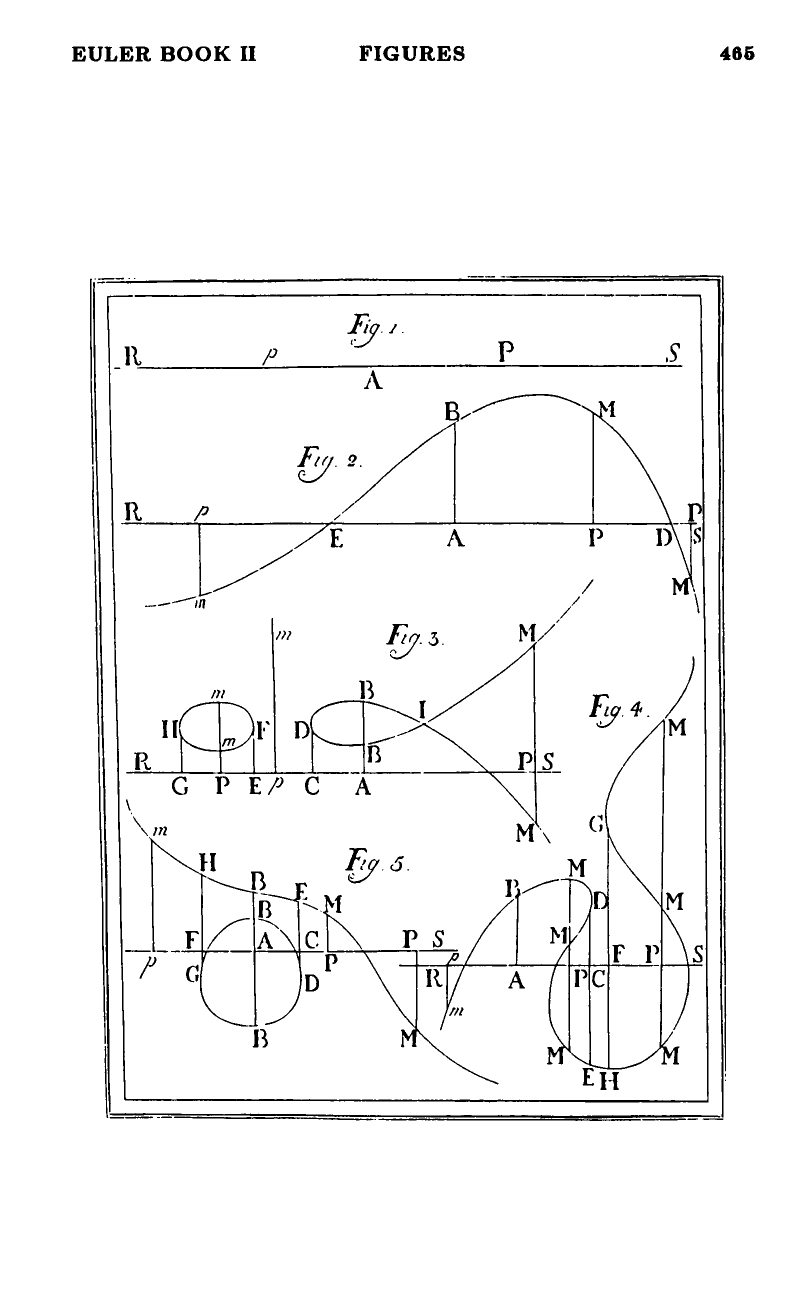 Figures 1–5