Equal Parts Without a Diameter
Summary: A curve can have similar and equal parts arranged with -fold rotational symmetry about a center but no diameter — no axis of reflection (§§355–360). The construction parallels n-diameters-by-cos-ns except that the polar invariant must now be invariant under (rotation by ) without also being invariant under (reflection). Both and satisfy the rotation condition, so the curve equation involves both the “Chebyshev real part” and the “Chebyshev imaginary part” . In rectangular coordinates, the latter appears as the imaginary part of : for , for , for , for , etc. Dropping the part recovers the diameter case.
Sources: chapter15 (§§355–360); figures 73 ( with no diameter), 74 ( with no diameter) in figures72-75.
Last updated: 2026-05-11.
How equal-part counts work (§355)
A curve with diameters has similar and equal parts: each diameter divides the curve into two halves, and the diameters together break the curve into alternating slices. Examples:
| Diameters | Parts | Figure |
|---|---|---|
| 2 | 4 () | 70 |
| 3 | 6 () | 71 |
| 4 | 8 () | 72 |
But — and this is the new observation of §355 — a curve can have multiple equal parts without having any diameter at all. The minimum number is (one rotational pair). The number of equal parts is always at least twice the number of diameters, but can exceed that, by exactly the count of rotational-only symmetries that have no companion reflection.
Two opposite parts, no diameter (§§356–357, figure 73)
Take two equal parts and situated in opposite regions. Setting and using the rotational pairing (i.e., takes the same value at and at the diametrically-opposite point with ):
Expressions invariant under this — but not under — include (since ). Equivalently, working with sines and cosines to avoid fractions: is a non-irrational function of , , and — i.e., in rectangular coordinates, of , , and . Cleanly: is a non-irrational function of , , and . The general equation is
This is the general §340 (even-degree homogeneous parts) form — a center but possibly no diameter. If the term (and its higher-degree analogs) vanish, becomes a function of alone, and the curve recovers the two perpendicular diameters of §342. Hence the ” part” is exactly the obstruction to having diameters.
Three parts at , no diameter (§358, figure 74)
Three equal parts arranged with -fold rotational symmetry about , with the three “spokes” at angles all giving the same value of . Invariants under are functions of and : So is a non-irrational function of , , and . The general equation:
A third-order line with three equal parts but no diameter has the form
If (the part vanishes), this collapses to the §351 diameter form .
Four parts at , no diameter (§359, figure 73 reused for analogous geometry)
Four equal parts arranged with -fold rotational symmetry about . Invariants under : is a non-irrational function of , , and . The general equation:
with the constraint that the quartic-degree pieces are an -linear combination of and (cf. §359 textually).
General equal parts no diameter (§360)
For equal parts at angle , is a non-irrational function of and the two Chebyshev polynomials of degree — the real and imaginary parts of . Explicitly:
(the imaginary part), and
(the real part, the Chebyshev real part). The closing observation:
If either of these last two expressions are missing, then the curve has diameters. (source: chapter15, §360)
Dropping recovers the -diameter case; dropping also gives a curve with diameters, but reflected by — the diameters now bisect the gaps between where the original ones would have been.
Symmetry, in summary
| Polar invariant | Geometric meaning |
|---|---|
| only | one diameter |
| only | two perpendicular diameters |
| only | diameters at angle |
| both | -fold rotational symmetry, no diameters |
| any | no symmetry |
The role of the imaginary part is precisely to break the reflective symmetry while preserving the rotational symmetry — turning diametrically equal parts into alternately equal ones.
Figures
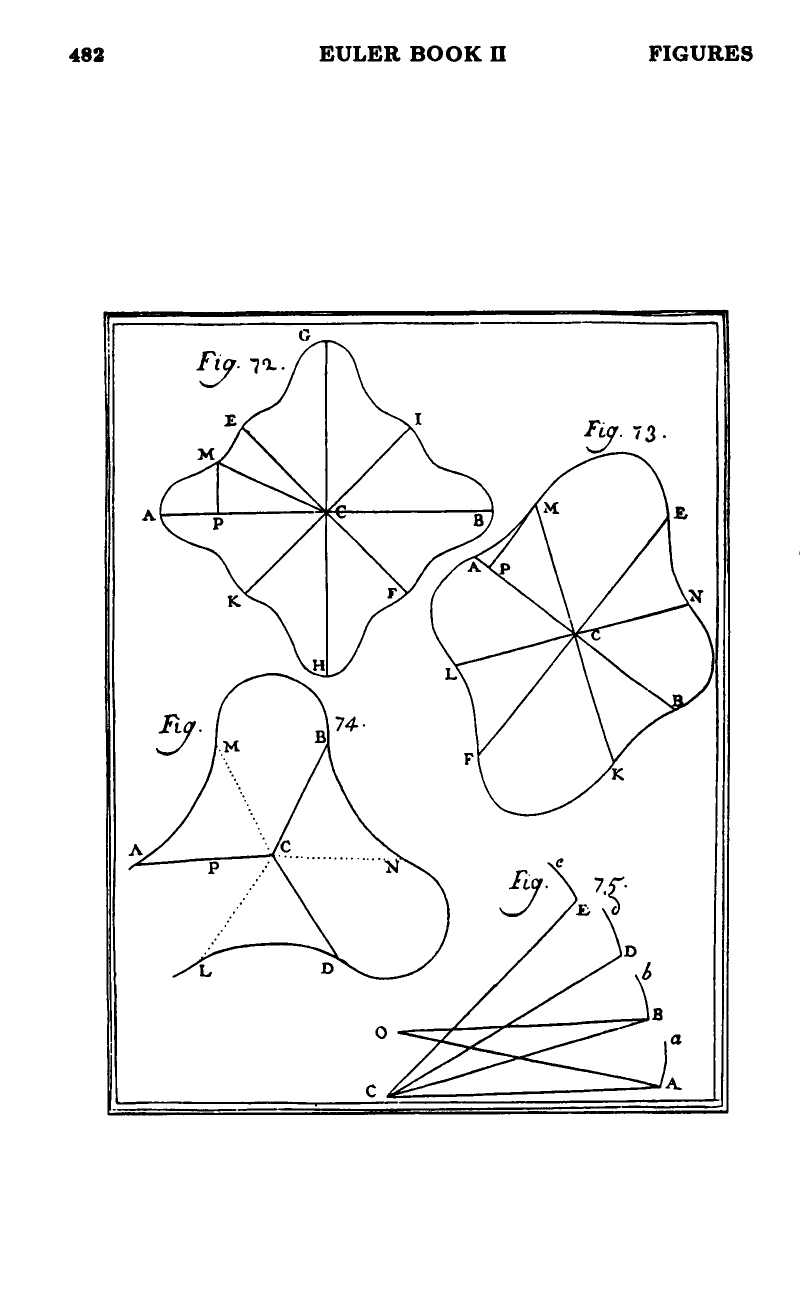 Figures 72–75
Related pages
- chapter-15-on-curves-with-one-or-several-diameters
- diameter-and-center-from-equation — the counterpart with reflective symmetry.
- n-diameters-by-cos-ns — the -only construction; equal parts arrange around diameters.
- concurrence-of-diameters — establishes the spacing.
- classification-of-equal-parts — the §§361–363 completeness theorem covering both this and the diameter case.