Chapter 15: Concerning Curves with One or Several Diameters
Summary: An invariant-theoretic classification of algebraic curves with symmetry (§§336–363). The chapter generalizes the diameter / center theory of chapter-5-on-second-order-lines from conics to all orders. Reflective symmetry — a diameter — corresponds to even powers of one coordinate in the equation . Point symmetry — a center — corresponds to invariance under , which decomposes into two cases: all homogeneous parts of even degree (curve has diameters too) or all of odd degree (curve has only the center, “alternately equal”). diameters must concur at a common center, separated by equal angles , alternating in two kinds — a rational fraction of is mandatory, since otherwise the symmetries multiply infinitely and force the circle. The closed-form description uses polar coordinates centered at : a curve with diameters has depending on only through , equivalently on rectangular coordinates through and the “Chebyshev real part” . Without reflective symmetry (rotational only), also enters — giving the ” equal parts but no diameter” family. A continuity argument shows these two families exhaust all algebraic curves with two or more similar and equal parts.
Sources: chapter15 (§§336–363). Figures 68–76 (in figures68-71, figures72-75, figures76-80).
Last updated: 2026-05-11.
Setting (§336)
The chapter opens by recalling the second-order results: every conic has at least one diameter; ellipse and hyperbola have two perpendicular diameters and a center; the circle is special, with innumerably many diameters. The aim of the chapter is to extend this from (conics) to all algebraic orders, and to make precise the distinction between “diametrically equal” (reflective) and “alternately equal” (rotational) pairs of parts.
Strand 1 — diameter and center as parity conditions (§§337–343)
The four-quadrant setup with axes and meeting at (figure 68) makes the symmetries visible as substitutions:
| Substitution invariance | Geometric meaning | Equation form |
|---|---|---|
| diameter | , only even powers of | |
| diameter | , only even powers of | |
| (even hom.) | center with diameters | sum of even-degree homogeneous parts |
| (odd hom.) | center without diameters | sum of odd-degree homogeneous parts |
| both and | two perpendicular diameters | , only even powers of both |
The last entry has a striking consequence: no curve of odd order admits two perpendicular diameters, since the equation has only even total degree. §341 names the two types of “equal pairs” — diametrically equal (with a diameter), alternately equal (point-symmetric only). See diameter-and-center-from-equation.
Strand 2 — concurrence and angle quantization (§§344–346)
If a curve has only two diameters they must be perpendicular (§344). With more than two, all diameters meet at one point (the “center”), and consecutive diameters are separated by equal angles. The bootstrap argument: each diameter is an axis of reflection, so reflecting one diameter across another gives a new diameter. Iterating produces an angular sequence that must close after finitely many steps — hence the angle between adjacent diameters must equal for some integer . Otherwise the bootstrap generates infinitely many diameters, forcing the circle. The diameters fall into two alternating kinds — odd-indexed and even-indexed in the cyclic order — playing equivalent roles under the symmetries. Also: no algebraic curve has two parallel diameters, since that would also generate infinitely many. See concurrence-of-diameters.
Strand 3 — the polar Chebyshev derivation (§§347–354)
Working in polar coordinates centered at , a curve with diameters has invariant under both (reflection across diameter ) and (reflection across the next diameter). The simultaneous invariant is :
| Polynomial | “Simplest” curve with diameters | Figure | |
|---|---|---|---|
| 1 | — | (degenerate) | |
| 2 | (ellipse / hyperbola) | 70 | |
| 3 | (cubic with three asymptotes bounding equilateral triangle) | 71 | |
| 4 | quartic with four asymptotes bounding square | 72 | |
| 5 | quintic with five asymptotes bounding regular pentagon | (not figured) | |
| order- curve with asymptotes bounding regular -gon | — |
These curves all share the structure: equation a non-irrational function of and . See n-diameters-by-cos-ns.
Strand 4 — equal parts without a diameter (§§355–360)
A curve with diameters has similar and equal parts. But a curve can also have equal parts with -fold rotational symmetry yet no reflective symmetry — only “alternately equal” arrangements. In polar coordinates this corresponds to invariant under (rotation) but not under (reflection). The natural invariants are and together; in rectangular coordinates, both the real and imaginary parts of appear:
| -part (real) | -part (imaginary) | |
|---|---|---|
| 2 | (i.e., the term) | |
| 3 | ||
| 4 | ||
| 5 |
Dropping the part recovers the -diameter case. The presence of the imaginary part is exactly what breaks the reflective symmetry while preserving the rotational one. See equal-parts-without-diameter.
Strand 5 — completeness (§§361–363)
The chapter closes by proving that the two classifications above — curves with diameters, and curves with equal parts but no diameter — exhaust all algebraic curves with two or more similar and equal parts. The argument is a continuity bootstrap: an isolated equal-pair would, by the law of continuity together with the equilateral-triangle (figure 75) or parallel-line (figure 76) construction, generate infinitely many copies of itself unless the angles match the quantization. Infinite copies imply infinite intersections with any transverse line, which the line–curve intersection bound forbids for algebraic curves. See classification-of-equal-parts.
Connection to other chapters
- Conics (chapter-5-on-second-order-lines): The §342 case recovers the central conics’ two perpendicular diameters; the §338 case recovers the parabola.
- Cubics (chapter-10-on-the-principal-properties-of-third-order-lines): Cubic curves can have a “sum-preserving” diameter or none, depending on coefficients. The chapter 15 framework restricts to orthogonal diameters, which forces and gives the very specific curve . Chapter 10’s diameter is more general but does not directly bisect.
- Branches at infinity (chapter-7-on-the-investigation-of-branches-which-go-to-infinity): The simplest -diameter curve of order has asymptotes through bounding a regular -gon — a direct application of the branch-at-infinity machinery.
- Modern symmetry theory: Chapter 15 is implicitly classifying curves invariant under the cyclic group (rotation by ) or the dihedral group (rotation plus reflection). Without naming groups, Euler arrives at the same invariant decomposition into real and imaginary parts of that the modern theory would call the irreducible -module decomposition.
Figures
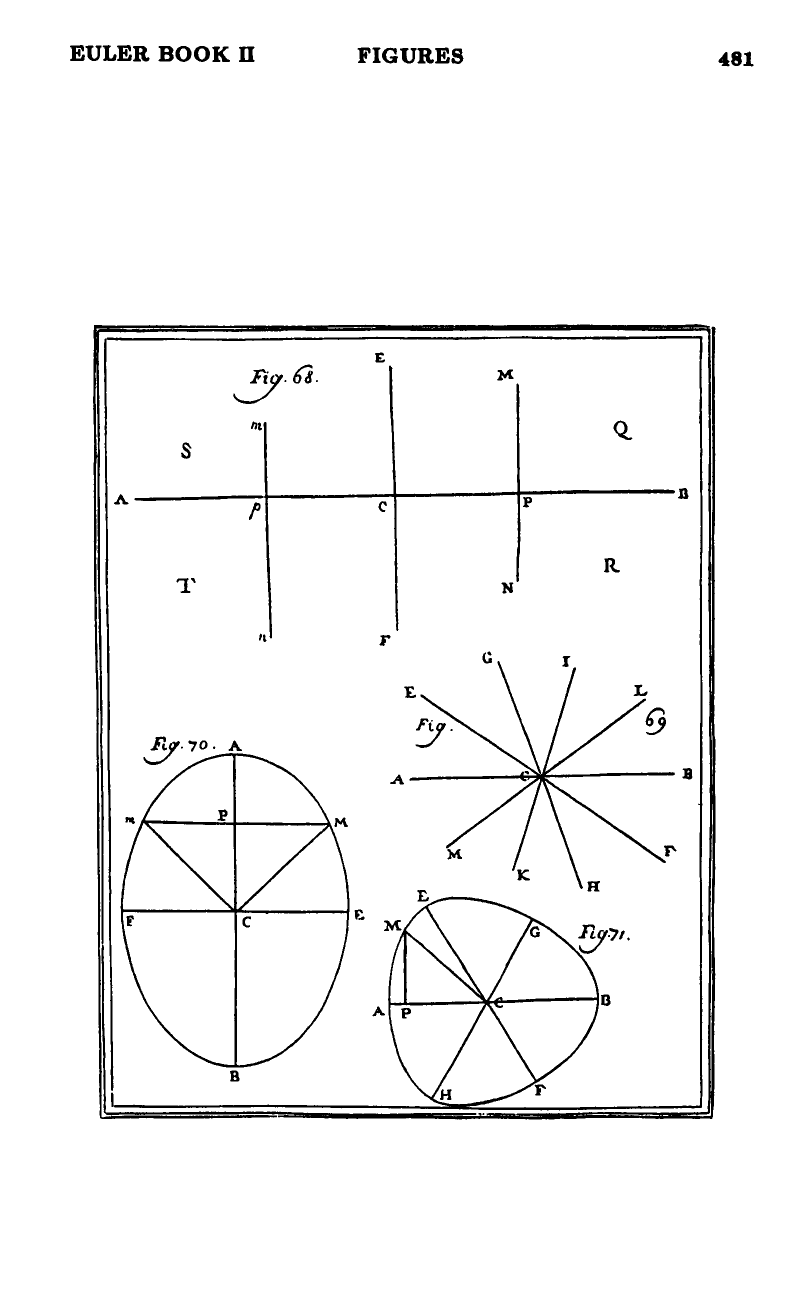 Figures 68–71
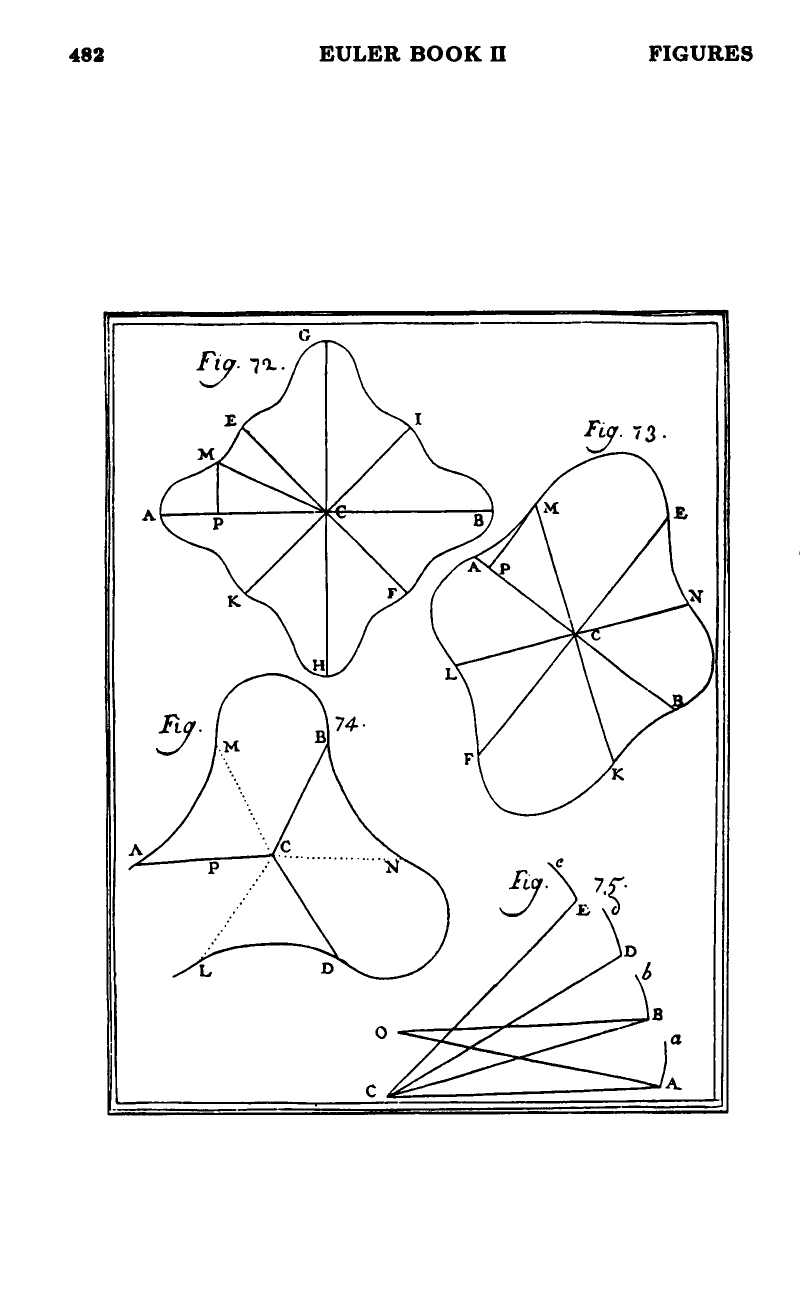 Figures 72–75
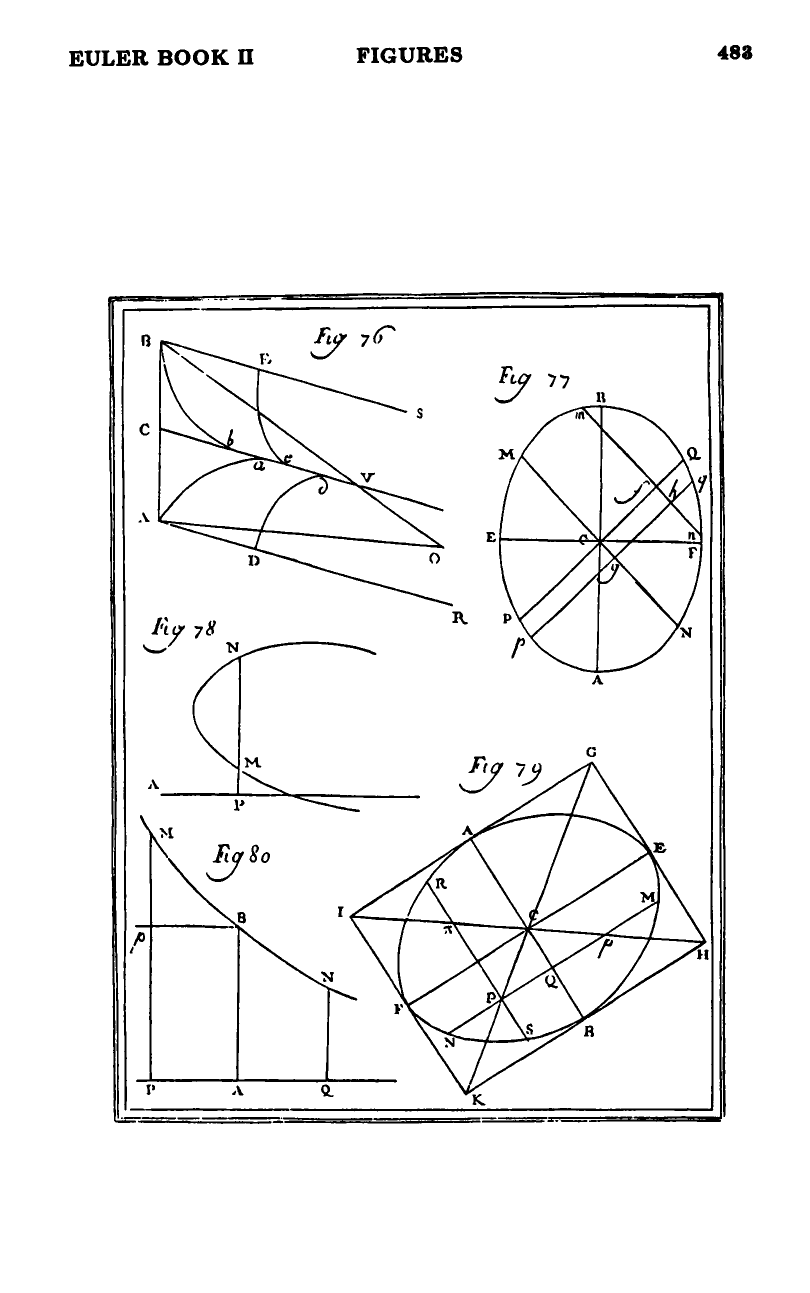 Figures 76–80
Related pages
- diameter-and-center-from-equation — §§337–343: parity conditions.
- concurrence-of-diameters — §§344–346: angle quantization, alternating kinds, no parallel diameters.
- n-diameters-by-cos-ns — §§347–354: polar Chebyshev derivation; simplest curves bounded by regular polygons.
- equal-parts-without-diameter — §§355–360: alternately equal classification.
- classification-of-equal-parts — §§361–363: completeness theorem.
- chapter-5-on-second-order-lines — the conic prototype.
- diameter-of-conic, center-of-conic — second-order origin of “diameter” and “center.”
- diameter-and-center-of-cubic — third-order diameter / center theory (sum-preserving, not orthogonal).