Concurrence of Several Diameters
Summary: If a curve has only two (orthogonal) diameters they must be mutually perpendicular (§344). With more than two, all diameters meet at a common point , and consecutive diameters are separated by equal angles (§§344–346). The diameters split into two alternating kinds — odd-indexed ones all play one role, even-indexed the other (§346). The angle between adjacent diameters must be a rational fraction of — otherwise the construction generates infinitely many diameters, which an algebraic curve cannot support (the only curve with infinitely many diameters is the circle) (§345). Furthermore no algebraic curve has two parallel diameters: a parallel pair would also force infinitely many, contradicting the bounded line–curve intersection count for algebraic curves (§345).
Sources: chapter15 (§§344–346); figure 69 in figures68-71.
Last updated: 2026-05-11.
The bootstrap argument (§344, figure 69)
Suppose a curve has two diameters and meeting at , not perpendicular. Argue forward:
- is a diameter, so the curve is symmetric across . The diameter on one side of must therefore have a mirror image on the other side, with .
- is now a diameter, so the curve is symmetric across . Reflecting the diameter across gives yet another diameter , with .
- Continue. Each step rotates by the fixed angle , producing diameters .
The process terminates only if some iterate returns to — i.e., if has a rational ratio to a right angle.
Why the angle must be (§345)
If is irrational with respect to , the bootstrap above generates infinitely many distinct diameters from a single starting pair. Each diameter is an axis of reflection, so the curve would have infinite symmetry — which forces it to be a circle, since every line through would then be an orthogonal diameter.
Conversely, in a circle every line through the center is an orthogonal diameter — innumerable, and consistent with the curve being a circle. The bootstrap thus describes the circle limit precisely.
For an algebraic (non-circle) curve, the bootstrap must close after finitely many steps, so for some integer — an aliquot part of , equivalently since for adjacent diameters.
No two parallel diameters
Suppose two diameters were parallel but distinct. The same kind of argument generates a third parallel diameter all separated by the same distance, then a fourth, and so on — infinitely many parallel diameters at the same spacing. A line transverse to all of them would meet the curve in infinitely many points, contradicting the line-curve-intersection-bound (a curve of order meets a line in at most points). Hence:
No algebraic curve can have two parallel diameters. (source: chapter15, §345)
Common point and alternating kinds (§346)
If finitely many diameters exist, they all intersect in a common point (since the bootstrap reflections all fix ), and they are equally spaced angularly. They come in two kinds, alternating in the cyclic order:
| Index | Examples | Role |
|---|---|---|
| odd | ”first kind” — equation in this axis has one form | |
| even | ”second kind” — equation in this axis has the form obtained by substituting |
Each kind shares the same equation when taken as the reference axis. The relevant invariance for the polar variable is (the original reflection) plus (reflection across the next diameter). The expressions invariant under both are functions of — the starting point for n-diameters-by-cos-ns.
Special cases by number of diameters
| Number of diameters | Angle between adjacent | Equal parts |
|---|---|---|
| 1 | (none) | 2 (e.g., parabola) |
| 2 | 4 (e.g., ellipse, hyperbola) | |
| 3 | 6 (figure 71) | |
| 4 | 8 (figure 72) | |
| finite | ||
| (every line) | — circle only |
Figures
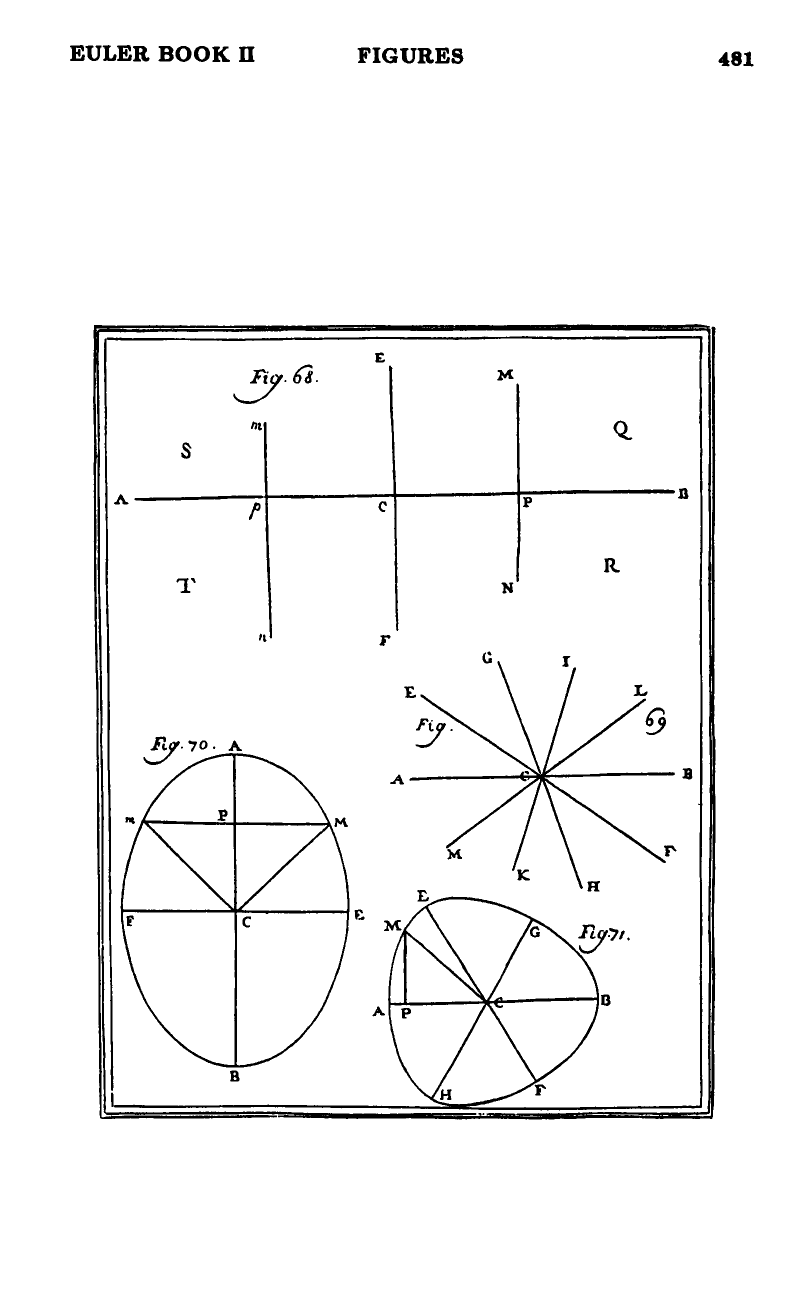 Figures 68–71
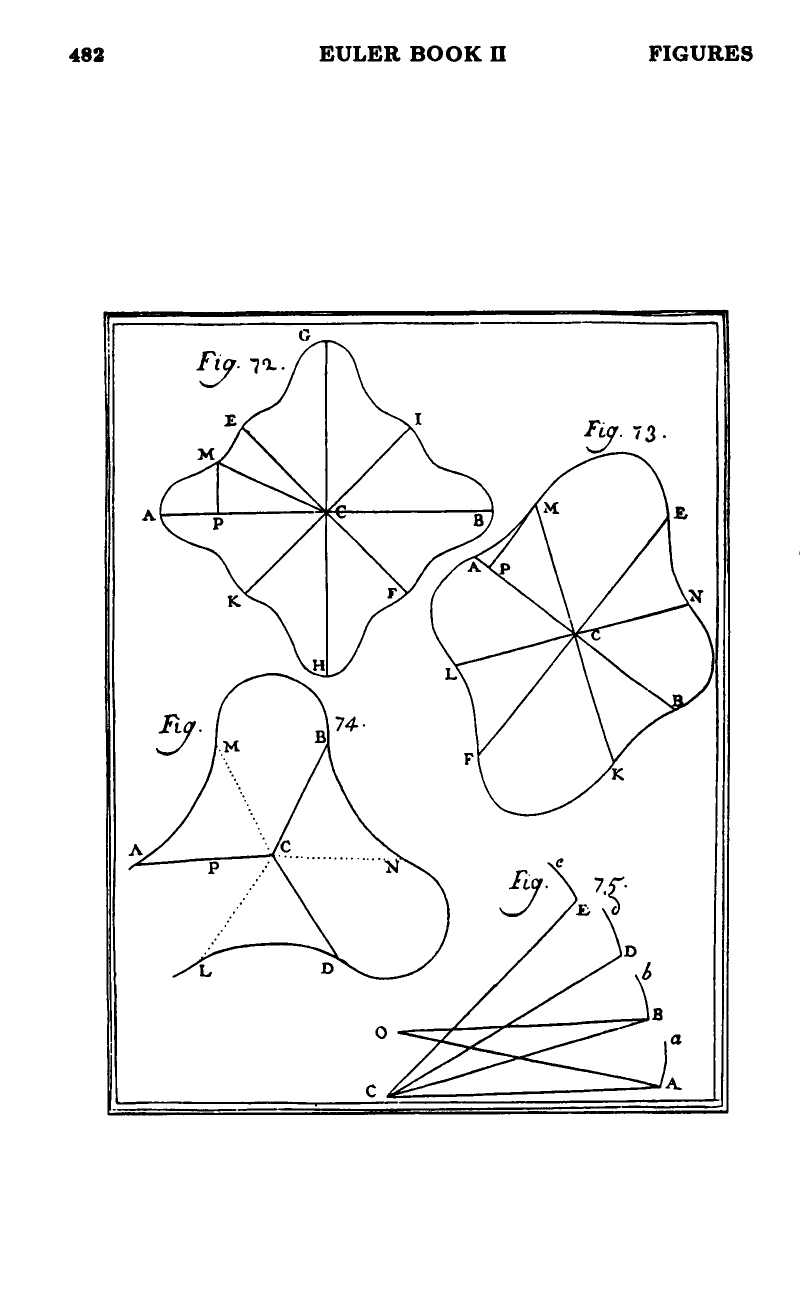 Figures 72–75
Related pages
- chapter-15-on-curves-with-one-or-several-diameters
- diameter-and-center-from-equation — the symmetry conditions that produce a diameter in the first place.
- n-diameters-by-cos-ns — what the equation looks like in polar coordinates once the angles have been pinned down.
- line-curve-intersection-bound — the bound that rules out two parallel diameters.
- asymptotes-of-hyperbola — the conic instance of “two diameters meeting at a center.”