First Species Cubic — Configurations
Summary: Euler unpacks the simplest first-species cubic from §258 into all its bounded-region varieties. Solved as a quadratic in the ordinate, the curve is governed by the quartic discriminant . Two real factors give an asymptotic curve with a single curl (figure 50); four distinct real factors give the same plus a separate conjugate oval (figure 51); double, triple, etc. factors collapse the oval into a conjugate point, then graft it onto the curve as a node (figure 52), then tighten the node into a cusp (figure 53). Five varieties in all — Newton counted each as a different species, Euler counts them as one.
Sources: chapter12 (§§273–277). Figure 49 (in figures47-50); figure 50 (in figures47-50); figures 51, 52, 53 (in figures51-54).
Last updated: 2026-05-04.
The simplest first-species equation
§273 — from §258 (simplest-oblique-cubic-forms) the first cubic species has, in oblique coordinates with as abscissa and as ordinate, the form
a quadratic in . Solving:
The radicand is a quartic in with leading coefficient , so it is negative for and must have at least two real roots. Everything depends on how many real roots this quartic has.
Variety 1 — two real roots (figure 50)
§§274–275 — the radicand has only two real roots, and . On the open interval both ordinates are real; outside it both are complex. So the curve lies entirely between the two vertical lines and in figure 49 (which sets up the labelling: vertical lines through points on the axis).
Where does the curve do at the origin? The denominator is , so is an asymptotic vertical line. But the numerator also has a determined behavior: at ,
so
So the branch goes to infinity along the -axis (the -axis is an asymptote), but the branch passes through the finite point . The curve is the S-shape of figure 50: an asymptotic branch hugging the -axis from below, swinging across through the point , and looping over to a tangential closure at on the right.
Variety 2 — four distinct real roots; conjugate oval (figure 51)
§276 — when the discriminant has four distinct real roots , the sign of alternates: positive on the central interval no — wait — the leading coefficient is , so the sign pattern from to is . The two positive intervals are and . The curve lives over both of them.
Over : real two-valued arc, closed off at and by tangential collapse — an oval bounded by vertical lines and .
Over : another real two-valued arc — an oval bounded by and .
The origin is between two of the four roots (Euler argues: since both ordinates at are real, lies in or in ). The asymptote at now joins one of the two arcs into the figure-50-style asymptotic curl. The other arc is left over as a self-contained oval, separated from the asymptotic branch:
“The curve consists of two parts which are separated; one lies between the straight lines and , while the other lies between the straight lines and . … In this case the curve has the configuration shown in figure 51, called a CONJUGATE OVAL, that is, it consists of an oval, called a conjugate oval, separated from the rest of the curve which is related to the asymptote .”
This is the first appearance in the chapter of the term conjugate oval.
Variety 3 — conjugate point ( and coincide)
§277 — let two of the four roots merge.
- ? Impossible: lies between and and would have to satisfy both roots, forcing , contradicting the assumption .
- : the conjugate oval shrinks to nothing — its vertical extent collapses because the two tangential closures fuse. What remains is a single isolated point lying on the axis at . This is the conjugate point (point isolé): a real solution of the equation that is not connected to any real arc. The picture is figure 50 plus an isolated dot on the axis.
Variety 4 — node ( and coincide; figure 52)
§277 — when the two interior roots merge, , the negative-sign interval between the two real-ordinate arcs disappears. The two arcs no longer separate: they touch at the common point on the axis. The asymptotic curl now has the conjugate oval grafted onto it through a single shared point. The two arcs cross transversally at this point, since the discriminant has only a simple zero of multiplicity 2 there (not a triple zero). This is a node — also called a double point (see multiple-points-on-curves). Figure 52 shows the configuration: the figure-50 curve has acquired a self-intersecting loop at the right.
Variety 5 — cusp ( all coincide; figure 53)
§277 — when three of the roots merge, , the loop of figure 52 tightens further: the two formerly separate ovals are joined not just at a transversal crossing but at a tangential one. This is a cusp (figure 53): the loop has shrunk to a single sharp point on the axis, with the two arcs of the curve approaching from opposite directions but along a common tangent.
Summary table
| # | Discriminant roots | Configuration | Figure |
|---|---|---|---|
| 1 | (2 real) | asymptotic curl (no oval) | 50 |
| 2 | all distinct | curl + conjugate oval | 51 |
| 3 | curl + conjugate point | (50 plus isolated point) | |
| 4 | curl with node | 52 | |
| 5 | curl with cusp | 53 |
“Hence there are five different varieties which find a place in the first species. Newton considered each of these to be a different species.” (§277)
This is one of the chapter’s two big editorial points (the other being the multiple-points classification, §282): the 72-vs-16 ratio between Newton and Euler in cubic species is doing exactly this kind of bookkeeping inside each of Euler’s species, which is why it inflates the count.
§278 — extension to the other cubic species
The same approach handles the other 15 species. Wherever one coordinate appears with degree no greater than 2, the discriminant-of-a-quadratic-in- argument applies. Euler does not enumerate this in detail; the chapter then turns to the general method and the singular-point classification that systematizes what these worked cases illustrate.
Figures
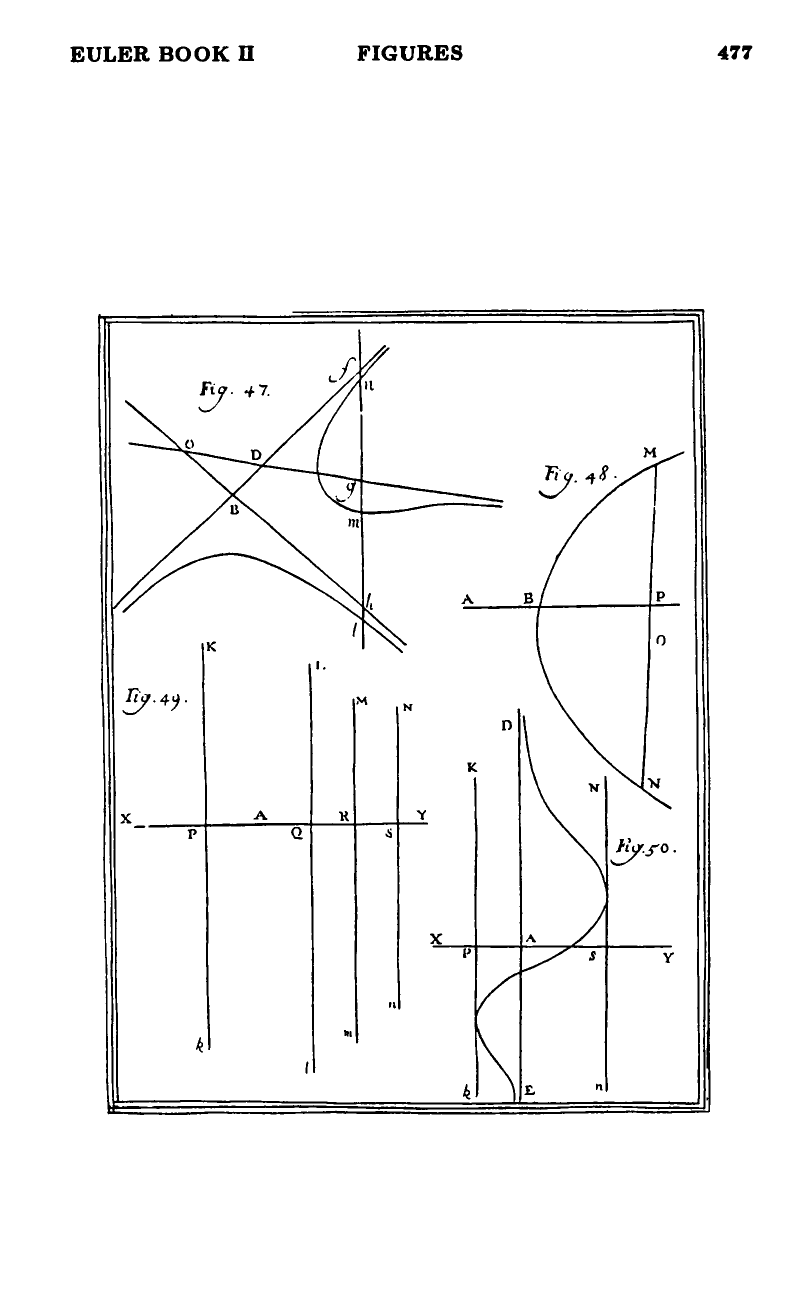 Figures 47–50
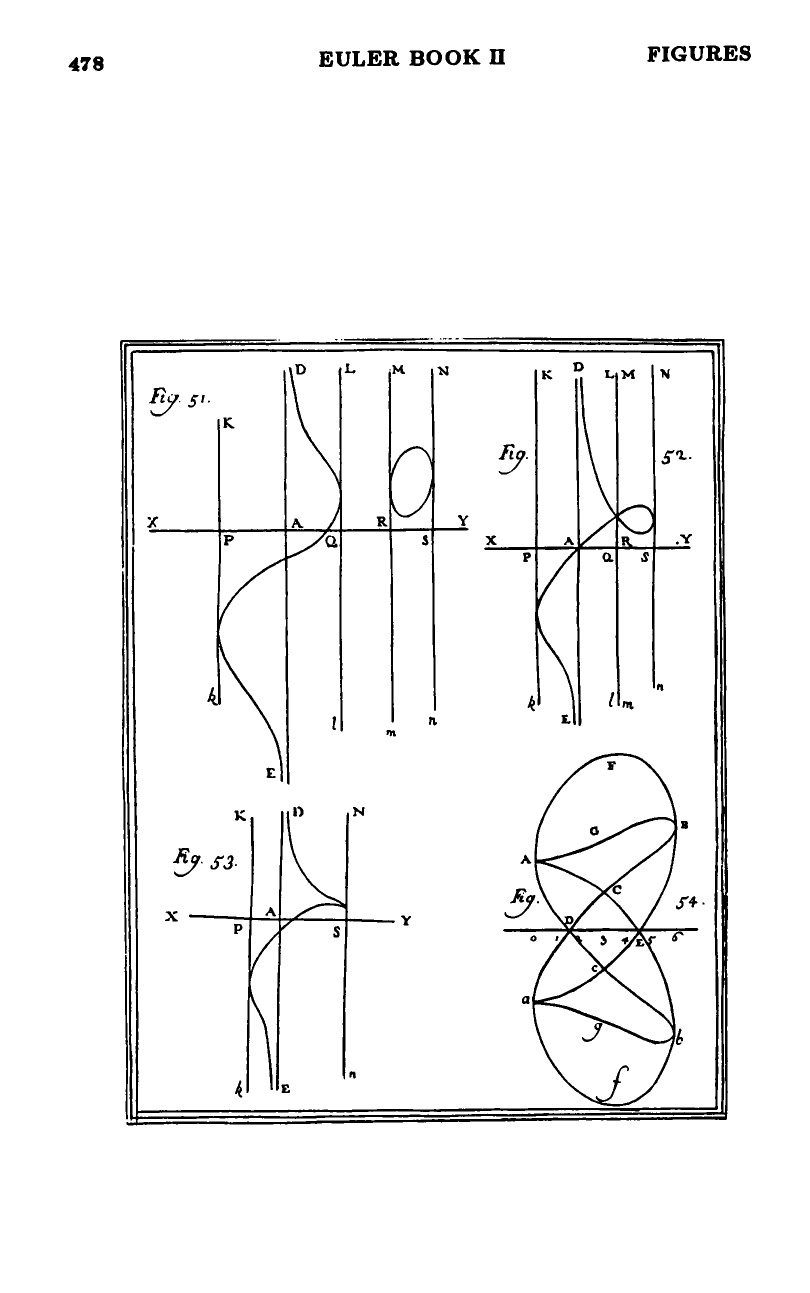 Figures 51–54
Related pages
- chapter-12-on-the-investigation-of-the-configuration-of-curves — chapter summary.
- configuration-from-discriminant — the general method this case instantiates.
- multiple-points-on-curves — node, cusp, conjugate point as a separate concept page.
- simplest-oblique-cubic-forms — §258, source of the equation worked out here.
- cubic-species-classification — the species this is the simplest of.
- euler-vs-newton-cubic-species — Newton’s “5 species” choice vs. Euler’s “5 varieties of one species” choice.