Cycloid
Summary: §§521–522. The path of a point attached to a rolling circle. Ordinary when the point is on the circumference (), curtate if inside (), prolate if outside (). Master equation with axis through the center of generation. Drawn as figure 105.
Sources: chapter21 §§521–522, figures103-105 (figure 105).
Last updated: 2026-05-12
Definition (§521)
A curve of this genus called a CYCLOID or trochoid, which is defined to be the path of a point on the circumference of a circle which is rolling along a straight line. (source: chapter21, §521)
The rectangular form Euler gives immediately is
The curve mixes a half-circle radical with the arc — square-root and inverse-cosine. This is what makes it transcendental.
General construction (§522, figure 105)
Generalize to a tracing point not necessarily on the circumference. Setup:
- Circle of radius rolls along the line .
- Tracing point lies on the extended diameter at distance from the center (so for ordinary, for curtate, for prolate).
- Initial position: circle is tangent to line at , with above, on the circumference, on the extension.
As the circle rolls so its center moves to position , with along the tangent line, the angle subtended at the rolling-circle center is . The tracing point has:
Drop perpendiculars and :
Hence . Extending to meet at and taking :
Using and :
Substituting back gives the explicit form
Centered form (§522)
Shift the origin to the center of the tracing-point-extended diameter. Let . Then and
When this is the ordinary cycloid.
Three species (§522)
| Species | Condition | Tracing point | Equation feature |
|---|---|---|---|
| Ordinary | On circumference | and | |
| Curtate | Outside circumference (on extension beyond) | throughout $ | |
| Prolate | Inside the circle | Same equation, smaller radical |
In all three, is an infinite-valued function of (or ) — any vertical line meets the curve in infinitely many points, unless (or ), when becomes complex.
Why it merits attention
This curve is worthy of note both because of the ease with which it is described, and also because of the many important properties which it possesses. Since most of these properties require analysis of the infinite for their explanation, we will now consider only a few which can be derived immediately from its description. (source: chapter21, §521)
Euler refers to the (then-recent) results on the cycloid being the brachistochrone and tautochrone, the rectifiability of its arc, and Pascal’s quadrature of its area — all requiring integral calculus.
Place in the chapter
The cycloid is the prize specimen of the circular-arc-curve genus, distinguished from the sine and tangent lines by its mechanical (rolling-circle) origin and its concrete physical importance (gear teeth, optimal-descent problem). The next section §523 generalizes the rolling motion from a straight line to a circle — epicycloid-and-hypocycloid.
Figures
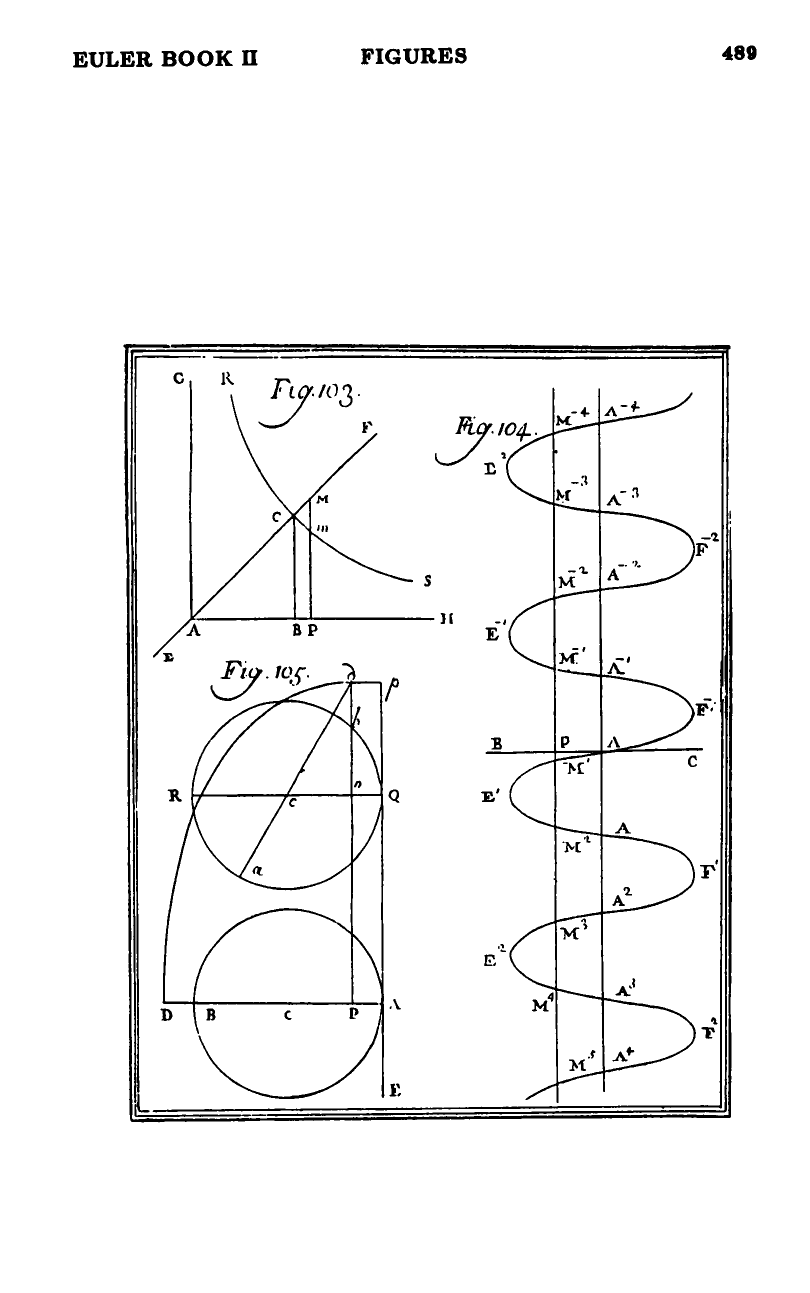 Figures 103–105
Related pages
- chapter-21-on-transcendental-curves
- sine-line — the same genus, simpler equation.
- tangent-and-secant-lines — same genus, distinct member.
- epicycloid-and-hypocycloid — natural generalization (rolling on a circle).
- arccos-log-curve — combines arccos with log; §525 generalization in a different direction.
- transcendental-curves