Sine Line
Summary: §520. The curve — the simplest transcendental curve of the circular-arc genus. Multi-valued: any vertical line cuts it in infinitely many points Leibniz’s name. Also the cosine line up to a shift. Drawn as figure 104.
Sources: chapter21 §520, figures103-105 (figure 104).
Last updated: 2026-05-12
The equation (§520)
Working in a unit circle (so arcs are dimensionless angles), the sine line has
i.e. is proportional to the arc whose sine is . Since for any sine value there are infinitely many arcs (differing by or by ), the ordinate is an infinite-valued function:
where is the shortest arc with sine . This is the defining feature: not only does the ordinate take infinitely many values, but every line through the curve cuts it in infinitely many points. Algebraic curves can never do this, because line-curve intersection is bounded by the curve’s order (line-curve-intersection-bound).
The figure (§520, figure 104)
Take as the axis with as origin (figure 104 has it vertical, but it could be either). At :
These are the labeled points on the axis. At :
— the labeled points on the vertical through .
The curve consists of infinitely many identical pieces , each spanning a height of . Two distinguished parallel lines and a mirror, passing through and at distances , are diameters (the curve is symmetric across each). The intervals all equal , as do the intervals
Leibniz called this curve the sine line, because it can be easily used to find the sine of any arc. (source: chapter21, §520)
Sine vs cosine
Setting in gives , so the same curve, with axis shifted by , is the cosine line. The two are coordinate translates of each other.
Place in the chapter
The sine line is the simplest case of “transcendental requires circular arcs”. The later §521 tangent-and-secant-lines ( and ) and §§521–522 cycloid are richer examples, and §525 arccos-log-curve mixes logarithms and arcs.
Figures
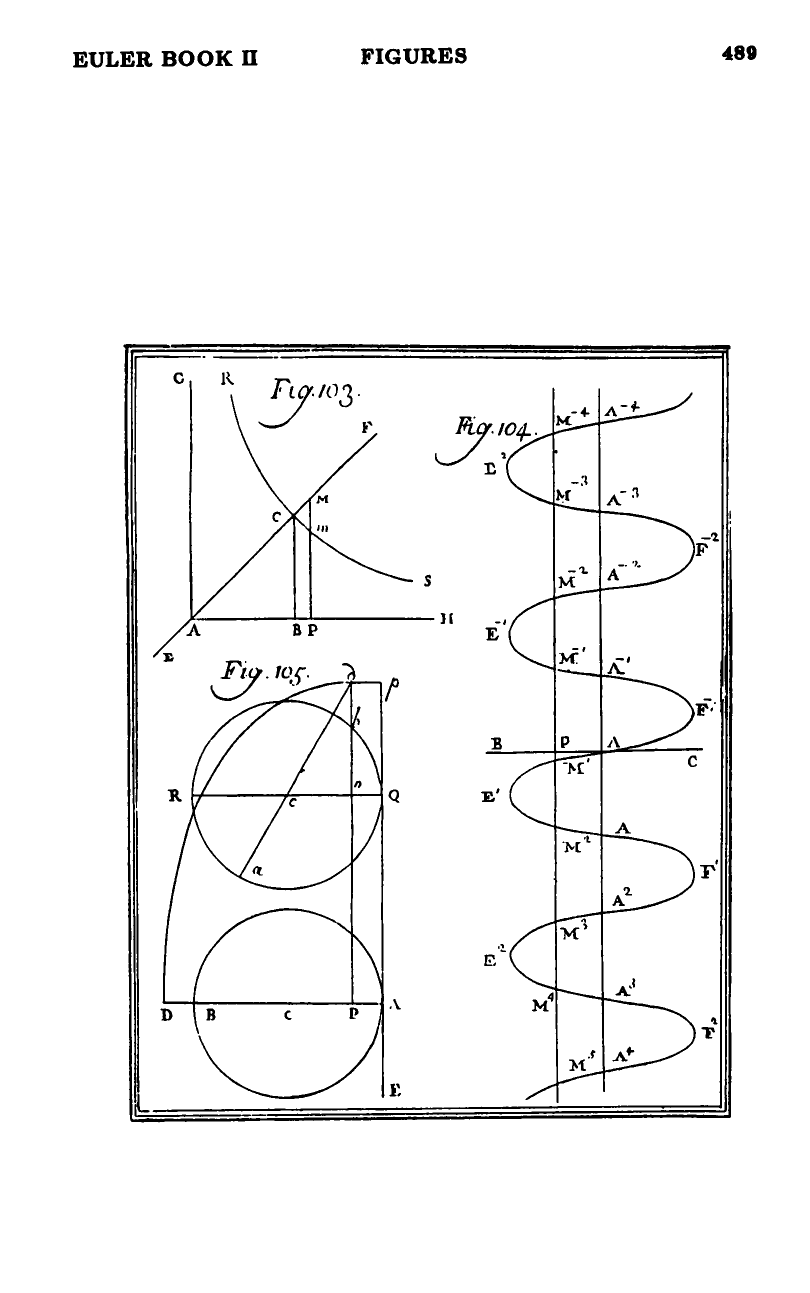 Figures 103–105
Related pages
- chapter-21-on-transcendental-curves
- transcendental-curves
- tangent-and-secant-lines — same genus, different inverse trig function.
- cycloid — distinguished member of the circular-arc genus.
- logarithmic-curve — analogous “simplest” curve of the logarithmic genus.
- line-curve-intersection-bound — the algebraic bound that this curve definitively violates.