Epicycloid and Hypocycloid
Summary: §§523–524. Curves traced by a point on (or extending from) a circle that rolls around the outside (epicycloid) or inside (hypocycloid) of a stationary circle. Parametric equations and analogue with sines. Algebraic when is rational; transcendental otherwise. Special case collapses to a curve through the center; yields the sixth-degree curve . Drawn as figure 106.
Sources: chapter21 §§523–524, figures106-108 (figure 106).
Last updated: 2026-05-12
Construction (§523, figure 106)
Setup:
- Stationary circle of radius , centered at .
- Moving circle of radius rolling on the outside, with center at distance from .
- Tracing point on the extended diameter of the moving circle at distance .
The desired curve uses as axis. From the initial position (where are collinear), the moving circle rolls so its contact point is at on the stationary circle, with arc subtending angle at . The moving circle is now in position , and since arcs rolled equal:
The angle (where is parallel to ) is therefore .
Drop perpendiculars and combine:
The center of the moving circle moves with , so
Setting (the new abscissa, distinct from the arc ) and and dropping the prime:
(Where here parametrizes by arc, and I am breaking Euler’s overloaded notation: he uses both for arc and abscissa.)
When is it algebraic? (§523)
It should be clear that if is a rational number, then because of the commensurability of the angle and , the unknown quantity can be eliminated so that it is possible to find an algebraic equation in and . In the other cases the curve described in this way will be transcendental. (source: chapter21, §523)
This is the central observation: rational ratio algebraic curve (the moving circle closes up after finitely many rotations); irrational transcendental (the path never closes).
Examples of the rational case. If (moving and stationary radii equal), — closes after one revolution, gives the cardioid (or epitrochoid for ). If , gives the astroid family.
Hypocycloid case
Here note that if we take to be negative, then the result will be a hypocycloid, since the moving circle lies inside the stationary circle. (source: chapter21, §523)
So the same formulas, with , describe the hypocycloid. Proper epicycloids/hypocycloids take (point on the circumference); gives the epitrochoid/hypotrochoid.
A useful identity (§523)
Squaring and adding:
This expresses in , useful for eliminating when and are commensurable.
Special case (§524)
If , the tracing point falls on the center of the stationary circle. The curves pass through . From the identity above:
Hence . From the parametric forms:
And , so
Sub-special case : then and the second factors simplify; let , so , , . Then
and
Let and square:
A sextic, hence algebraic for this rational-ratio case (consistent with ). Euler closes:
Since we are now concerned with transcendental rather than algebraic curves, we will leave this topic and move on to curves whose construction requires both logarithms and circular arcs. (source: chapter21, §524)
Figures
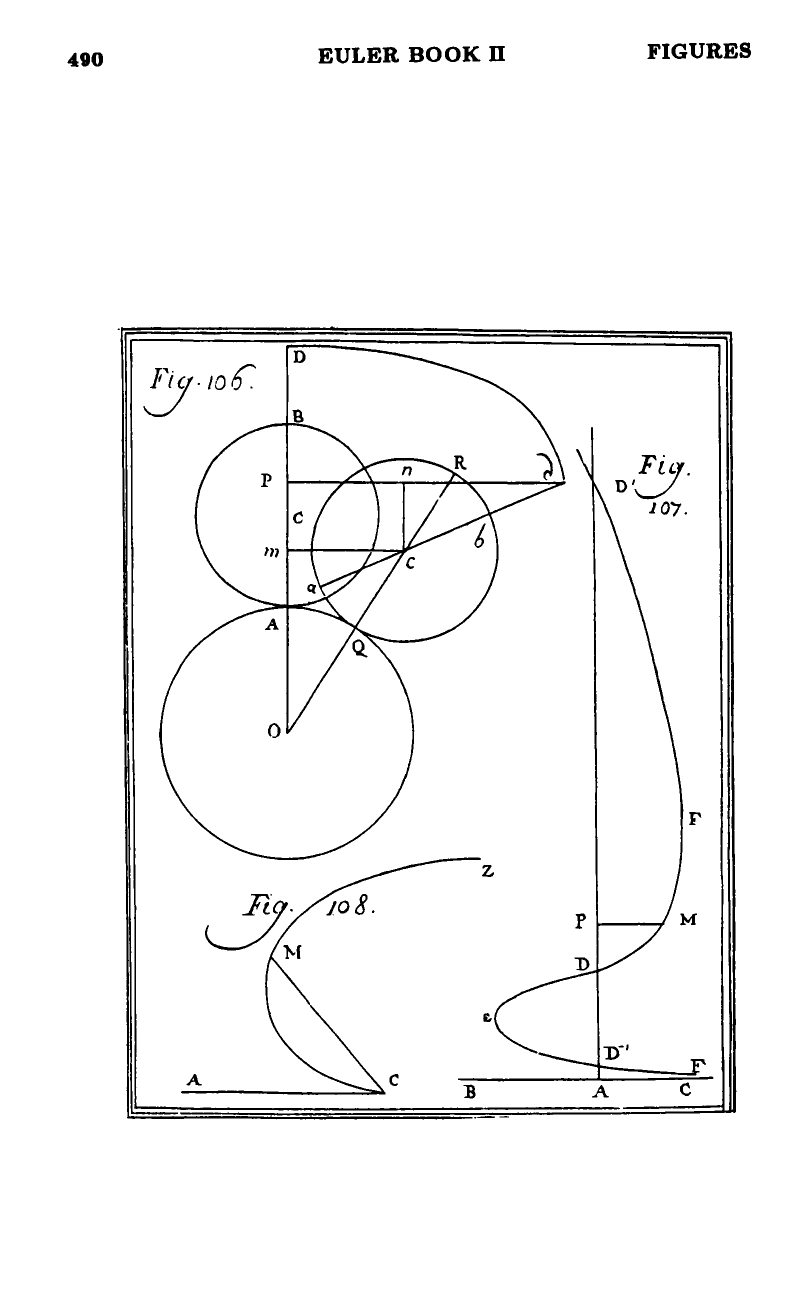 Figures 106–108
Related pages
- chapter-21-on-transcendental-curves
- cycloid — natural specialization (rolling on a line instead of a circle).
- arccos-log-curve — next member of the chapter’s catalogue, blending logs and arcs.
- similar-curves — affinity-and-similarity perspective on the rational/irrational dichotomy.
- transcendental-curves