The Curve
Summary: §525. The §511 curve inverted, written as or . Combines logarithms and circular arcs. The axis is met at (geometric progression). The curve oscillates and is tangent to two axis-parallel lines at points also in geometric progression. Asymptote is the finite interval , not an infinite line — a non-algebraic phenomenon. Drawn as figure 107.
Sources: chapter21 §525, figures106-108 (figure 107).
Last updated: 2026-05-12
Setup (§525)
The §511 complex-exponent curve collapses to . Solving for gives the inverted form:
Now is the abscissa, the ordinate. Negative is excluded (no continuous part there).
Geometric features (§525, figure 107)
Reading figure 107 (axis vertical, labeled , with inside the page):
Axis intersections ():
A geometric progression with ratio .
Inward intersections ():
Converging to as . These are also a geometric progression, with the same ratio .
Tangencies. The curve is tangent to two lines parallel to the axis through and (at distances — i.e. where , reaches its extremes and ). The points of tangency are stacked at distances from — yet again a geometric progression.
The remarkable asymptote. As oscillates and the curve loses amplitude (it doesn’t, actually — the stays bounded between , but the spacing of axis crossings grows geometrically), the inflections approach the interval at distance from the axis:
Furthermore, the infinite number of inflections of the curve approach the line and finally they move into that line. A particular characteristic of this curve is that the asymptote is not an infinite straight line, but the finite interval . This property of the curve keeps it from being an algebraic curve. (source: chapter21, §525)
The “asymptote” is a finite segment — a striking phenomenon that no algebraic curve can exhibit (where asymptotes are full lines or curves).
Why it qualifies as transcendental of mixed genus
The equation requires both:
- (or ) — for the relation between and the arc.
- — for the relation between and the arc.
So the curve sits at the intersection of the logarithmic genus (chapter 21 second cluster) and the circular-arc genus (third cluster). Euler treats it as the natural close of the catalogue before turning to spirals.
Place in the chapter
The §525 curve is the only mixed-genus example Euler presents, and it is included specifically because the §511 derivation already showed how complex exponents produce real curves involving both logarithms and arcs. The finite-asymptote phenomenon is its signature.
Figures
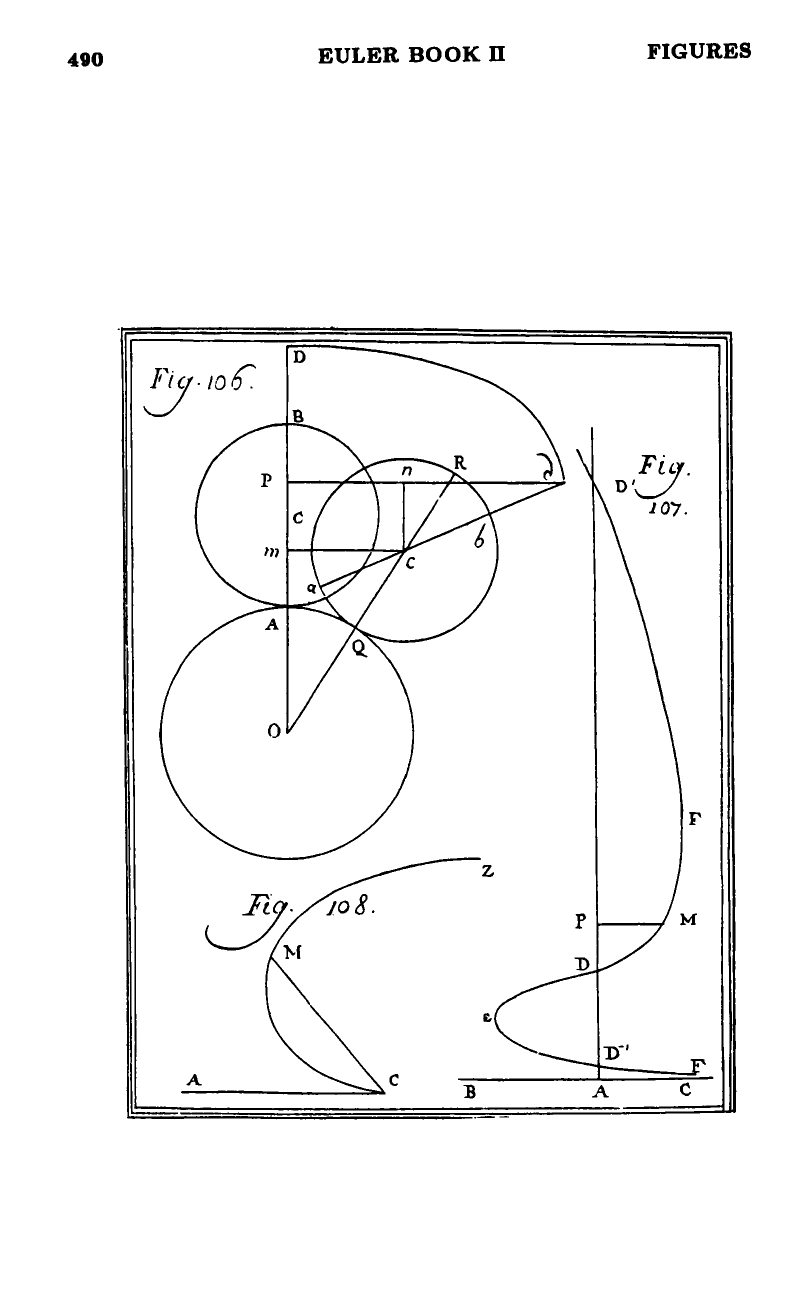 Figures 106–108
Related pages
- chapter-21-on-transcendental-curves
- transcendental-curves — §511 motivation: .
- logarithmic-curve — logarithmic-genus parent.
- sine-line, cycloid — circular-arc-genus relatives.
- transcendental-curves