Ellipse Sum-of-Squares Conjugate-Diameter Property
Summary: §368 of chapter-16-on-finding-curves-from-properties-of-the-ordinate. An elegant ellipse theorem: for any pair of conjugate diameters with circumscribed tangent parallelogram , the sum of squares of the two distances from the parallelogram’s diagonals to the ellipse, measured along any chord parallel to one of the conjugate diameters, is constant — equal to twice the squared semi-conjugate-diameter. Geometrically a refinement of conjugate-diameters; algebraically the instance of sum-of-ordinate-powers-curves.
Sources: chapter16 (§368). Figure 79 (in figures76-80).
Last updated: 2026-05-11.
Setup (figure 79)
Take an ellipse with conjugate diameters and (see conjugate-diameters for the definition: each one bisects all chords parallel to the other). Draw the parallelogram whose four sides are the tangent lines at . By the tangent-parallelogram theorem of §111, is a parallelogram whose sides are parallel to (sides ) and (sides ).
Now draw any chord of the ellipse parallel to the conjugate diameter . The chord meets the two diagonals and at points and . Similarly, draw any chord parallel to meeting the diagonals at and (figure 79).
The theorem
Equivalently: for any chord parallel to one conjugate diameter, measured from either diagonal of the tangent parallelogram, the sum of squared distances to the two intersections with the ellipse is constant, equal to twice the squared other semi-conjugate-diameter. Symmetrically, for chords parallel to :
Proof sketch (§368)
Work in conjugate-axis coordinates. Set , along the conjugate directions; let along the -direction and along the -direction. The ellipse equation in conjugate-axis coordinates is
i.e., the canonical ellipse in scaled coordinates (ellipse).
Let on diagonal have rectangular abscissa , and let parallel to meet the diagonal at with ordinate measured along . The slope of the diagonal in conjugate-axis coordinates is some ratio , so . Set (a single ratio). The chord parallel to has , equivalently and .
Substituting into the ellipse equation:
expanding,
Substituting , this becomes
This is exactly the curve equation of sum-of-ordinate-powers-curves for with replaced by — and so by Vieta, . Working it out:
Constant, as claimed.
Why “conjugate diameter” matters
The result fails for arbitrary diameter pairs — the constancy depends on and being a conjugate pair, which is what makes the chord-parallel-to-one bisected by the other, and what gives the parallelogram its tangent property at . The proof above used the conjugate-axis coordinate system, in which the ellipse takes its canonical form .
This is the algebraic reason: only in conjugate-axis coordinates is the ellipse equation symmetric enough that the Newton identity collapses to a constant.
Connection to the chapter
Inverse and forward directions:
- Forward (chapter 5): Given the ellipse, derive as a property of its conjugate-diameter chord pairs.
- Inverse (chapter 16, §368): Specify as the required property; the curve equation falls out as an ellipse with origin at center. §368 is presented in §368 explicitly as the forward direction “we obtain a rather elegant property of an ellipse” — Euler is showing that the inverse-problem result also explains a known elegant ellipse theorem.
Figures
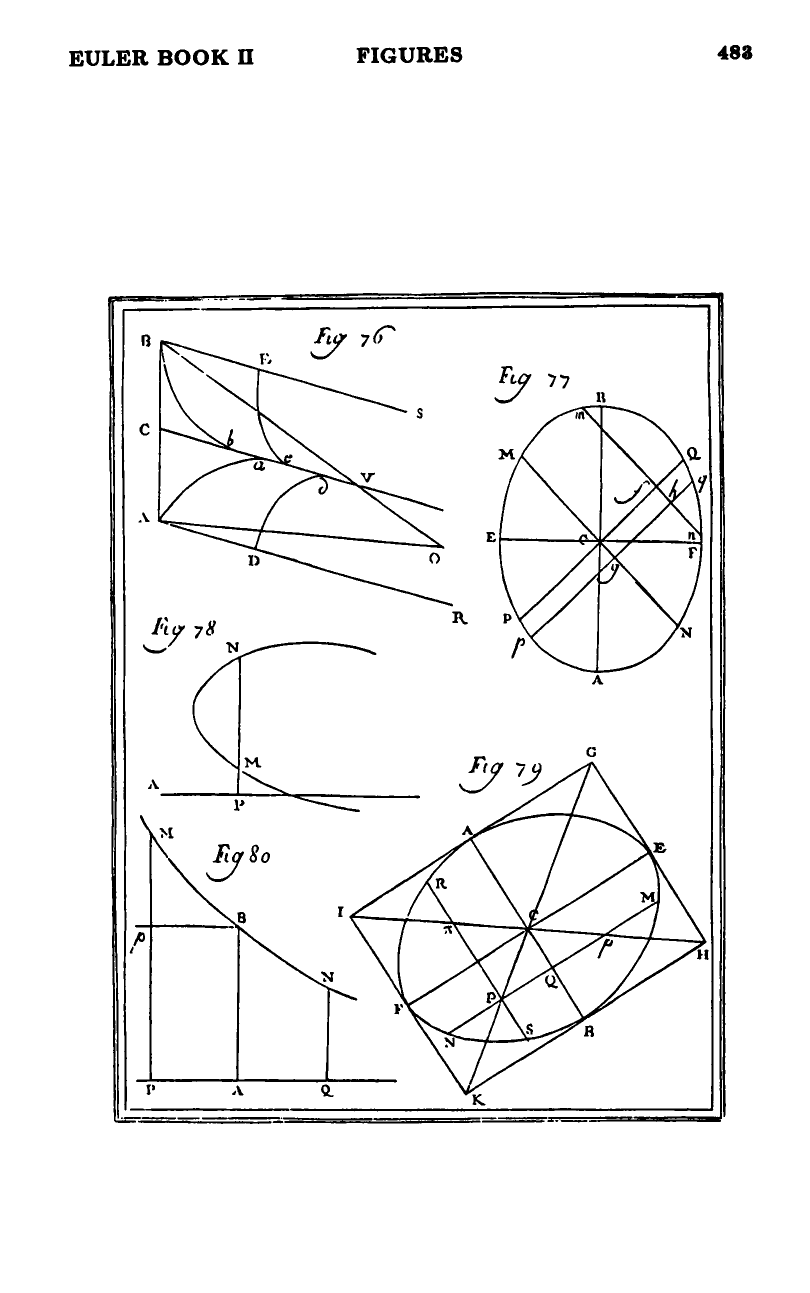 Figures 76–80
Related pages
- chapter-16-on-finding-curves-from-properties-of-the-ordinate — chapter summary.
- sum-of-ordinate-powers-curves — the general -th power family; §368 is the case.
- conjugate-diameters — chapter 5 definition and the tangent-parallelogram theorem.
- ellipse — canonical form used in the derivation.
- two-ordinate-sum-and-product — Vieta foundation used in the proof.