Two-Ordinate Sum and Product
Summary: The starting point of chapter-16-on-finding-curves-from-properties-of-the-ordinate (§§364–366). For any curve with non-irrational in , the two ordinates for each abscissa have sum and product (Vieta). Constancy of the sum gives a diameter, constancy of the product gives the chord-product property, and §365 packages all four conic species under one family. §366 records Pierre Variot’s prize-winning property of central conics.
Sources: chapter16 (§§364–366). Figure 19 (in figures19-22, hyperbola with asymptote as axis), figure 77 (in figures76-80, central conic with chords).
Last updated: 2026-05-11.
The Vieta setup (§364)
For an algebraic curve of the form
where are non-irrational functions of , each abscissa has either two real ordinates or none. By Vieta’s relations,
Sum and product of the two ordinates are encoded directly in the coefficients. Any symmetric function of becomes a polynomial in via Newton’s identities, which is what turns “inverse” problems (specify a symmetric property, recover the curve) into algebraic manipulation.
The four base cases
| Coefficient condition | Implication on ordinates | Geometric meaning |
|---|---|---|
| const | const | orthogonal diameter perpendicular to the axis (diameter-of-conic) |
| sum is linear in | oblique diameter where ordinates are bisected | |
| const | const | curve never meets the axis (the limiting case where would put a root on it) |
| factors as | , constant | chord-product property: ratio of ordinate-product to interval-product is constant (chord-rectangle-property) |
§365 highlights that the product-of-ordinates / product-of-intervals theorem of chord-rectangle-property — originally derived for conic sections — actually holds for any curve with a quadratic in that factors. Taking the chord that meets the curve at as the axis (figure 19, with the hyperbola asymptote example), the product has a constant ratio to across all parallel chords. Many higher-order curves inherit this property.
The unified conic family (§365)
Letting , the equation takes the form
(after rescaling). This equation gives all four conic species at once:
| Species | Geometry | |
|---|---|---|
| circle | ordinates perpendicular to the axis, right-angle property at | |
| ellipse | bounded, two intersections with parallel-chord direction | |
| parabola | borderline, asymptotic to a direction | |
| hyperbola | two-branched, two asymptote directions |
The case-split is exactly the discriminant of the quadratic in the highest-degree terms — same trichotomy as §131’s -sign in classification-of-conics, just in a different normalization.
Variot’s prize property (§366)
For any central conic with principal axes and (figure 77), draw two straight lines and each inclined at (“half a right angle”) to the principal axis , meeting at an interior point . Then
In particular, taking the two lines and through the center at : . Since this holds for every interior point , any pair of parallel translates of the two chords inherits the same equal-rectangle relation. Pierre Variot won an Académie prize for this theorem, hence the “prize-winning” tag (source: chapter16, §366).
A weaker variant of the same property: if and are drawn at the same angle to (so , hence ), then again . This case is just the chord-rectangle property of chord-rectangle-property applied to two equally-inclined chords; the genuine prize property is the specialization.
Reduction template for symmetric conditions
The pattern of §§364–366 is the chapter 16 template, repeated in higher strands:
- Write the condition on as a symmetric polynomial.
- Use Newton’s identities to convert it to a polynomial relation in .
- The relation pins down one of in terms of the other; the remaining one is freely chosen as a function of , generating an infinite family.
- The curve equation is then with the chosen (or ).
For sum = const this fixes , leaving free. For product = const this fixes , leaving free. The strand-2 and later analyses extend this to higher symmetric polynomials.
Figures
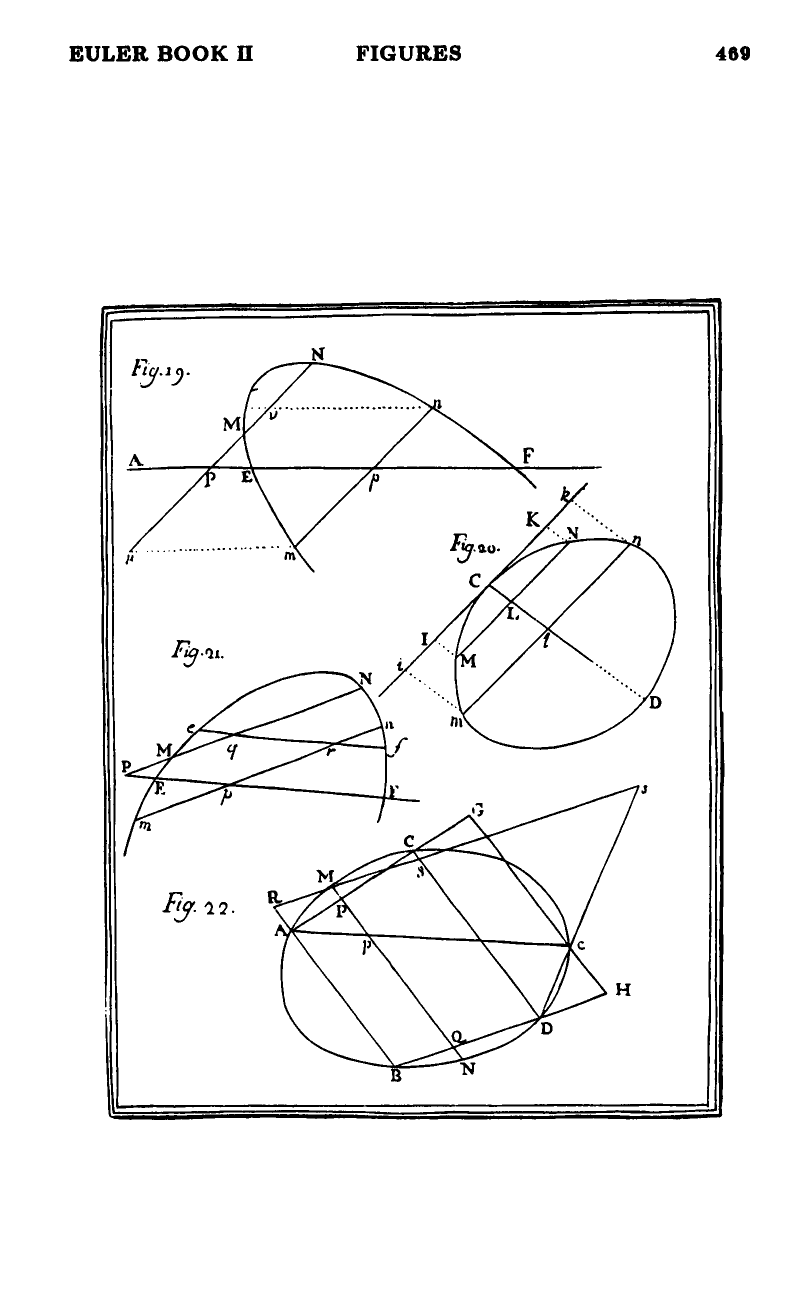 Figures 19–22
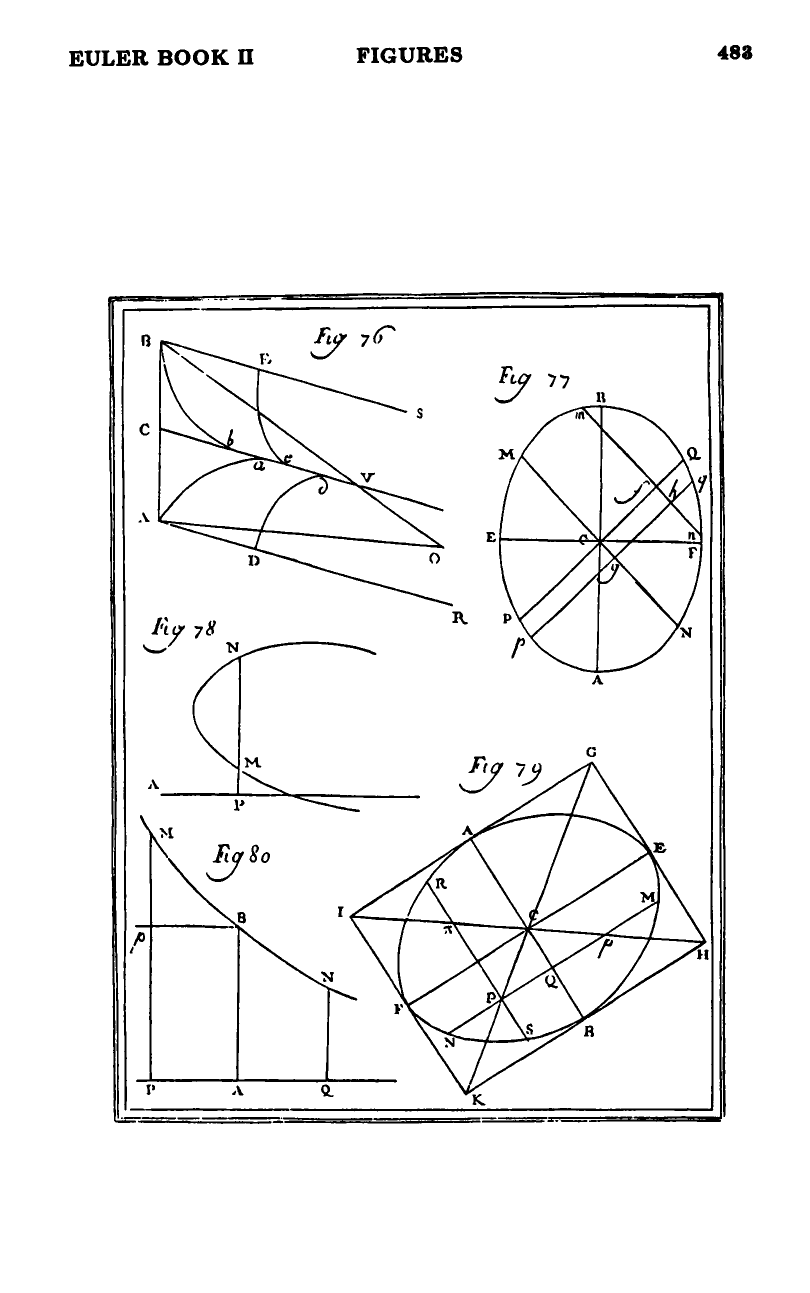 Figures 76–80
Related pages
- chapter-16-on-finding-curves-from-properties-of-the-ordinate — chapter summary.
- diameter-of-conic — chapter 5 forward direction: sum of roots gives the diameter.
- chord-rectangle-property — chapter 5 forward direction: product of roots gives the chord-rectangle.
- classification-of-conics — chapter 6 discriminant-sign trichotomy that matches the §365 unified family.
- sum-of-ordinate-powers-curves — §§367–373 extension to higher power sums.