Chapter 16: On Finding Curves from the Properties of the Ordinate
Summary: The inverse problem counterpart to chapters 5–15 (§§364–390). Where the earlier chapters started with a curve equation and read off ordinate properties — diameter, chord-rectangle, conjugate sums of squares — Euler now reverses direction: specify a symmetric property of the ordinates corresponding to each abscissa, and derive the curve equation. The master technique is Vieta’s relations. For a two-valued curve the two ordinates have sum and product , so any symmetric polynomial of them is a polynomial in ; demanding it equal a constant imposes one equation linking and and leaves the other free, generating a whole family of solution curves. The chapter walks this idea through five problem families: (1) Vieta basics — sum gives a diameter, product gives the chord-product property, with Pierre Variot’s prize-winning 45°-line property of conics as an instance (§§364–366); (2) the family via (§§367–373); (3) the ellipse’s sum-of-squares property on chords parallel to a conjugate diameter (§368); (4) three-valued curves with Newton-identity machinery for power sums, including a constant-perimeter / constant-area triangle from three ordinates (§§374–379); (5) relations between ordinates at symmetric abscissas , with a unified invariance principle “equation unchanged under and ” generating equal-sum and equal-product families (§§380–390).
Sources: chapter16 (§§364–390). Referenced figures 19 (in figures19-22) and 77–80 (in figures76-80).
Last updated: 2026-05-11.
The master idea
For any curve of the form
where are non-irrational functions of the abscissa , the two ordinates satisfy Vieta’s relations
Every symmetric polynomial in — in particular , , the squared-distance sum , etc. — is a polynomial in via Newton’s identities. So “demand that const” becomes “demand that const” — a single algebraic relation linking the two coefficients. Either or is then chosen freely as a function of , and the curve is the conic / cubic / higher-order object recovered from the resulting . Three-valued curves work the same way with one extra free function.
Strand 1 — sum and product of two ordinates (§§364–366)
The two simplest cases recover the chapter 5 conic theorems and immediately extend them:
| Condition | Implication | Reference |
|---|---|---|
| const | sum of ordinates constant → orthogonal diameter | diameter-of-conic |
| sum is linear in → oblique diameter | diameter-of-conic | |
| const | product of ordinates constant → curve never meets the axis | chord-rectangle-property |
| factorable | product-of-ordinates / product-of-intervals constant | chord-rectangle-property |
§365 then unifies all conics under one family: every curve is a conic — circle (, right-angle ordinates), ellipse (), parabola (), hyperbola (). §366 highlights Pierre Variot’s prize-winning property: for two lines drawn at to the principal axes of any central conic (figure 77), the rectangles of segments cut on those lines are equal. See two-ordinate-sum-and-product.
Strand 2 — sum of th powers (§§367–373)
For , expanding via Newton’s identities gives one relation between and :
| Newton expansion | Curve equation | |
|---|---|---|
| 2 | ||
| 3 | ||
| 4 | irrationality forces sign-choice resolution | |
| (general) |
The cleanest unified form is , expressing the obvious fact that if is one ordinate, the other is . An alternate cleanup uses for the other ordinate. The choice gives the ellipse
with origin at center. The choice gives a second-species cubic. Negative exponents (reciprocal sums) and fractional exponents extend the table; e.g., rationalizes to . See sum-of-ordinate-powers-curves.
Strand 3 — the conjugate-diameter sum-of-squares (§368)
A specific elegant case of strand 2 stands alone. For an ellipse with conjugate diameters and circumscribed tangent parallelogram (figure 79), any chord parallel to has
(with where meets the parallelogram diagonals). Symmetrically, any chord parallel to has . Algebraically: with , , the ellipse in conjugate-axis coordinates rotates back to exactly matching strand 2’s result. See ellipse-sum-of-squares-conjugate-diameter.
Strand 4 — three ordinates per abscissa (§§374–379)
Same idea with , three ordinates per abscissa, Vieta giving , , . Newton’s identities express any symmetric polynomial in these. Three problem types:
- Constant power sum : solve via Newton’s identity for the chosen , leaving two free coefficients. Negative integer via substitution.
- Constant root sum , , etc.: square or cube to chase out the radicals — eventually reducible but tedious.
- Constant triangle area via Heron: combined with (constant perimeter) gives the explicit third-order curve
with constant ordinate sum and constant triangle area . See three-ordinate-curves.
Strand 5 — ordinates at symmetric abscissas (§§380–390)
The previous strands related ordinates at the same abscissa. Now: relate at to at (figure 80). If is the curve equation, then and . Decompose with even and odd; then and .
| Required property | Solution | Geometric meaning |
|---|---|---|
| , odd | center at (rotational symmetry) | |
| , odd | th-power center | |
| , odd | ”alternately equal” about | |
| , odd | nth-power alternating |
The §388 master invariance principle: the desired equation should be unchanged under the simultaneous substitution and . From this, Euler builds the general form
with even and odd functions of . Multiplying through to clear fractions yields polynomial equations of indefinite degree , and tabulating for low orders recovers (§390) the straight-line, conic, and cubic solutions of the equal-product condition. See relations-at-symmetric-abscissas.
Method takeaway
Three reusable moves underlie everything in the chapter:
- Vieta + Newton’s identities translate any symmetric ordinate condition into one polynomial relation between
- The ” is one root, is the other” rewriting avoids ever computing the Newton identity explicitly, giving the cleanest equation form.
- Symmetry-driven invariance (§388): when ordinates at are related, an explicit substitution captures the condition, and the equation is built from terms invariant under that substitution.
These three moves anticipate the modern algebraic-geometry view that the ring of invariants — for a given group action on — pins down the equation.
Connection to other chapters
- Chapter 5 conic theorems (chapter-5-on-second-order-lines): the strand-1 sum-and-product story is the inverse of the §§87–100 diameter and chord-rectangle derivations. The strand-3 sum-of-squares (§368) is the inverse of conjugate-diameters.
- Chapter 10 cubic theorems (chapter-10-on-the-principal-properties-of-third-order-lines): strand 4 is the cubic analogue — Vieta now gives three sums, and chord-product-cubic (§247) appears here as a consequence of demanding = const.
- Chapter 15 symmetry classification (chapter-15-on-curves-with-one-or-several-diameters): strand 5 is exactly the polar-coordinate symmetry analysis from chapter 15 reframed in rectangular coordinates. The “alternately equal” curves of §381–388 are the family of equal-parts-without-diameter for ; the §388 invariance is a hidden change-of-variable that makes a curve with center at into one with center at .
- Newton’s identities: explicitly cited in §375’s power-sum table for three variables — the same identities ground both this chapter and chapter 5’s derivation of the chord-rectangle property.
Figures
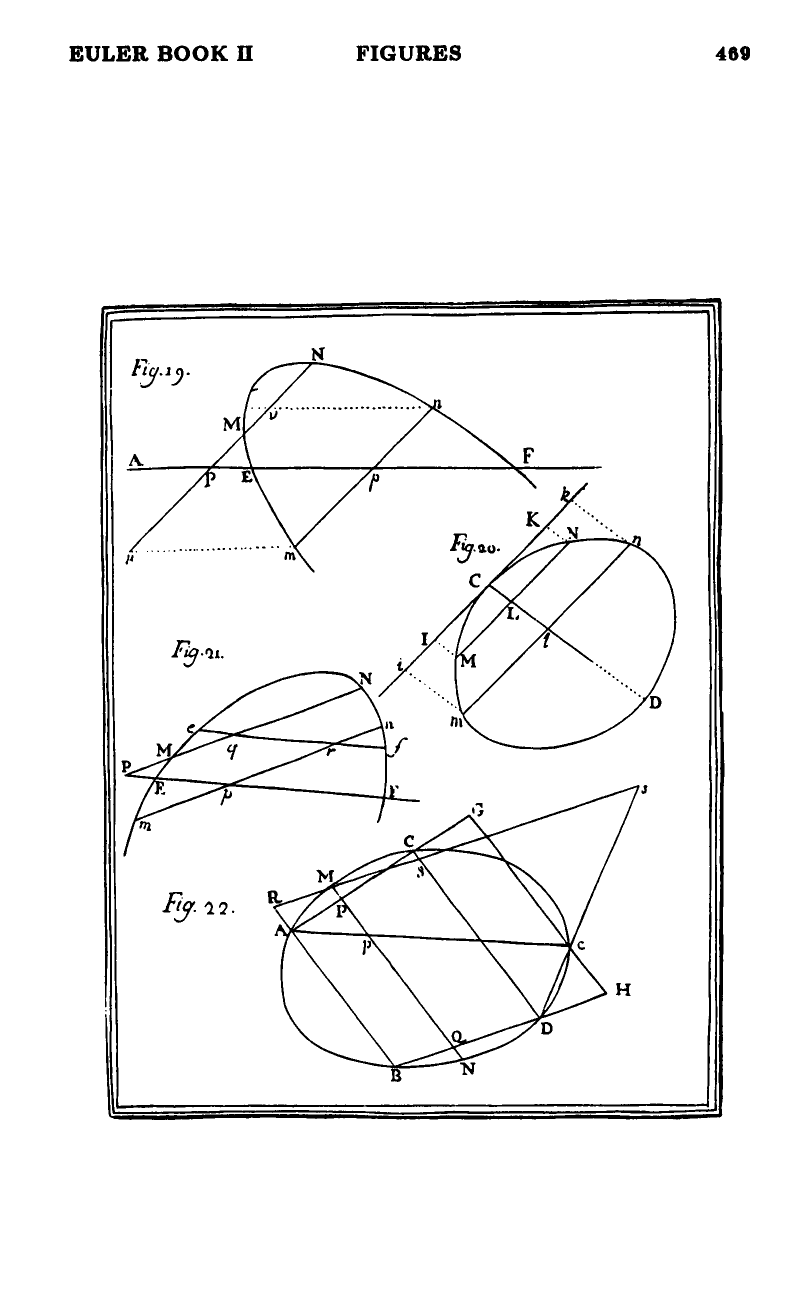 Figures 19–22
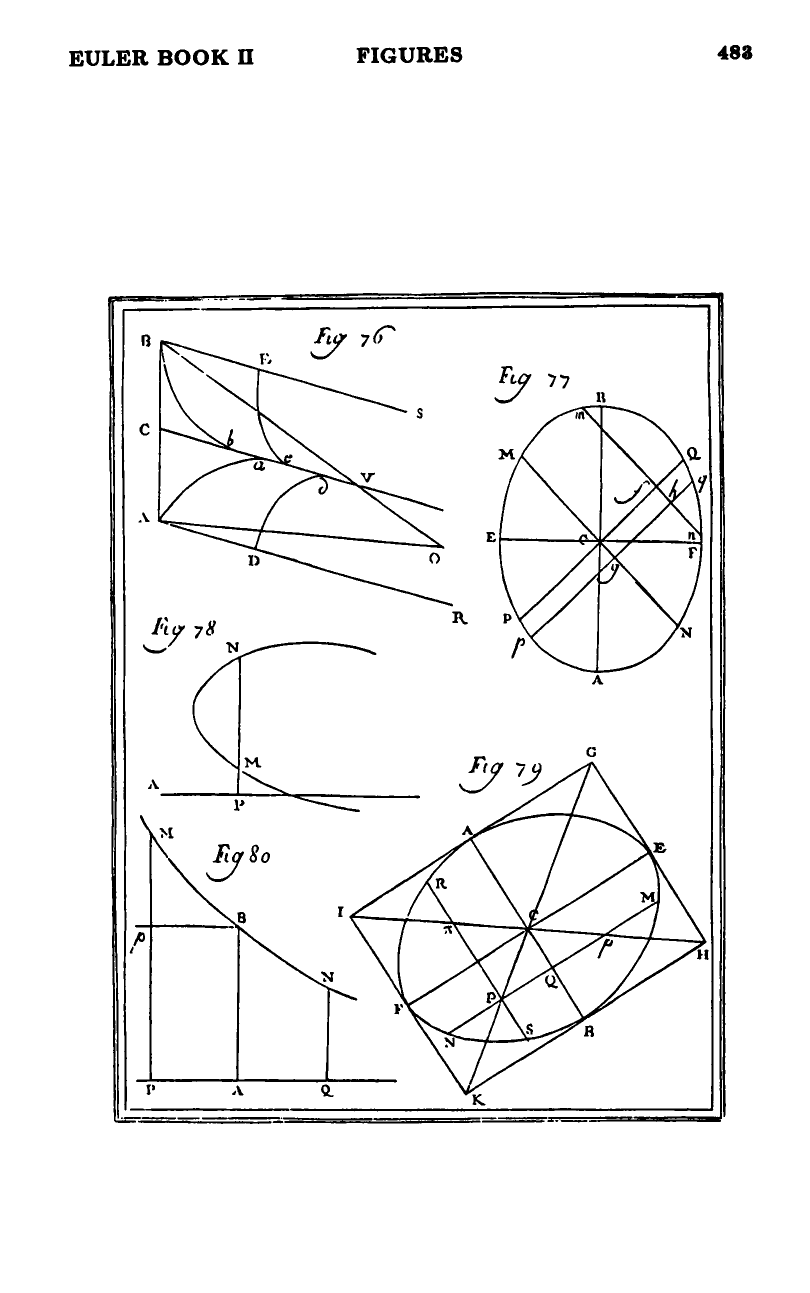 Figures 76–80
Related pages
- two-ordinate-sum-and-product — §§364–366: Vieta basics; diameter, chord-product, the unified conic family, Variot’s prize property.
- sum-of-ordinate-powers-curves — §§367–373: family; the master equation; fractional and negative exponents.
- ellipse-sum-of-squares-conjugate-diameter — §368: chord-parallel-to-conjugate-diameter sum-of-squares.
- three-ordinate-curves — §§374–379: cubic-in- curves; Newton’s identities; constant power sums, root sums, triangle area.
- relations-at-symmetric-abscissas — §§380–390: at vs at ; equal-sum, equal-product; §388 invariance principle.
- chord-rectangle-property, diameter-of-conic — chapter 5 forward-direction counterparts.
- chord-product-cubic — chapter 10 cubic analogue.
- equal-parts-without-diameter — chapter 15 link to the “alternately equal” family.