Conjugate Diameters
Summary: Two diameters and of a conic are called conjugate when each bisects all chords parallel to the other (§111). With the center as origin and any diameter as axis, the conic’s equation is , and the chord through the center parallel to the ordinates — the diameter with — is the conjugate of the axis diameter with . Under any oblique change of coordinates the conjugate-pair structure is preserved (§§112–115), and two metric invariants emerge: the parallelogram circumscribed about any conjugate pair has constant area (§§116–117), and the sum of squares of any pair of conjugate semidiameters is constant, (§§118–120).
Sources: chapter5 §§109–120, figures26-29 (figures 26, 27)
Last updated: 2026-04-25
Diameter and conjugate emerge from the center-form equation (§§109–111)
After the center is taken as origin and a diameter as axis, the conic’s equation reduces to (see center-of-conic §§109–110)
Setting gives the endpoints of the diameter on the curve:
Setting gives a chord through the center parallel to the ordinates:
Since passes through the center, it is itself a diameter (every chord through the center is a diameter — §107). The chord direction it bisects: by the diameter-construction logic of diameter-of-conic §91, the diameter bisects every chord parallel to the original chord direction — i.e., parallel to the original ordinates, which were parallel to (the original axis direction)… wait, this needs careful unpacking.
Actually, by symmetry of the equation :
- Fix , the chord at that abscissa has ordinates , symmetric about . So the line (the axis ) bisects every chord at fixed — i.e., every chord parallel to .
- Fix , the chord at that ordinate has abscissas , symmetric about . So the line (the diameter ) bisects every chord at fixed — i.e., every chord parallel to .
Each diameter bisects all chords parallel to the other: this is the conjugate property.
These two diameters, and , are related to each other in such a way that one bisects all chords parallel to the other. Because of this reciprocal property, these two diameters are called CONJUGATE. (source: chapter5, §111)
Tangents at the endpoints of a diameter (§111)
The same equation reveals: the tangent at (where is “extremal” as ) is parallel to , and the tangent at is parallel to . More generally, the tangent at the endpoint of any diameter is parallel to the conjugate diameter.
This is the coordinate-free statement: pick any diameter; the tangents at its two endpoints on the curve are both parallel to the conjugate diameter.
Oblique change of variables preserves conjugacy (§§112–115)
Take any oblique ordinate at angle to the axis, with , . New coordinates: , . Trigonometry on triangle (where with = original axis–ordinate angle) gives where , . Substituting into :
The new diameter for chords parallel to has the equation (sum of -roots = for midpoint at ):
So is a straight line through — confirming that every chord through the center is a diameter, in any oblique system (no surprise; just verifies §107).
Now compute the semidiameter lengths half the diameter parallel to direction (i.e., setting ? No, setting that direction as new axis); and semiconjugate.
After algebra (§§114–115): where is the angle between the new diameter and the old conjugate , is the angle between the old conjugate pair, and is short for the angle (so is not zero — it’s , an unfortunate notational collision in Euler’s text).
These are the lengths of the new conjugate pair in terms of the old conjugate pair. The pair is also conjugate — the conjugate-pair structure transforms covariantly.
Equal parallelograms (§§116–117)
From the formulas above,
Rearranging,
Now, is the angle at the center between the new conjugate pair , and is the angle between the old conjugate pair . The product is the area of the parallelogram with sides and — equivalently, twice the area of the triangle with vertices at the center and at the endpoints of the two semidiameters.
Geometrically: if we double each conjugate pair into a full diameter pair (or ) and circumscribe the parallelogram tangent to the conic at each endpoint (tangent at is parallel to , etc., by §111), the resulting parallelogram has area . So:
All parallelograms which are described around the pairs of conjugate diameters are equal to each other. (source: chapter5, §116)
This is one of the two classical metric invariants of a conic with a center.
Sum of squares of conjugate semidiameters (§§118–120)
Set , , (Euler’s notation, again collision-prone). From §119, after applying sum-to-product identities,
After simplification (a sequence of trig identities including ):
Hence
In any second order line the sum of the squares of two conjugate semidiameters is always constant. (source: chapter5, §119)
This is the second classical metric invariant.
Practical use of the invariants (§120)
Given two conjugate semidiameters and any other semidiameter , the conjugate to is computable:
This will be used in principal-axes-and-foci to find the orthogonal conjugate pair (the unique one for which the angle between them is a right angle).
Tangent construction at a general point (§118, figure 27)
Given conjugate semidiameters , choose any point on the curve and form parallel to to the axis (so is a semichord parallel to , with ). The tangent at is parallel to the conjugate semidiameter where
Hence the tangent direction is constructable from and the conjugate-pair sum of squares.
This is more than a curiosity — it is the construction of a tangent to a conic at any of its points using only the conjugate semidiameters, no calculus needed. It will lead in §§121–124 to the Newton tangent ratios.
The dual reading of
The reduced form has two coefficients that admit two interpretations:
- Diameter-and-conjugate reading. = semiconjugate, = semidiameter on the chosen axis.
- Coefficient reading. controls the “size” of the conic; controls its eccentricity along the chosen axis.
When , both semidiameters are real — the conic is closed (an ellipse). When , the axis-semidiameter is imaginary — Euler will read this as the curve having no real intersection with the axis (a hyperbola in disguise). The case-split is classified in chapter 6 by the sign of the discriminant.
Why “conjugate”?
The relationship is reciprocal: bisects chords parallel to and bisects chords parallel to . Each plays the same role for the other. This is unlike the diameter-chord pairing in general, where the diameter sits on one side and “the chord direction” on the other; for conjugate diameters, both lines are simultaneously diameters and both are simultaneously chord-directions for each other.
Algebraically, conjugacy expresses the symmetry of the equation under each of and separately, plus the swap when (giving the circle, where every diameter is its own conjugate’s mirror — see principal-axes-and-foci §127).
Figures
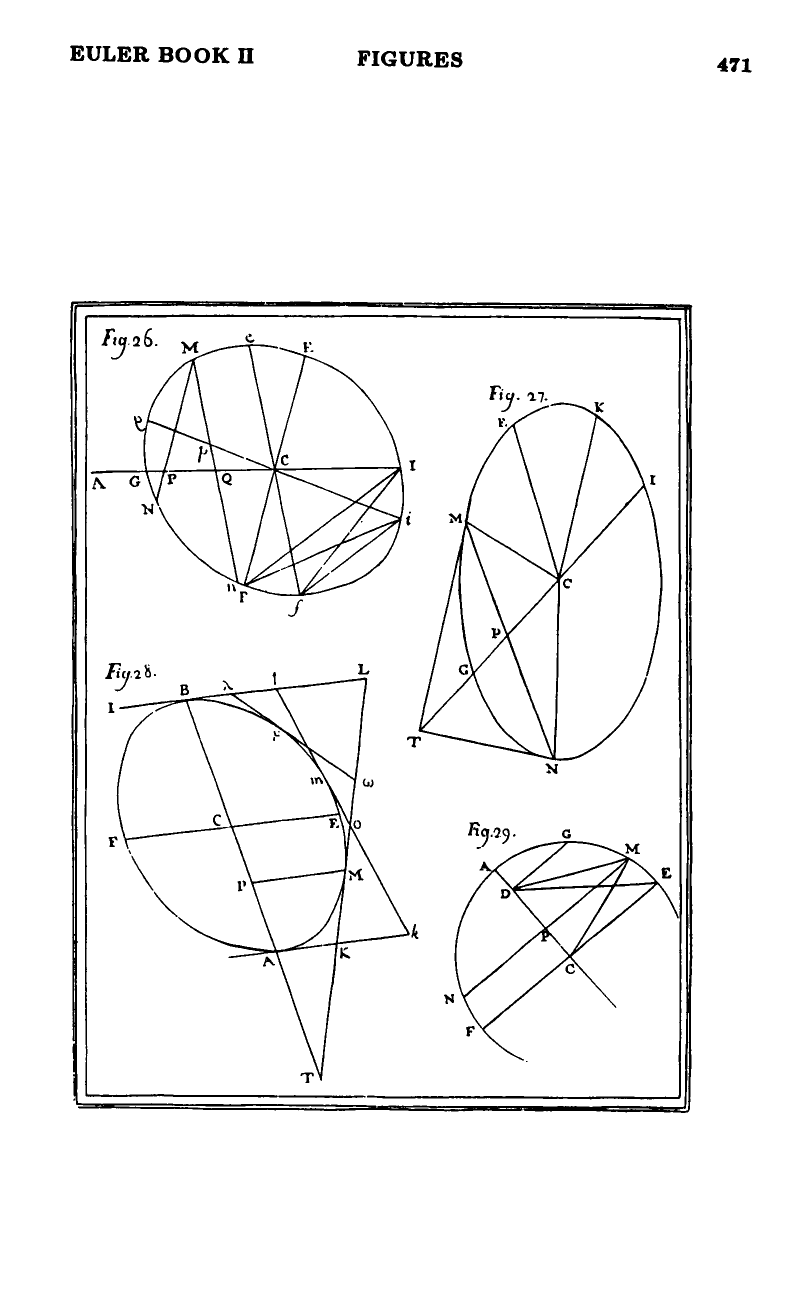 Figures 26–29
Related pages
- chapter-5-on-second-order-lines
- center-of-conic — every diameter passes through the center; the center is the origin for the reduced equation
- diameter-of-conic — definition of diameter as bisector of parallel chords
- principal-axes-and-foci — exactly one conjugate pair is orthogonal
- tangent-properties-conic — tangent construction at any point uses the conjugate pair
- chord-rectangle-property — companion algebraic strand (product of roots)