Sum of Ordinate Powers Curves
Summary: §§367–373 of chapter-16-on-finding-curves-from-properties-of-the-ordinate. Given the symmetric condition on the two ordinates of a two-valued curve , Newton’s identities pin down one polynomial relation in . The cleanest closed form is the master equation , expressing the fact that if is one ordinate then is the other. An alternate form uses the product instead. The equations extend to negative-integer and fractional exponents.
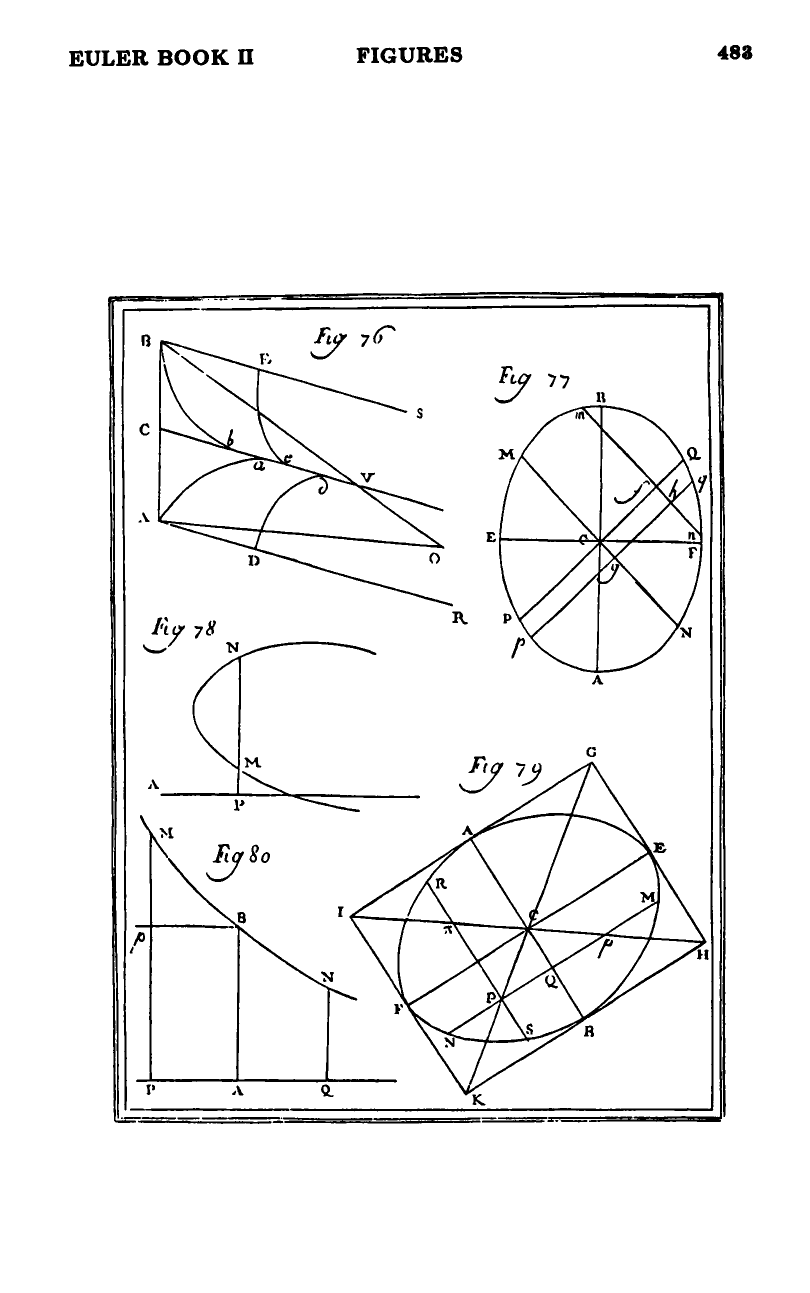
Sources: chapter16 (§§367–373). Figure 78 (in figures76-80) for the setup.
Last updated: 2026-05-11.
The problem (§367)
For each abscissa , let be the two ordinates (figure 78). We want curves with
for constant. Since and , Newton’s identities convert the condition to a polynomial relation in :
| Newton identity for | Required condition | |
|---|---|---|
| 1 | (the diameter case, two-ordinate-sum-and-product) | |
| 2 | , i.e., | |
| 3 | , i.e., | |
| 4 | ||
| (Newton expansion) | one polynomial relation linking |
Solving for in terms of gives the curve equation , with still a free function of .
The ellipse (§367)
With , choose (linear in ). The curve is
a conic. Solving the quadratic gives . The radicand is bounded, so the curve is an ellipse, centered at the origin (since the symmetry exchanges branches via reflection). This is exactly the ellipse — its two ordinates have constant sum of squares, an instance of ellipse-sum-of-squares-conjugate-diameter.
The cubic (§369)
With , the curve equation is
or after clearing the denominator and choosing , :
This is a third-order line. Euler notes it belongs to the second species of the cubic classification (see cubic-species-classification).
The irrationality (§370)
For , the relation solved for gives
The radical is generally irrational, but was required to be a non-irrational function of . Euler’s resolution: from , the value of cannot be real unless the radical is taken with the positive sign. With this sign choice, has only two values (despite being double-valued formally), as the problem requires.
The general master equation (§371)
The closed-form pattern for all is
with any single-valued function of chosen freely. The argument is immediate: if is one of the two ordinates, then is the other (since they sum to ). The condition thus reads directly.
For : ; since , the equation expands to , which is . Similarly for , and so on.
The alternate form via (§372)
Eliminating instead of : since , substitute into with as the other ordinate to get
equivalently . Solving the quadratic in ,
This is two-valued for each as required, provided is non-irrational. The advantage of the form is lower degree.
Tables for integer and fractional exponents (§373)
The chapter tabulates the cases for negative-integer reciprocal sums:
| Required property | Equation (using ) | Equation (using ) |
|---|---|---|
And for fractional exponents:
| Required property | Master equation | Rationalized form |
|---|---|---|
| , or | , or | |
| , or |
The general claim is: one equation covers all cases, whether is a positive integer, negative integer, or fraction. Equivalent forms in also exist.
Why the master equation is so clean
The clean form packages three ingredients:
- Vieta — the two ordinates are and , dual roles played by the two terms.
- No symmetric function machinery needed — the condition reads directly without Newton’s identities.
- Universality in — the same equation works for integer, fractional, and negative exponents.
This is the chapter’s prototype of “right-side-of-the-equation thinking”: rather than expanding to via identities, encode the condition const by substituting for the two roots.
Figures
 Figures 76–80
Related pages
- chapter-16-on-finding-curves-from-properties-of-the-ordinate — chapter summary.
- two-ordinate-sum-and-product — the (sum) and product cases.
- ellipse-sum-of-squares-conjugate-diameter — geometric meaning of the case for the ellipse.
- cubic-species-classification — the curve lives in the second species.
- chord-rectangle-property — chapter 5 forward-direction prototype.