Singular Points by Jet
Summary: When the linear truncation of the translated equation has both coefficients , the point is singular: no single tangent direction. The next non-vanishing homogeneous form classifies the singularity. Quadratic form : → conjugate point (vanishing oval); → node (two distinct tangent directions, figure 56); → tangent contact (cusp/tacnode). Cubic form classifies triple points, quartic form quadruple points, and so on. This is the jet-theoretic counterpart to chapter 12’s discriminant-collision approach to the same taxonomy.
Sources: chapter13 (§§293–298). Figure 56 (in figures55-60).
Last updated: 2026-05-07.
Set-up: when the linear part vanishes (§293)
Recall (from tangent-by-translation) that translating the origin to via , gives an equation
with the constants gone because is on the curve. When — i.e., both first-degree coefficients vanish — the linear truncation gives no tangent direction. Higher-degree terms cannot then be neglected: they are now the leading terms. Drop everything of degree to obtain
This homogeneous quadratic in is the second jet of the curve at .
The trichotomy on (§§294–296)
Solving for in gives
Three cases on the discriminant:
| Discriminant | Roots | Local picture |
|---|---|---|
| complex | conjugate point — is on the curve but isolated; vanishing oval | |
| two distinct real | node — two real branches cross at , each with its own tangent direction (figure 56) | |
| one repeated real | tangent contact (cusp/tacnode) — two branches share a tangent direction |
Conjugate point (§294)
If , the equation has no real solutions for except the trivial one . So is on the curve but no real arc passes through it — it is isolated, an oval shrunk to nothing. There is no tangent because a tangent requires two adjacent real points on the curve, while here there is only one. (This is the same conjugate point arising in chapter 12 as a vanishing oval.)
Node (§295)
If , the quadratic factors over the reals as giving two distinct linear equations and , each of which is the tangent direction of one of two real branches passing through (figure 56). The two branches cross at , making a double point in the sense of multiple-points-on-curves.
Since the equation always indicates a double point — whether the roots are real (node) or complex (conjugate point) — Euler treats both as “double points,” distinguished by the sign of the discriminant.
Tangent contact (§296)
If , the two factors coincide: so the two branches share the same tangent direction at . They are mutually tangent. is still a double point: a straight line through it in the common tangent direction is considered to cut the curve in two coincident points there.
In modern terms this case decomposes further once higher-degree terms are taken into account: a cusp (e.g. has lowest jet ) versus a tacnode (where two distinct arcs are tangent, e.g. ). Euler’s classification at the second-jet level does not distinguish these; both fall under “two branches mutually tangent.”
Summary: three species of double point
Whenever the equation we obtained in section 286 has both and equal to zero, we conclude that the curve has a double point, of which there are three species: an oval shrinks to a point (conjugate point); two branches intersect in a node; or two branches are mutually tangent. — §296
Higher-order jets (§§297–298)
If in addition , the next non-vanishing form is the cubic
This gives three (possibly complex, possibly equal) roots for :
- Three distinct real roots → three branches cross at , each with its own tangent direction. is a triple point.
- One real root, two complex roots → one branch through together with a vanishing oval glued at .
- Three real roots, two equal → two of the three branches are mutually tangent at .
- Three equal real roots → all three branches share a tangent direction.
In every case is a triple point: a straight line through in any tangent direction cuts the curve in three coincident points there.
If all vanish too, the next non-vanishing form is the quartic
classifying quadruple points by the multiplicity pattern of its roots: four distinct real → four crossing branches; two real + one complex pair → two branches with a vanishing oval; two complex pairs → two coincident vanishing ovals; et cetera. In general, if all forms up to degree vanish, the lowest non-vanishing form has degree and is a -fold point.
Connection to the discriminant-collision picture
multiple-points-on-curves derives the same taxonomy (conjugate point, node, cusp, triple/multiple) by a different route: as collisions of the real roots of the discriminant in the chapter-12 setup. The two views are dual:
- Chapter 12: read singularities off the discriminant as a function of .
- Chapter 13: read singularities off the lowest jet at the point.
Both produce the same list because they characterize the same local objects.
Why the recipe works
The argument generalizes the §288 argument for the tangent: when the curve is expanded around in , the local behavior near is dominated by the lowest-degree terms. If linear terms are present they fix a unique tangent line. If they are absent the next homogeneous form takes over and fixes a bundle of tangent directions — one for each linear factor over . The number of distinct real factors is the number of real branches through ; coincident factors signify tangency among branches; complex factors signify isolated (conjugate) ovals.
Figures
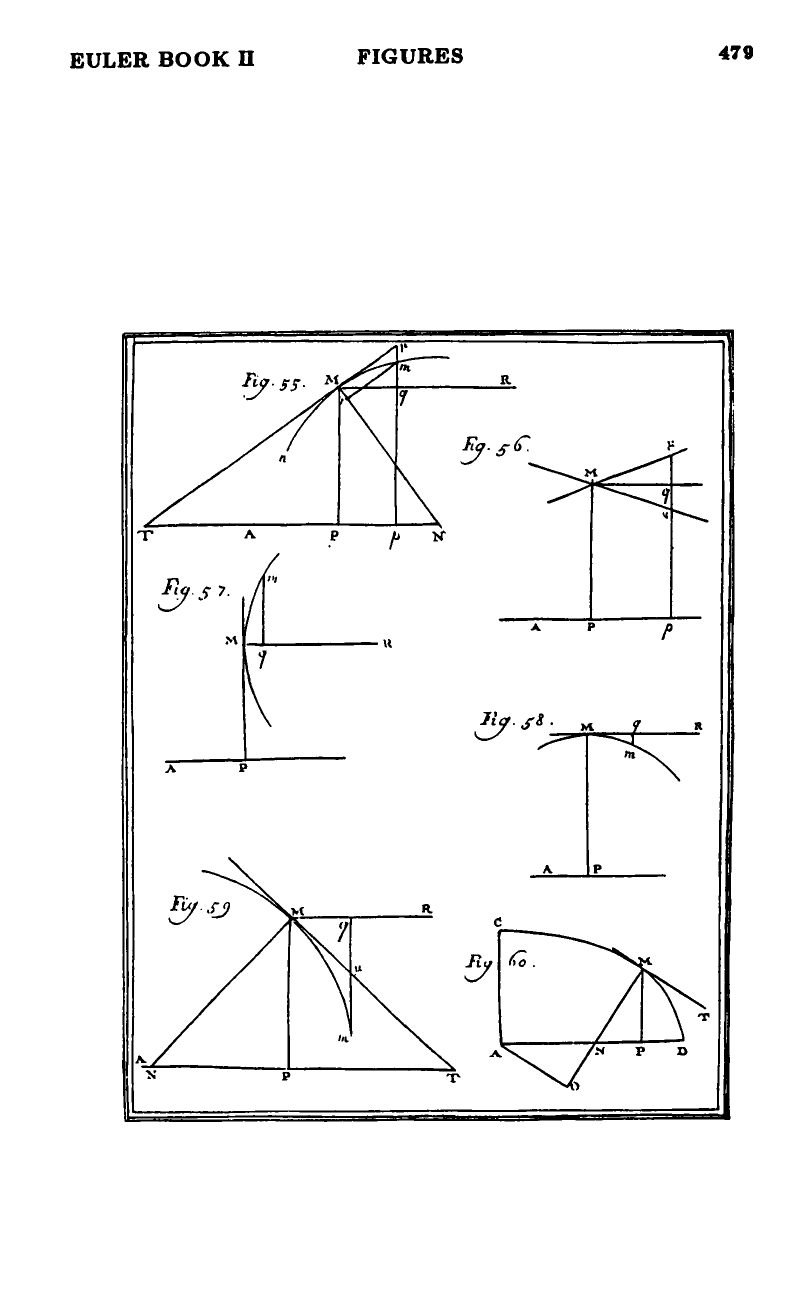 Figures 55–60
Related pages
- chapter-13-on-the-dispositions-of-curves — chapter summary.
- tangent-by-translation — the linear case (when the lowest jet has degree 1).
- multiple-points-on-curves — chapter 12’s discriminant-collision derivation of the same taxonomy.
- general-equation-multiple-point — synthetic counterpart: equations that prescribe a -fold point.
- first-species-cubic-configurations — explicit cubic instances of conjugate point, node, and cusp arising from this analysis.