Constant Chord Interval and the Conchoid of Nicomedes
Summary: §§410–418. The headline of chapter 17. Starting from and generalizing to , Euler arrives at the case const — equivalently the interval is constant — and gives two polar solutions: (three varieties: conjugate point at for , cusp for , node for ; figures 83–85) and , which is the conchoid of Nicomedes (figure 86). §§417–418 extend the construction to a conchoidal-genus family in which any single-intersection curve serves as directrix (figure 87).
Sources: chapter17 §§410–418; figures 83–85 in figures81-85; figures 86–87 in figures86-89.
Last updated: 2026-05-11.
(§§410–411)
Since and , we have , so . Substituting and :
which after substituting and clearing denominators gives
If this collapses to — a circle with at the center, which trivially satisfies .
§411 lists explicit fourth-order specializations:
- , : .
- , (divide by ): .
Every even order provides such a family, and a second family for orders when is divisible by .
The unified family (§§412–413)
Identity: . Setting this to gives , hence
giving the general equation
A second general form is obtained by letting :
§413 specializes:
- : constant. Both equations are homogeneous in , so they force to share a linear factor — meaning the curve is a pair of lines through , not a genuine curve. Confirms the §405 impossibility.
- : const — i.e., the interval is constant. This is the rich case.
Constant interval : the four-line family (§§413–414)
Setting gives , hence
The simplest case in the first equation: , :
With this rearranges to
Transforming to polar coordinates with recovers the clean form
The simplest case in the second equation gives the other clean polar form
Three varieties from (§415, figures 83–85)
The geometric construction: draw line through with ; from measure in both directions on to find (so ). For any line through at angle , drop perpendicular from ; on from measure in both directions. The points are on the curve, with always. The diameter is , and the normal line through has length .
Three sub-cases:
| Case | Geometry at | Figure |
|---|---|---|
| is a conjugate point (isolated point off the rest of the curve) | 83 | |
| is a cusp; the interval vanishes | 84 | |
| is a node (double point); lies between and | 85 |
These are exactly the three local types from multiple-points-on-curves and first-species-cubic-configurations, here all instantiated in the same one-parameter family.
The Conchoid of Nicomedes from (§416, figure 86)
Construction: principal line through with and , so are on the curve. Draw the normal line through . For any line through meeting at with , . Then in both directions on gives points on the curve.
This is the classical conchoid of Nicomedes, with as pole and as the directrix (asymptote). The curve has four branches converging to at infinity; the upper part is the exterior of the conchoid, the lower part is the interior; and there is a conjugate point at .
The conchoid was used by Nicomedes (c. 200 BCE) for trisecting angles and duplicating the cube; Euler’s contribution is to derive it inversely as the unique constant-chord-interval companion to the line-directrix.
The conchoidal genus (§§417–418, figure 87)
§417 generalizes: replace the polar-line with any single-intersection curve (where is odd in , as in curves-from-polar-coordinates). Then has the constant-interval property too.
§418 illustrates with figure 87: is an arbitrary single-intersection curve; on each line through , measure on either side of on that line; the locus of all such is the conchoidal-companion curve , which still has .
When the directrix is a circle through , the resulting curve is the same fourth-order one from §414 (with ). This furnishes one of the earliest unifications of the conchoid and the limaçon of Pascal as cases of the same conchoidal-genus construction.
Figures
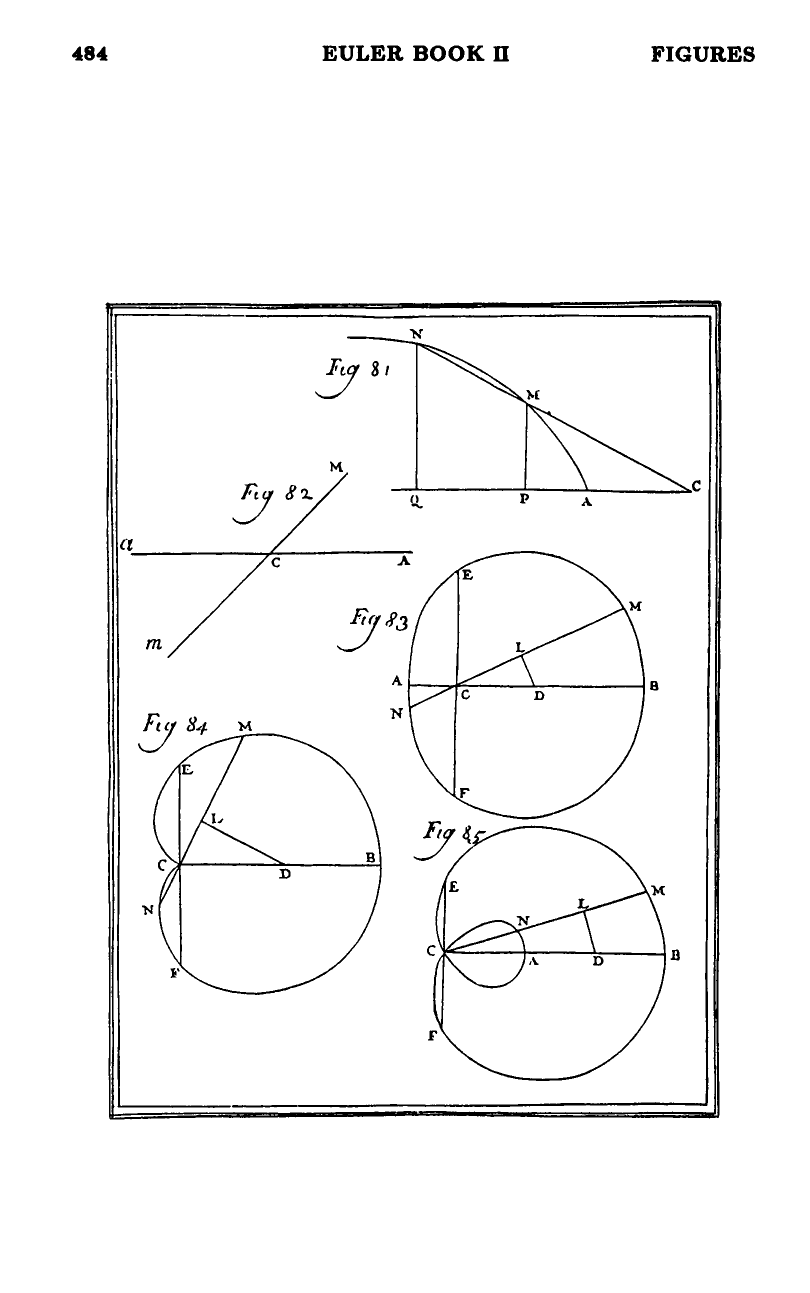 Figures 81–85
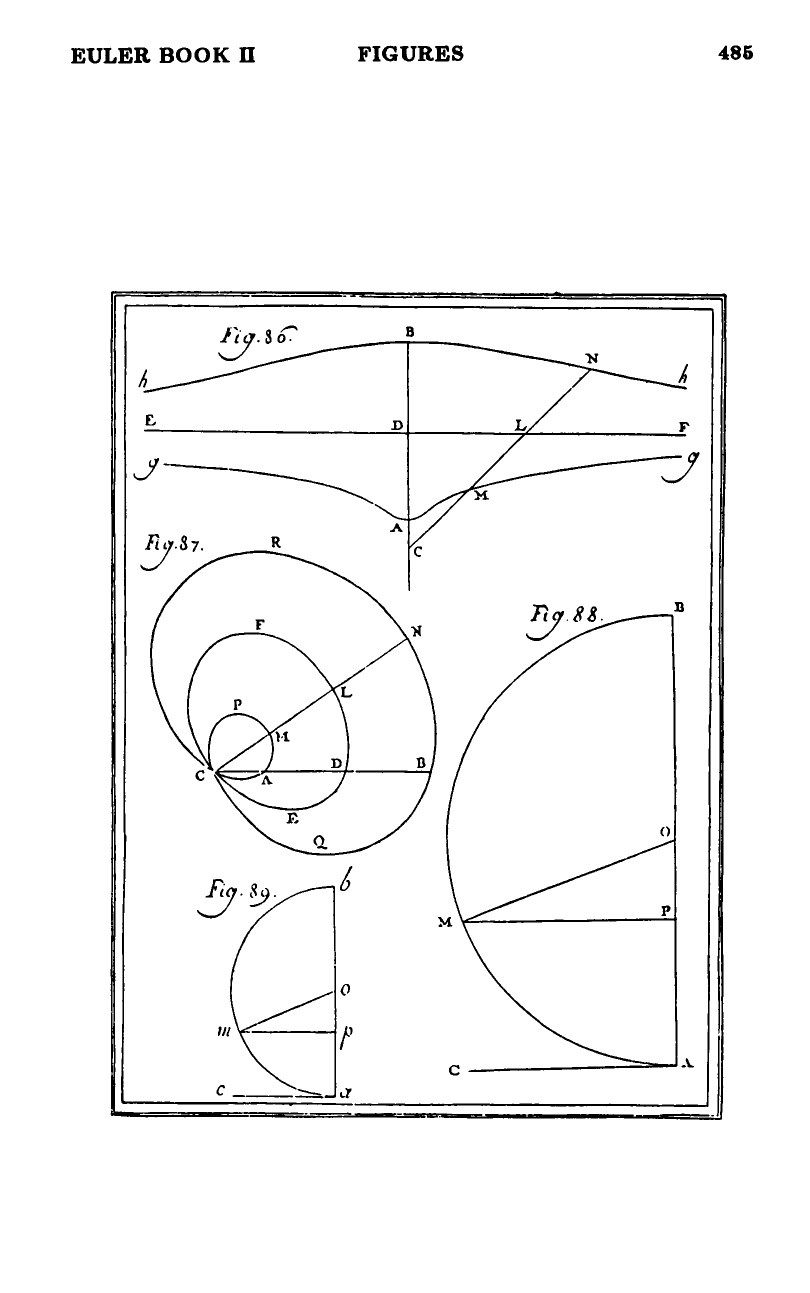 Figures 86–89
Related pages
- chapter-17-on-finding-curves-from-other-properties
- two-point-equation-from-fixed-point — provides the framework used here.
- sum-and-product-of-chords-from-point — the basic-sum / basic-product cases.
- ordinate-powers-from-fixed-point — pushes to higher symmetric functions.
- curves-from-polar-coordinates — directrix family for the conchoidal-genus generalization.
- multiple-points-on-curves — node/cusp/conjugate-point trichotomy at .
- first-species-cubic-configurations — same trichotomy in the cubic context.