Surface Coordinates and Equation
Summary: §§3–12 of the Appendix on Surfaces. Three mutually perpendicular axes meeting at assign each point in space three coordinates , , (figure 119). A surface is then given by an equation in these three variables, just as a plane curve is given by an equation in . The role-switch among the three coordinates is the surface-analogue of oblique-coordinates.
Sources: appendix1, §§3–12. Figure 119 in figures119-120.
Last updated: 2026-05-12.
The three-coordinate apparatus (§§4–5)
A table top represents a fixed plane. On it lies a directrix with origin . From any point of the surface drop the perpendicular to the table; from drop the perpendicular to the line . Then are three mutually perpendicular segments giving the three coordinates of (source: appendix1, §4).
Letting , the nature of the surface is expressed by an equation in in which is given as a function of and (source: appendix1, §5):
- : above the table;
- : below;
- : on the table;
- complex: no point of the surface on that perpendicular;
- multiple real at one : the perpendicular meets the surface in several points.
Continuous vs. irregular surfaces (§6)
A continuous (regular) surface is one whose entire shape is captured by a single equation . An irregular surface is patched from several — e.g. a sphere joined to a cone. Euler restricts attention to the continuous case (source: appendix1, §6).
Single-valued and multi-valued (§§8–9)
If equals a non-irrational function , every perpendicular through meets the surface in a single real point — never complex (source: appendix1, §8). The next levels are quadratic and cubic in :
giving two- and three-valued surfaces by exact analogy with the plane-curve case in multi-valued-curves (source: appendix1, §9). The intersection count of a vertical line with the surface is read directly from the number of real roots of .
The single-valued/multi-valued distinction is frame-dependent: rotating the reference plane may turn a single-valued surface into a multi-valued one and vice versa (source: appendix1, §8). What matters for intrinsic study is the equation up to coordinate change.
Six coordinate orderings (§10)
Just as for plane curves the two coordinates can be swapped, here the three coordinates can be permuted in ways. With three reference planes and two axes per plane, there are six relations between the coordinates (source: appendix1, §10):
| Plane | Choice 1 | Choice 2 |
|---|---|---|
In every case, the straight-line distance from to is
The three-plane reference frame (§§11–12)
The same equation in describes the surface’s relation to all three reference planes (source: appendix1, §11): measures distance to , to , to . The three coordinates are pairwise perpendicular, locating as the corner of a parallelepiped opposite (figure 119, source: appendix1, §12). Sign conventions follow the orientation of each axis.
Cross-references
- Plane analogue: abscissa-and-ordinate (Book II Chapter 1).
- Multi-valued levels: multi-valued-curves.
- Six-fold permutations as a generalization of the oblique-coordinates axis choice.
- Worked example with a specific surface: §28 sphere in sections-by-coordinate-planes.
Figures
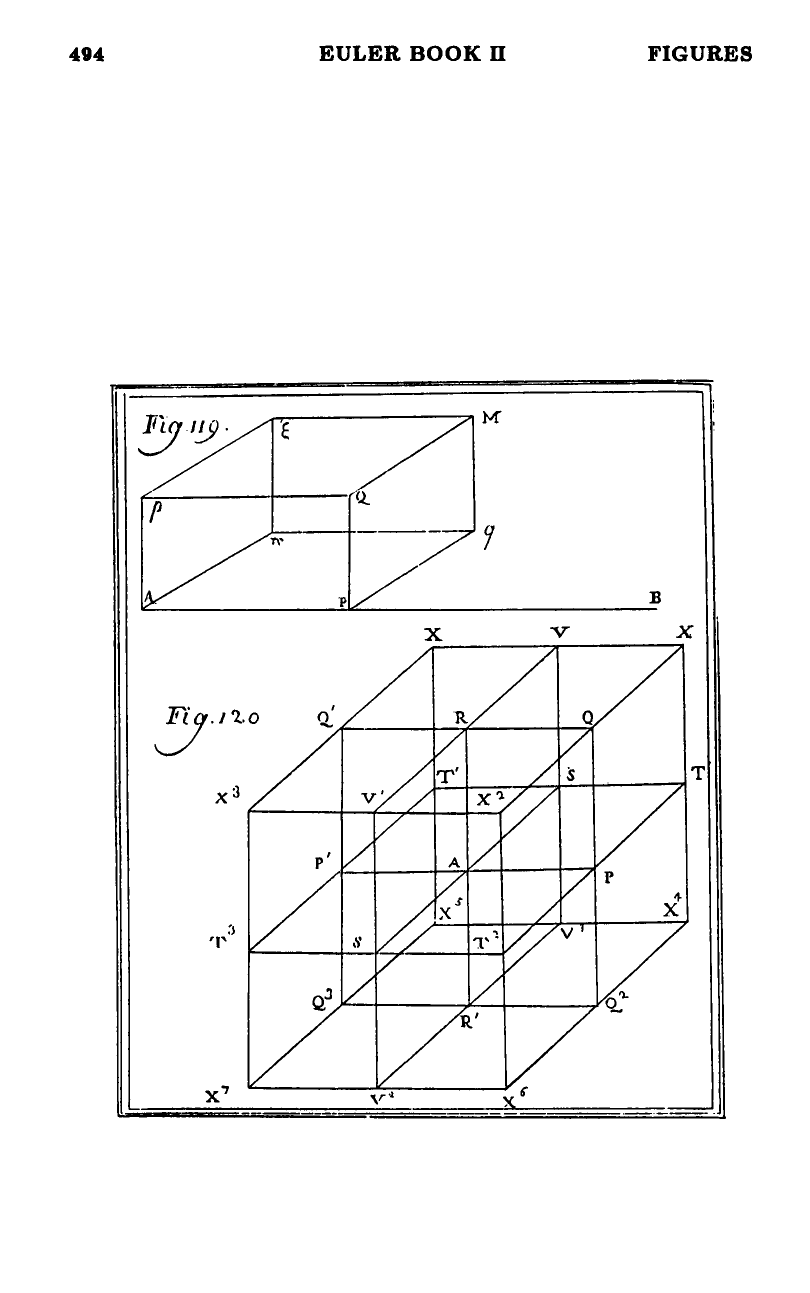 Figures 119–120