Paraboloids and Parabolic Hyperboloid
Summary: §§123–125 of the Appendix on Surfaces. The two paraboloid genera in which one coefficient of the canonical form vanishes. Genus 4 = elliptic paraboloid (figure 146, both ); sections perpendicular to the axis are ellipses, sections containing it are parabolas. Genus 5 = parabolic hyperboloid (figure 147, opposite signs); first principal section is two intersecting straight lines , the two perpendicular planes through which are asymptotic planes. Species at the boundary include the parabolic cone (, round) and the elliptic / hyperbolic cylinder ().
Sources: appendix5, §§123–125. Figures 146, 147 in figures145-147.
Last updated: 2026-05-12.
§123 — Center at infinity from vanishing coefficient
If one coefficient in the canonical form vanishes — say — then the translation step in quadric-canonical-form can no longer kill the term. The general equation becomes
and by shifting further:
(absorbing into ). The center now lies at .
In either case the center of the surface will lie on the axis but at an infinite distance. (source: appendix5, §123)
§124 — Genus 4: elliptic paraboloid (figure 146)
Principal sections:
- : single point at the origin.
- : parabola with axis , equation .
- : parabola with axis , equation .
- Section by const: ellipse const — every level perpendicular to axis is an ellipse.
Since every section perpendicular to the axis is an ellipse and every section containing this axis is a parabola, the solid of this genus is called an elliptic paraboloid. (source: appendix5, §124)
Species:
- Parabolic cone (, “round”): the ellipses become circles. Generated by revolving a parabola about its axis.
- Cylinder (): equation degenerates to (an ellipse independent of ) — an elliptic cylinder. Right if , scalene otherwise.
§125 — Genus 5: parabolic hyperboloid (figure 147)
First principal section (): , i.e., — two intersecting straight lines in figure 147. Each section parallel to the plane (i.e., const) is a hyperbola with center on the axis and asymptotes parallel to these two lines.
The two perpendicular planes through and approach the surface at infinity — they are asymptotic planes. The surface has two asymptotic planes rather than an asymptotic cone — this is the genus-5 signature.
The surfaces belonging to this genus are called parabolic hyperboloids with two planes for an asymptote. (source: appendix5, §125)
The other two principal sections ( and ) are parabolas as in genus 4.
Species:
- Hyperbolic cylinder (): equation becomes — sections perpendicular to are congruent hyperbolas.
- Two asymptotic planes (): the equation reduces to , i.e., — two planes intersecting in the -axis.
Modern note: the parabolic hyperboloid as a saddle
The parabolic hyperboloid is the modern “saddle surface” — every horizontal section is a hyperbola, every vertical section is a parabola. The two intersecting lines at are the two straight rulings through the saddle point. Euler’s genus 5 is the first description of this surface in the analytic-geometry literature.
Cross-references
- The asymptotic-cone-degenerates-to-planes case: the §111–112 intermediate equality. The two planes are real (Genus 5) or complex (Genus 4) according to whether the homogeneous linear factors are real or complex; coincident factors give Genus 6 parabolic-cylinder-quadric.
- 3D analogue of the parabola: where the parabola is the limit of the ellipse with , the paraboloid is the limit of the ellipsoid as one axis goes to infinity. Where the hyperbola has asymptotes-of-hyperbola, the parabolic hyperboloid has asymptotic planes.
- The cylinder species at are pure-cylindrical-and-prismatic-surfaces examples in Genus 4 (elliptic) and Genus 5 (hyperbolic).
Figures
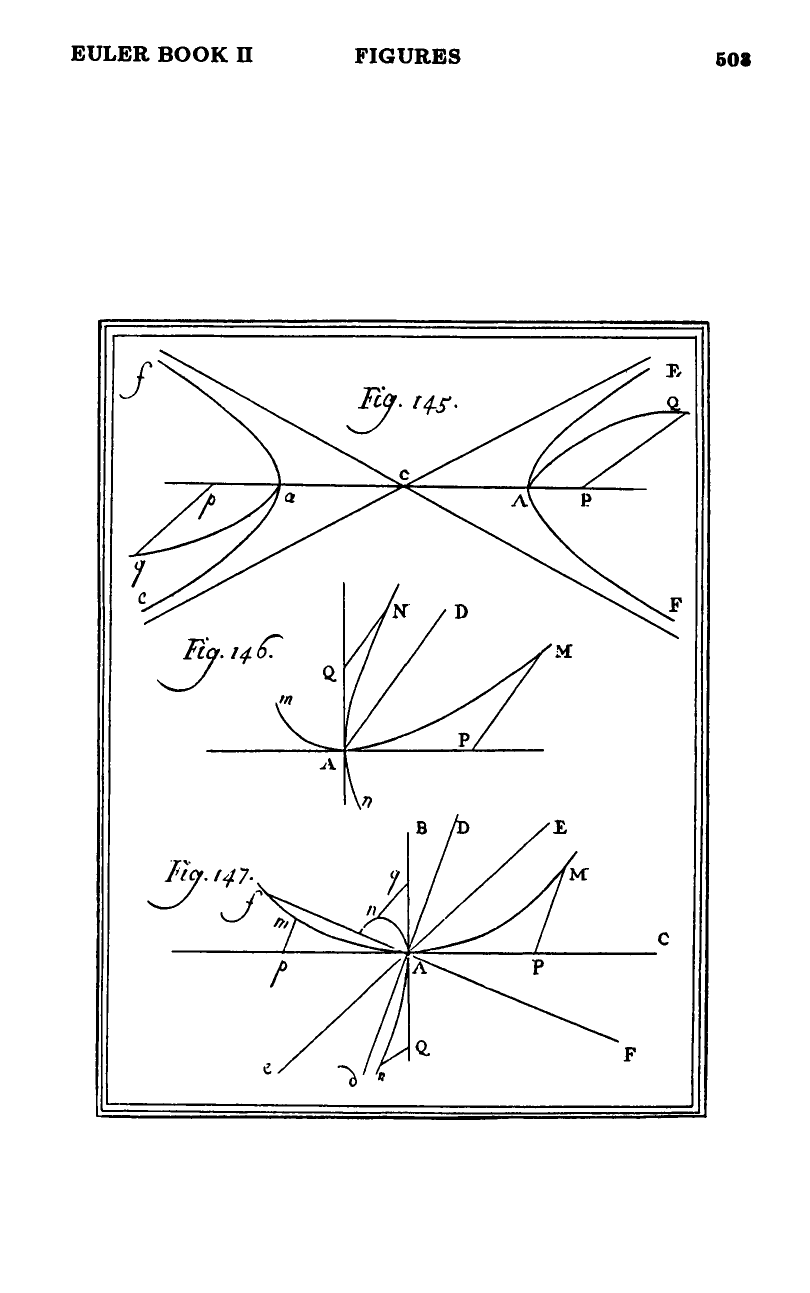 Figures 145–147