Parabola
Summary: With the vertex as origin and the principal axis as -axis, the parabola has the simple equation where is the semilatus rectum. The focus lies on the axis at , and for every point on the curve — the focal radius equals abscissa-from-vertex plus vertex-focus distance. The parabola is an ellipse with infinite major semiaxis, so every ellipse property carries over with : every diameter is parallel to the axis, the triangle formed by tangent and axis is isosceles, and the subnormal is constant.
Sources: chapter6 §§148-152; figure 32 (in figures30-32)
Last updated: 2026-04-26
Set-up: parabola as limit of ellipse (§148)
In the vertex-origin form of the ellipse , set the vertex-focus distance to half the semilatus rectum, . The term vanishes, leaving
This is the γ = 0 case of with the origin shifted by . The vertex is . The focus is at , and is the semiparameter (semilatus rectum), with the latus rectum.
For every point on the parabola the defining identity is
As grows, grows without bound in both signs — two infinite branches. For the ordinate is imaginary, so beyond in the opposite direction there is no curve. (This recovers the two-branches-to-infinity count.)
Parabola as an ellipse with infinite axis (§149)
Since the equation of the ellipse becomes that of the parabola when , the parabola is an ellipse whose semiaxis has gone to infinity. All ellipse properties continue to apply with the major semiaxis taken as infinite. This is the master principle of Euler’s parabola section: every theorem is read off from its ellipse counterpart.
The focal property (§149)
Since , we have . Then
so . The focal radius equals the distance from the vertex to the foot of the ordinate, plus the vertex–focus distance (source: chapter6, §149). Equivalently, every point of the parabola is equidistant from the focus and the vertical line — the directrix, although Euler does not use this name here.
Tangent at infinity and oblique diameters (§§150-151)
In the ellipse, the tangent at meets the axis at with and . For the parabola, is infinite, so and (source: chapter6, §150):
That is, the tangent meets the axis at a point such that : the subtangent is twice the abscissa, . (Equivalent statement.)
Likewise the line from to the (infinite) centre is parallel to the axis . So every diameter of a parabola is parallel to the principal axis — a striking simplification of the diameter notion for ellipses, where diameters meet at a finite centre. Each such oblique diameter bisects all chords parallel to the tangent at (source: chapter6, §151), in keeping with the general diameter property.
The diameter form, with and , becomes , i.e. . Each oblique diameter has its own latus rectum — four times the focal distance to the vertex of that diameter. This is the parabolic generalisation of the diameter-form from §95 of chapter 5.
Isosceles tangent triangle (§152)
Combining and gives . So the triangle formed by the focus, the foot of the tangent on the axis, and the point of contact is isosceles with (source: chapter6, §152). The angle , doubling the tangent inclination — a parabolic version of the central angle being twice the inscribed angle.
The perpendicular from the focus to the tangent satisfies — the focal perpendicular to the tangent is the geometric mean of and .
Subnormal is constant (§152)
Drop the normal at , meeting the axis at . Then from with and :
Wait — Euler computes where his is twice the modern semilatus rectum. Translating to the modern convention used above: the distance from the foot of the ordinate to the foot of the normal is a constant, equal to half the latus rectum (the modern semilatus rectum). The result in Euler’s notation is “half the latus rectum, that is, the ordinate ” (source: chapter6, §152). Furthermore and .
Notable points
- The cleanest equation in Book II. Putting the vertex at the origin reduces the parabola to — one symbol , one variable squared, one variable linear. Every other conic in this chapter requires two parameters (or ). Euler exploits this by reading off all properties as limits of ellipse properties (§149).
- No metric centre. The “centre” of the parabola is at infinity, which is why all diameters are parallel to the axis (§151) — every chord-direction has its own diameter, but those diameters never meet at a finite point. The result is that the parabola has no genuine conjugate diameters in the ellipse sense; every diameter has the same “conjugate direction” (the tangent direction at its vertex).
- Constant subnormal as the parabolic signature. const distinguishes parabolas from all other conics: in an ellipse or hyperbola the subnormal grows linearly with ; in a parabola it stays fixed. This is one of the simplest tests for parabolicity from a graph.
- is the focus-directrix property in disguise. The right-hand side is the distance from to the line (the directrix) — i.e. equals the distance to the directrix. Euler does not introduce the directrix explicitly, but the equation he derives is exactly that property.
- Latus rectum varies along oblique diameters. While the principal latus rectum is , the latus rectum on an oblique diameter through is (§151) — four times the focal radius to the diameter’s vertex. This is sometimes called the “general latus rectum” and accounts for the parabola appearing differently when viewed along an oblique axis.
Figures
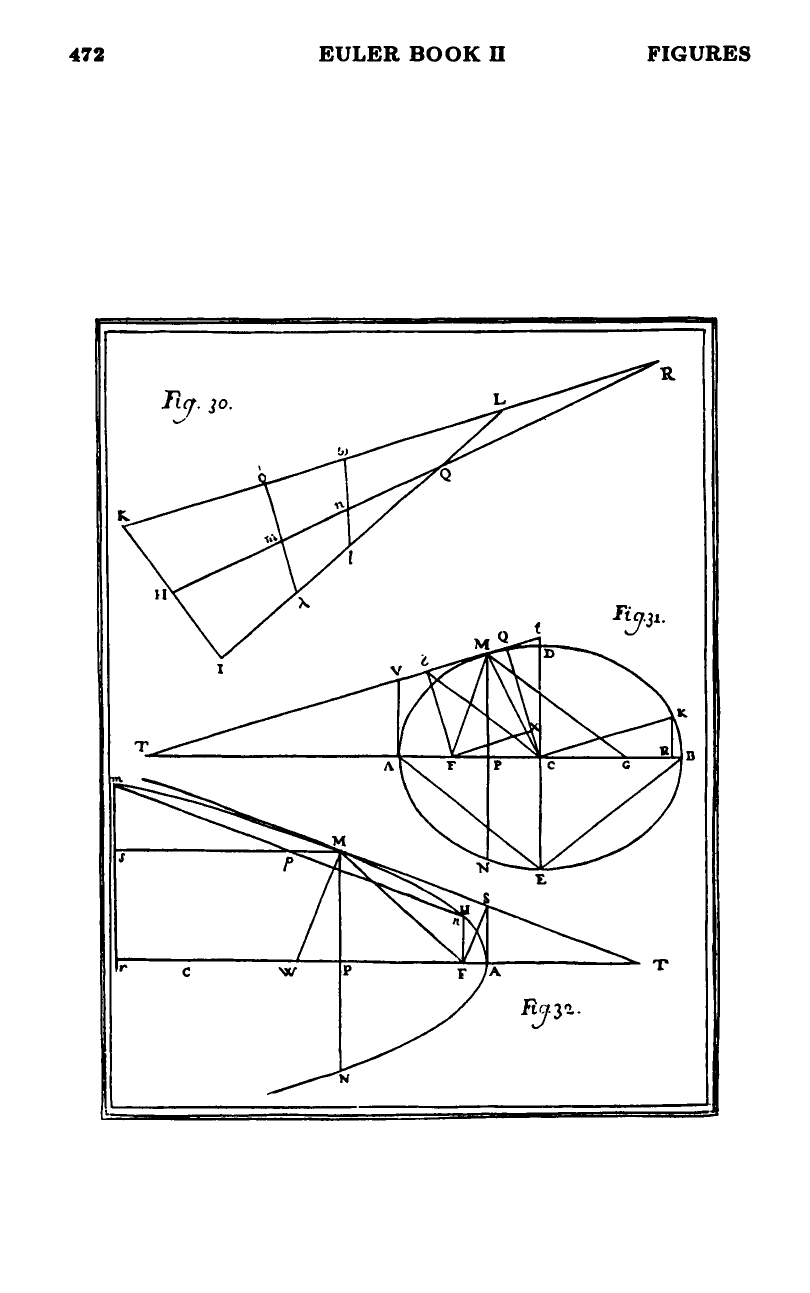 Figures 30–32