Appendix Chapter 4 — On the Change of Coordinates
Summary: The 3D analogue of Book II’s chapter 2. Builds up the most general rigid motion in space in three stages — origin translation (§87), in-plane rotation of the -axis (§§88–89, figure 140), tilt of the -plane about (§90, figure 141), and the full composition (§§91–92) — yielding a six-parameter substitution that leaves the surface invariant. From this Euler extracts degree invariance (§§93–94), planes = first-order surfaces (§§96–97), and the angle of inclination of a given plane to each coordinate plane (§§99–100, figure 142).
Sources: appendix4, §§86–100. Figures 140, 141 in figures138-141. Figure 142 in figures142-144.
Last updated: 2026-05-12.
§§86–87 — Origin translation
Just as a plane curve admits infinitely many coordinate equivalents, a surface admits infinitely more — the cutting plane itself can vary. The simplest change: keep the axis direction, slide the origin. leaves the surface invariant in shape but introduces three free parameters.
§§88–89 — Rotation of the axis in the same -plane (figure 140)
Pick any line in the plane to be the new abscissa axis. Drop with , and let . New coordinates . Then
Three free constants .
§90 — Tilt of the -plane about the axis (figure 141)
Now the plane of the first two coordinates changes. Keep as axis; rotate the second plane about it by angle . From any surface point , drop onto the new plane ; new coordinates . Then
§§91–92 — Full rigid-motion composition
Combine §89 (in-plane rotation by ) and §90 (out-of-plane tilt by ), then further rotate the new abscissa axis in the new plane by about the line , with displacements and reference angle . Substituting:
Six arbitrary constants and (through ) the three translations. See change-of-coordinates-3d.
§§93–96 — Degree invariance
Although the general equation is usually very complicated, still if we consider the total degree of the coordinates, that total degree is always equal to the total degree of the original coordinates . (source: appendix4, §94)
The sphere is second-degree and stays second-degree (§94). An th-order surface admits sections of degree (§95), recovering the §50 invariance of oblique-plane-section-method from a higher vantage point. See degree-invariance-surfaces.
§§96–98 — First-order surfaces are planes
Any surface whose every plane section is a straight line must itself be a plane — the analogue of the straight-line-equation theorem. From the most general equation (§98): a judicious choice of the six constants reduces to , manifestly a plane parallel to the -plane.
§§99–100 — Position of (figure 142)
Setting gives the trace of the plane on the principal coordinate plane: . Building the right triangle at any surface point (with and the projection of ), one finds
By cyclic symmetry the inclinations to the three coordinate planes have tangents
Cross-references
- 3D lift of coordinate-transformations (Book II Chapter 2 §§17–24).
- §94 lifts degree-invariance from curves to surfaces.
- §§96–98 lift straight-line-equation.
- §§99–100 form the bridge to Appendix Chapter 5: the canonical reduction of every second-order surface to depends on being able to align coordinate axes with the principal diametral planes.
Figures
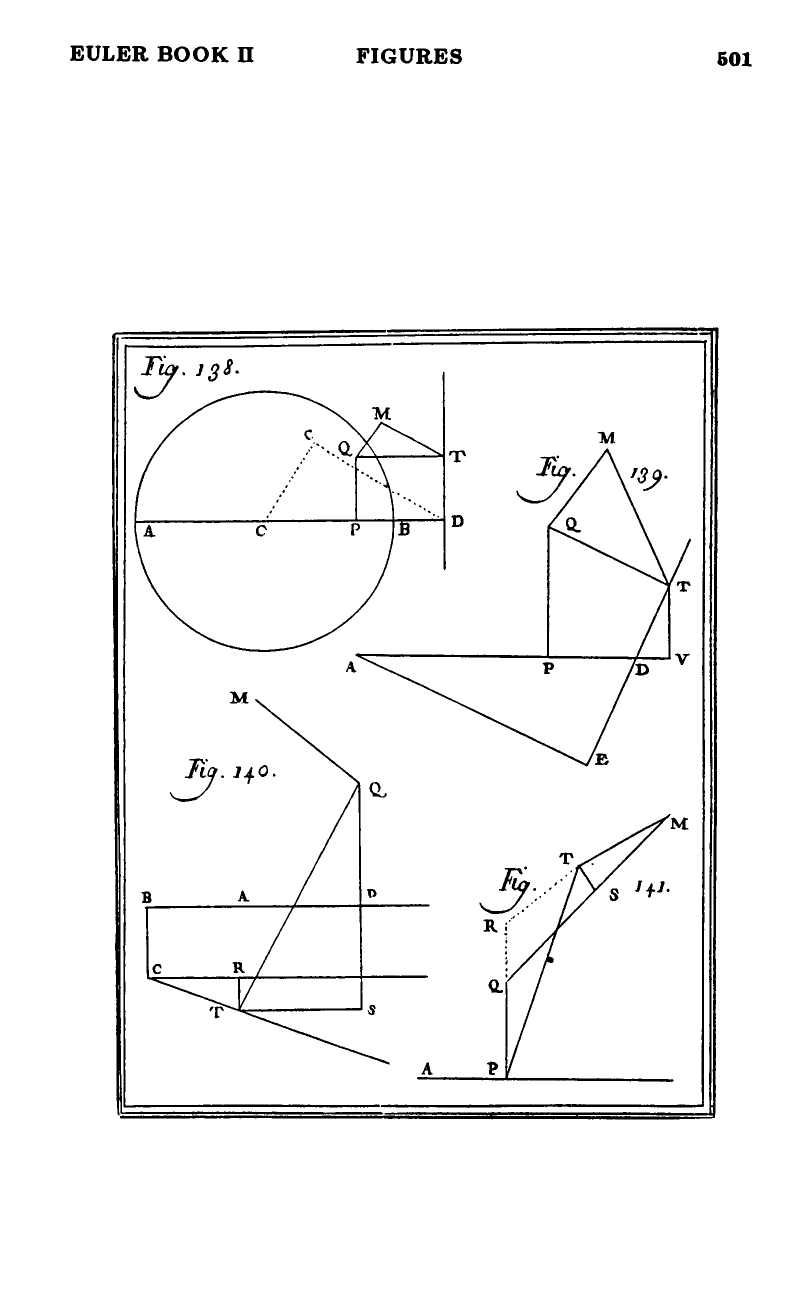 Figures 138–141
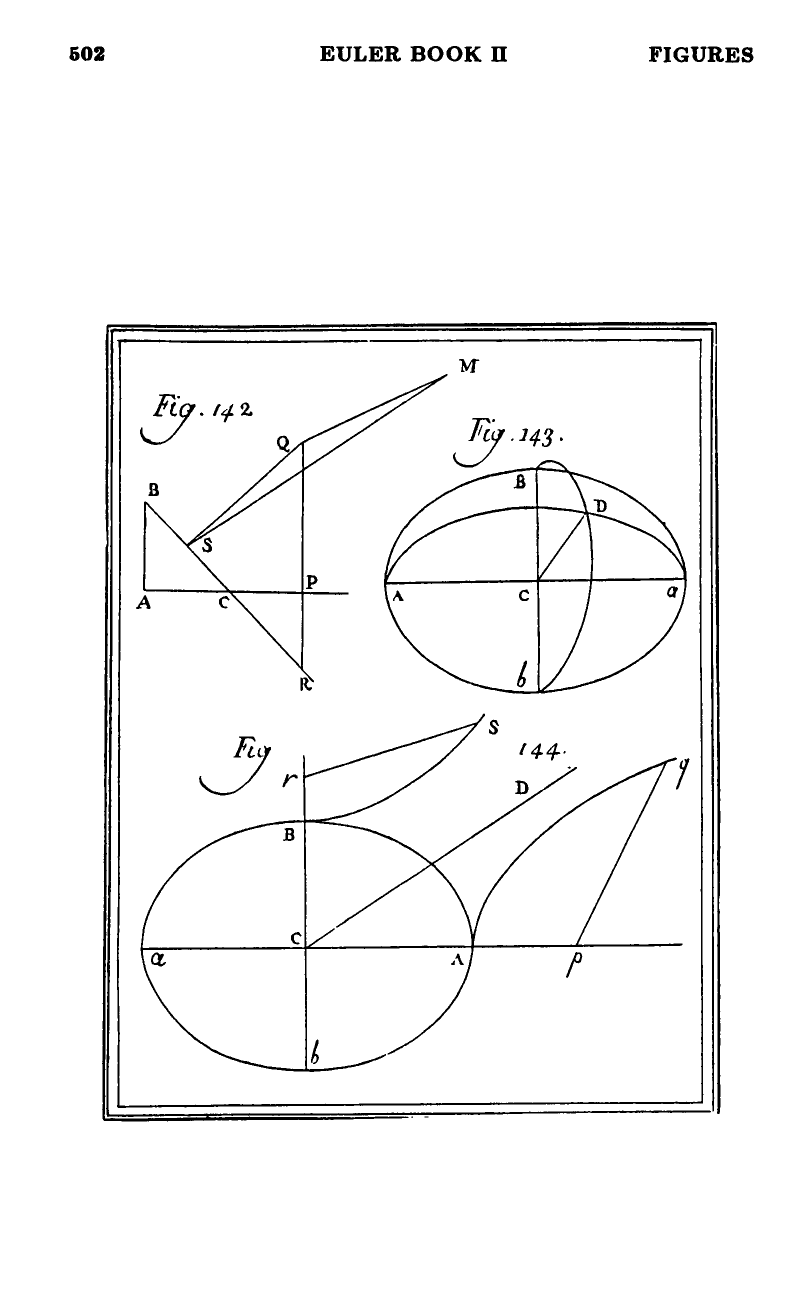 Figures 142–144