Sections by Coordinate Planes (and Parallels)
Summary: §§26–31 of the Appendix on Surfaces. The first and easiest cuts of a surface : setting one variable to zero gives the section by the corresponding coordinate plane; setting one variable to a constant gives the section by the parallel plane at distance . Sweeping over all values traces out the whole surface as a one-parameter family of planar curves. Sections parallel to one coordinate plane are all congruent iff that variable is missing from the equation — the precondition for the cylindrical-and-prismatic-surfaces genus.
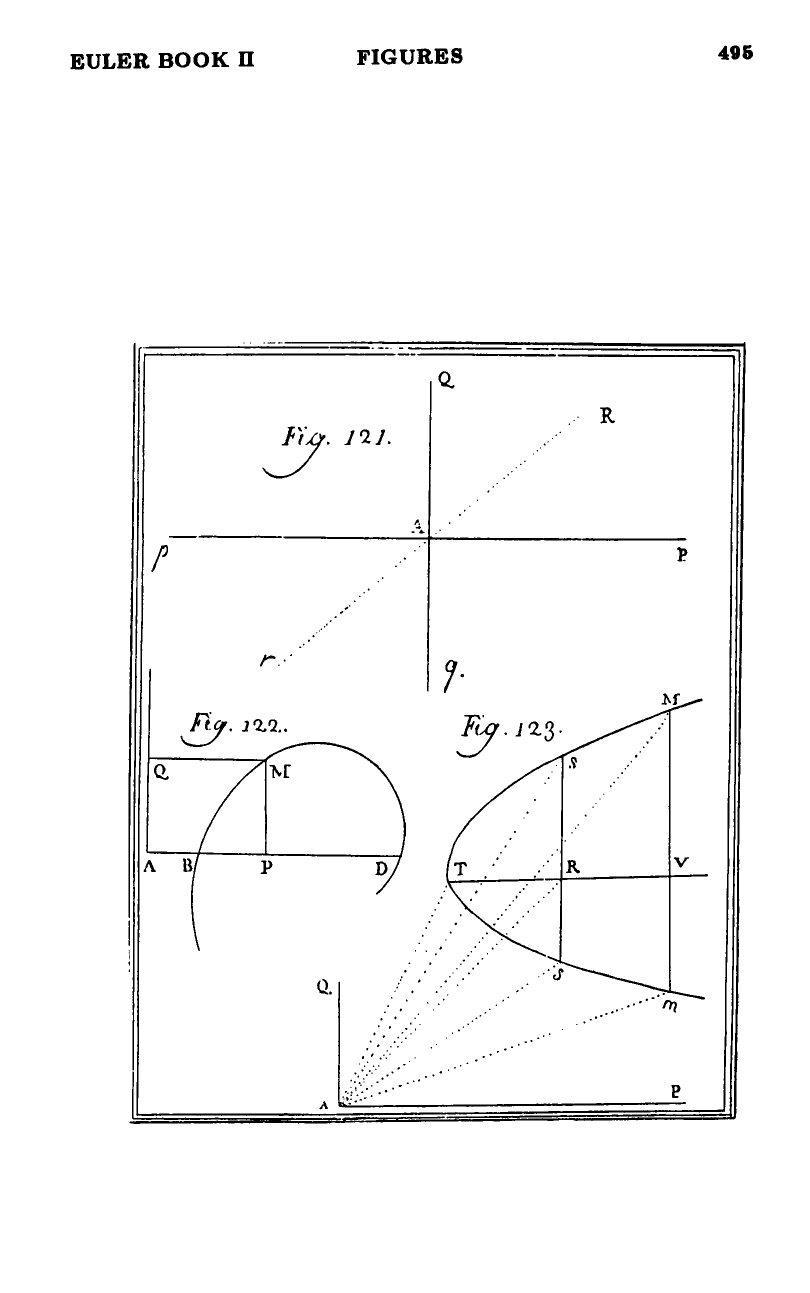
Sources: appendix2, §§26–31. Figure 121 in figures121-123.
Last updated: 2026-05-12.
§§26–27 — Sections by the three principal planes
Just as two lines (curved or straight) meet at points, two surfaces meet along a curve. The intersection of two planes is a straight line (Euclid); of a sphere with a plane, a circle (source: appendix2, §26).
For the three principal planes of figure 121 (source: appendix2, §27):
- in the surface equation gives the curve in plane ;
- gives the curve in plane ;
- gives the curve in plane .
These three sections together capture the surface’s “shadow” against each of the three principal planes.
§28 — The sphere as worked example
For the sphere centered at with radius , all three principal sections are great circles (source: appendix2, §28):
§§29–30 — Parallel-plane sections sweep out the surface
If we let instead of , the resulting equation in is the section by the plane parallel to at perpendicular distance . Letting run through all positive and negative values produces an infinite family of planar sections that collectively trace out the whole surface (source: appendix2, §30):
Similarly gives sections parallel to , and sections parallel to .
The same three families of parallel sections give three orthogonal “stacks” of cross-sections — knowing any one stack determines the surface.
§31 — Congruent parallel sections ↔ missing variable
All of the sections by planes parallel to the plane will be congruent (and the same is true if the plane is or ) if the equation in and is the same no matter what the value of might be. This will happen only if the variable , for which is substituted, does not occur in the equation for the surface. (source: appendix2, §31)
Equivalent dictionary:
- absent → all sections parallel to congruent;
- absent → all sections parallel to congruent;
- absent → all sections parallel to congruent.
This is the algebraic gateway to the cylindrical-and-prismatic-surfaces genus of §§32–33: a missing variable means the surface is generated by translating its base curve along the axis of that missing variable.
Cross-references
- The next genera up — sections all similar (not congruent) — characterize the conical-and-pyramidal-surfaces homogeneous case (§§34–38).
- The most general sections — by planes oblique to all three principal planes — require the substitution method of oblique-plane-section-method (§§47–50).
- The §51 universal-quadric-section theorem in general-quadric-surface reduces to the §28 sphere sections when the quadric is a sphere.
Figures
 Figures 121–123