Chapter 19 — On the Intersection of Curves
Summary: Chapter 19 generalizes the line–curve bound from chapter 4 to two arbitrary curves: their intersections are found by eliminating from the two simultaneous equations and reading the real roots of the resulting polynomial in . The chapter divides into three movements: the procedure itself (§§457–464); the new phenomenon of complex intersections — real roots of the eliminant that fail to give real intersections because the ordinate value is complex (§§465–473); and two systematic methods for performing the elimination — cascaded subtraction with closed-form tables for (§§474–482) and an alternative via indeterminate multipliers that is essentially a resultant construction (§§483–485).
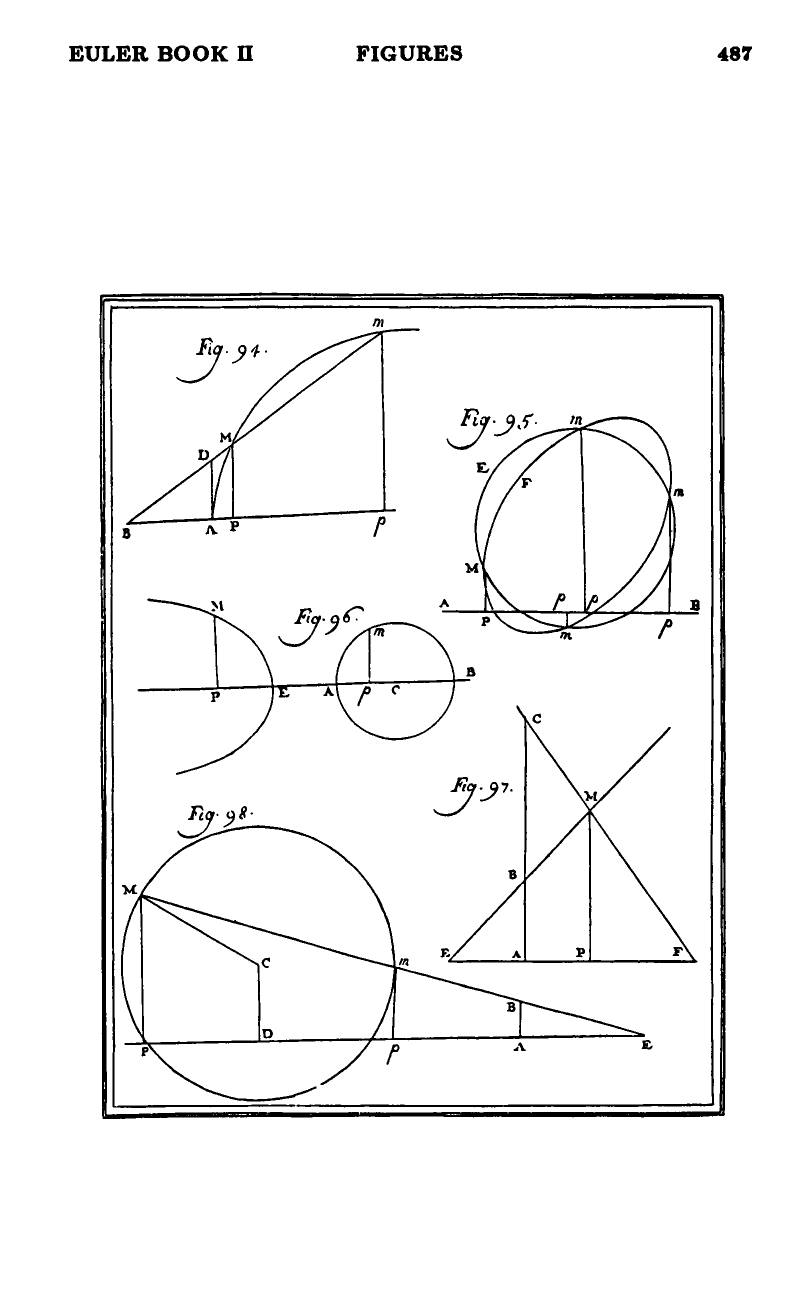
Sources: chapter19 (§§457–485); figures 94, 95, 96 in figures94-98.
Last updated: 2026-05-12.
The chapter at a glance
Chapter 4 (line-curve-intersection-bound) established that a curve of order meets a straight line in at most points. The proof was algebraic: substitute the line’s parameterization into the curve’s equation and count real roots. Chapter 19 generalizes that move to two curves, neither of which need be linear — and discovers in the process that the elimination is more subtle than it looked. Three new ingredients appear:
- when both curves are multi-valued in , the eliminated equation can have real roots that correspond to no real intersection (the ordinate is complex);
- for low-degree pairs in , the eliminant has a closed combinatorial form, and Euler tabulates it;
- for higher-degree pairs, a more systematic method using indeterminate multipliers avoids the doubling complexity of the closed-form approach — this is essentially the resultant.
1. The elimination procedure (§§457–464)
The chapter opens with the line–curve case as warm-up (figure 94, §458). With curve in coordinates and straight line given by , substitute into the curve’s equation to get a polynomial in alone whose real roots are the abscissas of the intersections, and recover at each root from the line’s equation. The degree of the substituted polynomial is at most that of the curve — re-establishing the chapter-4 bound (§460).
Two genuine curves (figure 95, §463) work the same way in principle but require careful elimination: take the same in both equations, eliminate to obtain a single polynomial in , find its real roots, and recover the ordinates.
See intersection-of-two-curves.
2. Complex intersections (§§465–473)
Here Euler discovers a phenomenon absent in the line–curve case. When — recovered as a function of from the elimination — is irrational in , two ordinate values from one curve at a given may be complex but equal to each other. Then satisfies the eliminant but no real intersection exists at : this is a complex intersection.
Three illuminating examples drive the section:
- §465 (parabola vs. circle, sharing axis). and . Subtracting linearizes as a rational function of , so every real root of the quartic in gives a real intersection. No complex intersections here.
- §§467–468 (disjoint parabola and circle, figure 96). and with such that no real intersection exists. Eliminating produces a quadratic with two real -roots whose corresponding values are complex — pure complex intersections.
- §§471–473 (cubic vs. parabola with spurious factor). and . After elimination, is linear in — but the equation factors as ; the second factor gives a real -root whose parabola ordinate is complex. Lesson: linearity of the eliminant in is not enough — a hidden factor can still admit complex intersections.
Sufficient condition for no complex intersections (§§469–470): after elimination, should be a single-valued (non-irrational) function of , and the elimination should not have involved a polynomial division by a factor that could mask the irrationality.
3. Closed-form eliminants for low degrees (§§474–482)
Euler tabulates the eliminant for each pair of degrees of :
| Degrees | Eliminant in |
|---|---|
| pure even | |
| general | |
| long expansion, §480 | |
| long expansion divided by , §481 | |
| cascade of brevity letters , §482 |
The case is a tour de force: four passes of subtraction-and-substitution, each reducing the joint degree by one, with brevity substitutions that exploit the symmetries , , to close the recursion. The final equation comes out as , expanded to a polynomial in just eight letters (four upper, four lower) after observing divisibility by .
4. The indeterminate-multiplier method (§§483–485)
The cascaded-subtraction method doubles the size of the expression at each step. Euler concludes the chapter with an alternative: multiply each equation by a polynomial in with indeterminate coefficients and , equate the products, and match coefficients of every power of . The matching equations form a linear system in the indeterminates; the final (coefficient of ) equation, after solving, is the eliminant.
The counting: with both products of degree in , the indeterminate-letter count must equal the matching-equation count , forcing . Euler demonstrates on the case and verifies that the result coincides with the entry of the §480 table.
In modern terms, this construction produces the resultant as a determinant of the Sylvester matrix — a determinantal condition for the two polynomials in to share a root. Euler does not phrase it as a determinant, but the algebraic content is identical.
See indeterminate-multiplier-elimination.
Foreshadowing Bézout
The chapter establishes that the eliminant of two equations of joint degrees in has -degree at most , and that real roots of the eliminant overcount real intersections (because of complex intersections) — so real intersections are at most . The full Bézout statement that the count is exactly in projective space, with multiplicity, including complex points, requires the next chapter to develop in earnest. Chapter 19 supplies the algebraic machinery; chapter 20 will apply it.
Connections to earlier chapters
- The line–curve bound of line-curve-intersection-bound (§§66–73) is the case of this chapter’s general elimination.
- The discussion of complex-intersections connects to multiple-points-on-curves (§§281–282): two coincident real roots of the eliminant signal a tangency or self-intersection, while a pair of complex-conjugate values gives a conjugate point.
- The pure-even sub-case of elimination-of-ordinate presupposes that the axis is a diameter of both curves — the chapter-15 condition.
- The closed-form (1,1) eliminant is the simplest instance of the line–line intersection: two lines meet in one point unless they are parallel, in which case the eliminant degenerates.
Figures
 Figures 94–98