Complex Intersections
Summary: When the ordinate , eliminated from two simultaneous curve equations, is an irrational function of the abscissa , real roots of the resulting eliminant in need not correspond to real geometric intersections — the matching ordinate may be complex. Euler calls these complex intersections: algebraic phantoms of the elimination that vanish geometrically. The number of real roots of the eliminant therefore gives only an upper bound on the number of real intersections, with equality iff is expressible as a single-valued (non-irrational) function of .
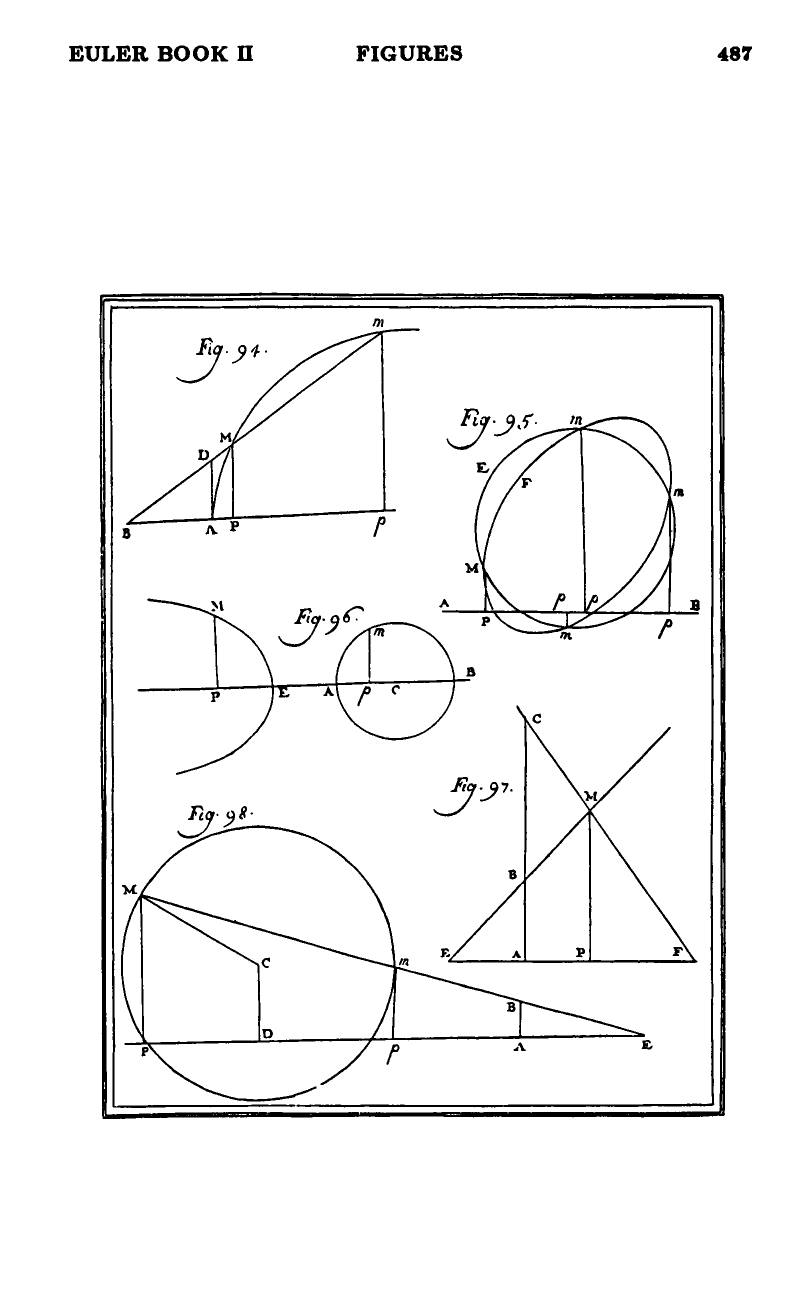
Sources: chapter19 (§§466–473), figures94-98 (figure 96).
Last updated: 2026-05-12.
The phenomenon (§§466–468)
After eliminating between two equations , one obtains a polynomial in the abscissa alone. Two situations differ sharply:
- rational in . Each real root of yields a real ordinate via with rational, so every real root corresponds to a true intersection.
- irrational in . The two ordinate values from each curve at a given may both be complex and equal to each other. Algebraically, then satisfies both equations; geometrically, no real point is created.
If it happens that the two complex values are equal, then there will be no true intersection. (source: chapter19, §466)
Consequence (§468):
The number of real roots of the final equation in is not always the number of intersections. It can happen that there may be more roots than there are intersections, and there may be no intersections at all, even though there are two or more real roots . Nevertheless, each intersection always provides a real root of in the final equation, and for this reason, there are always at least as many real roots as there are intersections. (source: chapter19, §468)
Test: a real root gives a real intersection iff the corresponding is real; if is complex at the intersection is complex (i.e., nonexistent geometrically).
Worked example: disjoint parabola and circle (§§467–468, figure 96)
Place a parabola with parameter and a circle of radius on the same axis so they do not intersect (figure 96). Let . With as origin and positive toward ,
Eliminating ,
Two real roots in , one positive and one negative — yet geometrically no intersection exists. Substituting back, is in both cases
and the radicand is negative: the ordinates are complex. The two real -roots are the abscissas of complex intersections — algebraic shadows of the elimination.
Sufficient conditions for no complex intersections (§§469–470, 473)
Complex intersections arise only when (after elimination) cannot be expressed as a single-valued function of . Two diagnostic situations:
- Both equations have only even powers of with the principal axis a diameter of both curves. Then survives elimination only as , hence as an irrational function of (§469). Example: and combine to , which seems to give only two intersections; but admits two real for each root, yielding four genuine intersections.
- expressible as a single-valued function of . Then no abscissa corresponds to a complex ordinate, and every real root of the eliminant is a true intersection (§470).
Euler emphasizes (§473) that elimination producing an equation in which appears only to the first power is not automatically enough: division by a polynomial factor during elimination can mask complex intersections inside one factor.
A subtler example: cubic vs. parabola via spurious factor (§§471–472)
Take the cubic and the parabola . The cubic has real ordinates for every abscissa (three values for ); the parabola has no real ordinate for . Hence no intersection can occur at any negative abscissa.
Eliminate : from the parabola , the cubic becomes , so
But the previous equation is divisible by ; performing the division gives , that is . This suggests an intersection at — but the parabola has no real ordinate at , so it is a complex intersection. The genuine intersections come from the factor : combined with this gives , so (origin) or (with ).
This shows that even when the eliminant in is linear in (no irrationality on the face of it), a factored eliminant can hide complex intersections inside one factor.
Why “complex” rather than “imaginary”?
Euler does not use imaginary in the modern sense. His phrase is complex intersection (intersectionum imaginariarum), denoting that the algebraic apparatus produces a candidate but the ordinate, once recovered, is non-real. The phenomenon foreshadows the modern statement that two curves of orders and meet in exactly points counted in projective space, with multiplicity, including complex points (Bézout’s theorem). Euler’s chapter 19 already accounts for the gap between the count in the real affine plane and the algebraic-elimination count.
Figures
 Figures 94–98