Chapter 17 — On Finding Curves from Other Properties
Summary: Inverse-problem chapter parallel to chapter-16-on-finding-curves-from-properties-of-the-ordinate, but with the parallel-ordinate setup replaced by polar coordinates at a fixed point . Vieta’s symmetric functions of the chord-distances (and triples ) recover the curve up to a homogeneous-decomposition rule ; the chapter’s headline result is the conchoid of Nicomedes and its node/cusp/conjugate-point relatives.
Sources: chapter17 (§§391–434); figure 81 in figures81-85; figures 82–85 in figures81-85; figures 86–87 in figures86-89.
Last updated: 2026-05-11.
The chapter at a glance
Euler abandons the chapter-16 parallel-ordinate frame because the new properties — length of , angle , product of two chord-distances, sum of squares — are not naturally expressed by ordinates. He sets up polar coordinates at a fixed point : and (figure 81). Rectangular coordinates re-enter through , , .
The chapter unfolds in five strands, in order of how many points a straight line through meets on the curve.
1. Polar setup and the one-point case (§§391–398)
§§391–394 introduce and isolate the single-intersection condition: meets each line through in just one point iff is odd in both and . §§395–398 translate the parity condition to rectangular coordinates ( odd in ) and tabulate the explicit equations for orders 1–4. The order- pattern: lines, conics through , cubics with a double point at , quartics with a triple point at — i.e. a multiplicity- point at . See curves-from-polar-coordinates.
2. The two-point case (§§399–404)
§§399–400 set with odd, even in . The non-irrational rectangular form forces and with homogeneous of degrees . The general equation collapses to
§§401–402 specialize to the conic, where the exceptional “one-intersection” lines coincide with asymptote directions (a hyperbola has two such directions; a parabola has one; an ellipse has none). §403–404 give the order- rule: a curve of order is cut by every line through in 2 points iff is a multiplicity- point of the curve. See two-point-equation-from-fixed-point.
3. Sum and product of (§§405–409)
§405 asks for const: would require const, but carries the irrationality , so no curve satisfies this strictly. §406 allows additional intersections and gets concentric-circle-pair families. §§407–409 ask for const: the circle is the obvious solution (Euclid’s Elements), and from each higher order one gets a non-circular family . See sum-and-product-of-chords-from-point.
4. Squared-sum, constant interval, and the conchoid (§§410–418)
§§410–411 solve via ; the general equation is
§§412–413 unify under the family .
§§414–418 are the chapter’s geometric highlight: const — equivalently constant chord interval — produces in lowest order . Three sub-cases by the comparison of to :
- : conjugate point at (figure 83)
- : cusp at (figure 84)
- : node at (figure 85)
The same problem on the other general family gives , the conchoid of Nicomedes (figure 86), with directrix as asymptote. The “conchoidal genus” of curves for any odd generalizes the construction to any single-intersection curve as directrix (figure 87). See constant-chord-interval-conchoid.
5. Higher symmetric functions and three-point curves (§§419–434)
§§419–425 take : even gives genuine solutions, odd does not (squaring doubles intersections). The closed form
(via the §372 trick from chapter 16) covers all even cases. See ordinate-powers-from-fixed-point.
§§426–434 promote the line to a three-intersection chord: with odd and even reduces to
where are homogeneous of degrees . is a multiplicity- point of the order- curve. Constant , constant , constant , and constant are worked out as examples; §434 closes by noting that the four-intersection problem requires nothing new. See three-point-equation-from-fixed-point.
Connections to earlier chapters
- The parity-of-exponents trick echoes diameter-and-center-from-equation (chapter 15), now applied to the polar variables .
- The decomposition mirrors §365’s conic family from two-ordinate-sum-and-product, but in the polar frame.
- The §423 “easier method” explicitly recalls §372 of sum-of-ordinate-powers-curves — the same Newton-identity machinery, redirected from parallel ordinates to chord-distances.
- The multiplicity bound at (two-point-equation-from-fixed-point) is the polar analogue of the line-curve-intersection-bound.
Figures
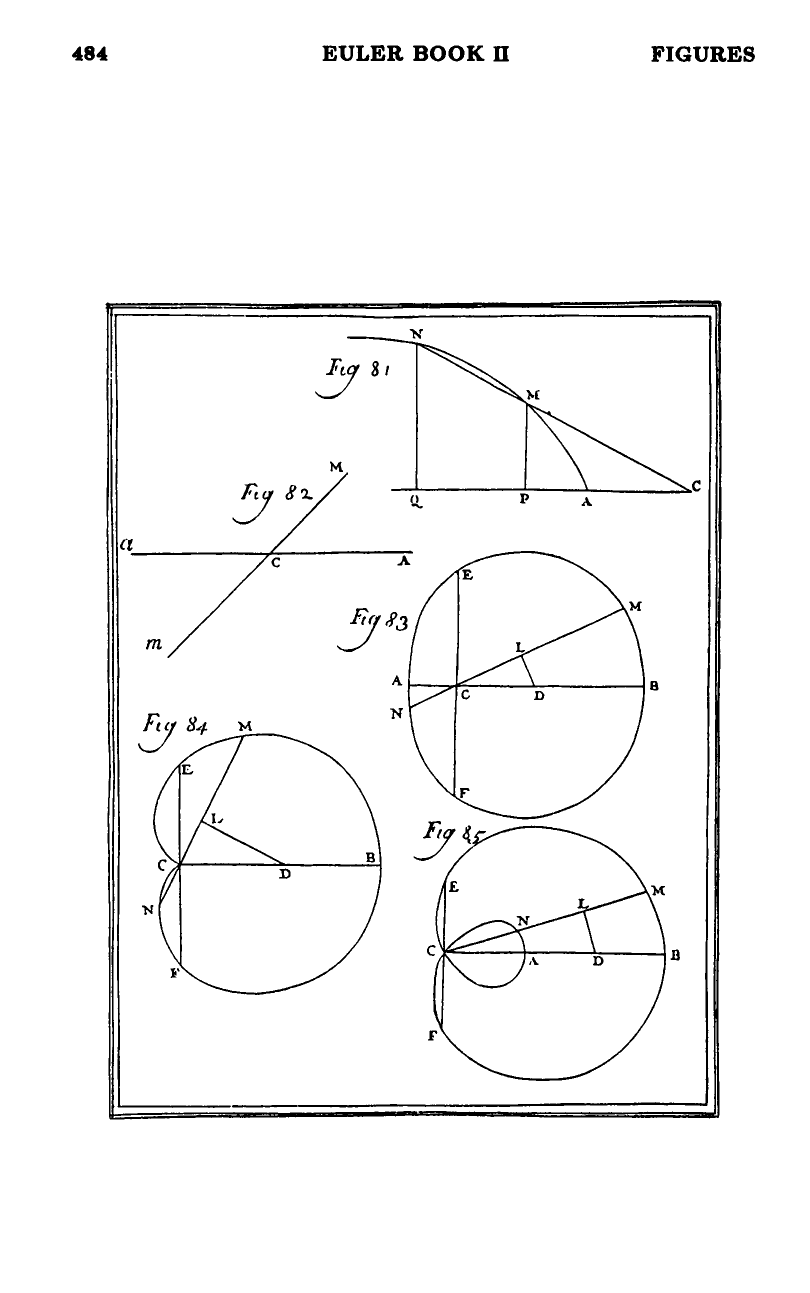 Figures 81–85
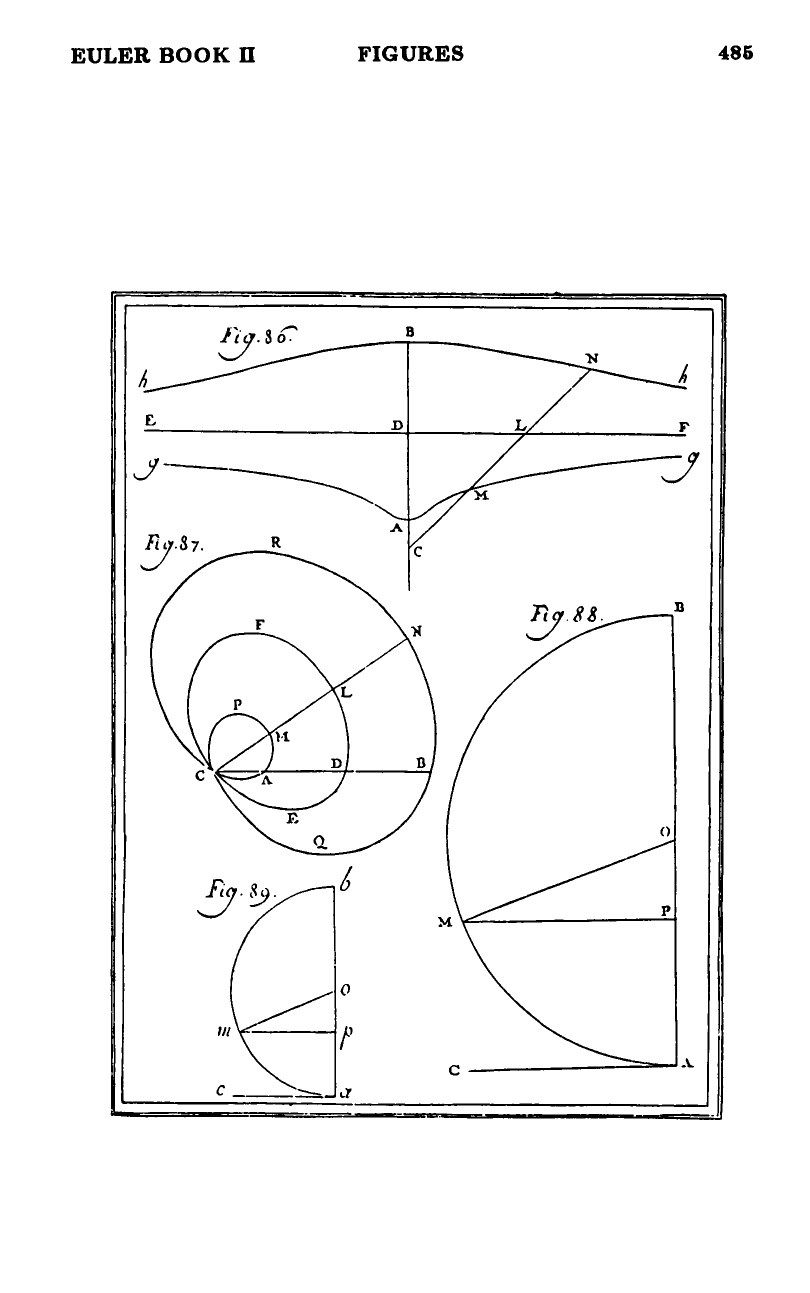 Figures 86–89