Curves from Polar Coordinates at a Fixed Point
Summary: Euler’s polar setup for chapter 17: at a fixed point , write and (figure 81); convert to rectangular coordinates via , , . Curves cut by every line through in exactly one point are characterized by with odd in and — equivalently, an order- curve with a multiplicity- point at .
Sources: chapter17 §§391–398; figures 81–82 in figures81-85.
Last updated: 2026-05-11.
The polar frame (§§391–392)
The chapter-16 setup expressed a curve through its parallel ordinates at varying abscissa . That framework cannot directly state properties of straight lines through a fixed point , such as ” is constant” — those properties are radial, not vertical. So Euler reorients:
- Pick a fixed point and a fixed direction as polar axis (figure 82).
- For a point on the curve, set (the chord-distance) and (the polar angle).
- Every angle picks out a chord , and the equation (function of ) determines the curve.
Conversion to rectangular coordinates, with the projection of onto and the perpendicular: , , so
The one-intersection parity rule (§§393–394)
If where depends only on , the same straight line through corresponds to two angles, and , since rotating by two right angles puts the line in the same position (only the direction flips). Under that flip . If , then and — a second intersection of the curve with the same line, unless , i.e., unless is odd in .
The same flip sends . So if depends on both, the single-intersection condition is that be odd in both arguments simultaneously: .
Rectangular form: odd in and (§§395–397)
Because and are odd in (both flip sign), being odd in is the same as being odd in . Euler tabulates the lowest cases:
and proceeding to higher powers,
§396 observes: dividing by leaves only even powers of , which then eliminates. So every such equation reduces to a non-irrational rectangular equation of degree in .
§397 packages this into the order- master form
The left side is homogeneous of degree ; the right side is times a homogeneous form of degree .
The order-by-order catalogue (§§397–398)
| Order | Equation | Geometry |
|---|---|---|
| I | straight line | |
| II | conic through | |
| III | cubic with double point at | |
| IV | quartic with triple point at |
Reading the pattern: the homogeneous-of-degree- left side and homogeneous-of-degree- right side meet at to order , so is a multiplicity- point of the order- curve. By the line-curve-intersection-bound, a line through a -fold point of an order- curve meets the rest of the curve in exactly further point — recovering the single-intersection property.
Reading: conic example
For order II, fix on the conic. Every line through meets the conic at itself and at one other point — exactly the lemma underlying many of Newton’s Principia constructions. The right side is the tangent direction of the conic at generalized to a variable scale.
Figures
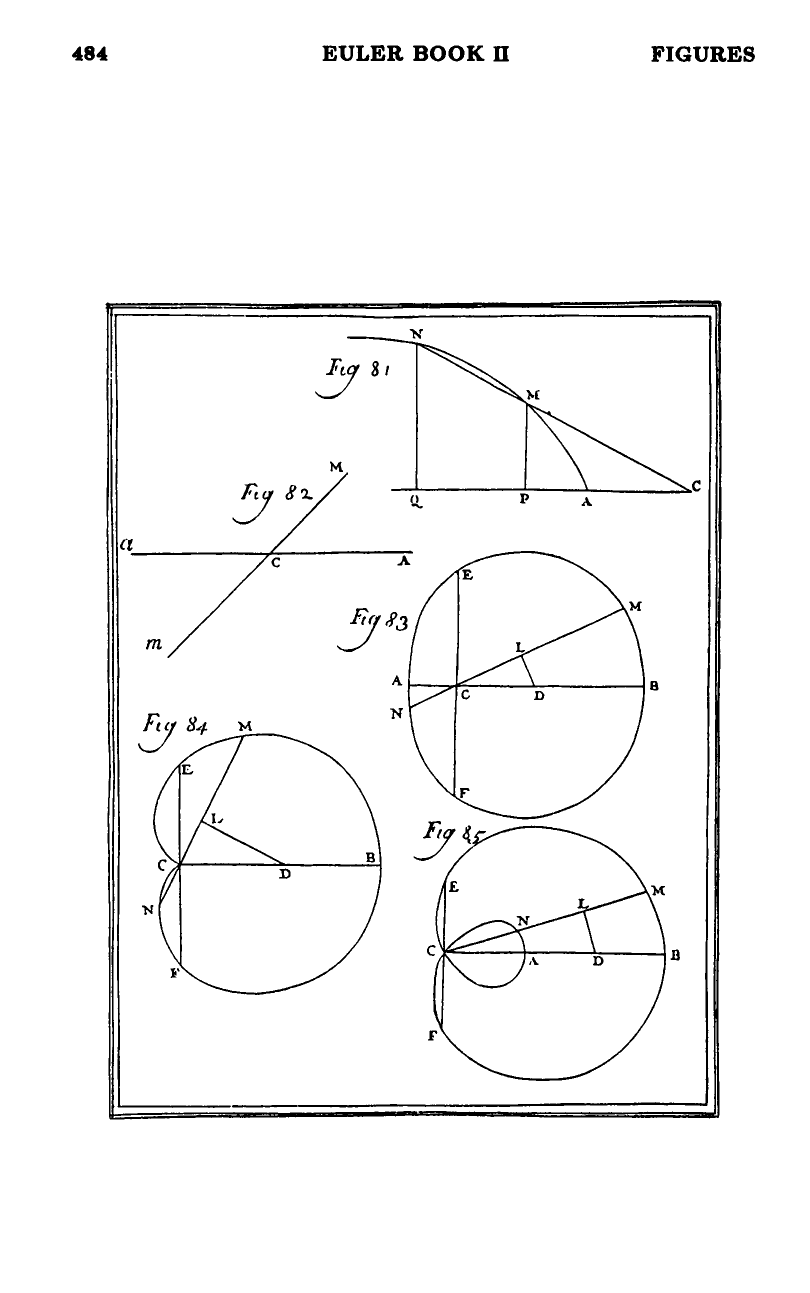 Figures 81–85
Related pages
- chapter-17-on-finding-curves-from-other-properties
- two-point-equation-from-fixed-point — the immediate generalization to two-intersection lines.
- multiple-points-on-curves — Euler’s local theory of singular points, here applied at .
- line-curve-intersection-bound — the multiplicity- result rests on this.
- chord-rectangle-property — the conic precursor in chapter 5.