Convexity from the Osculating Circle
Summary: §§311–315. The bare formula for the osculating radius involves the radical whose sign is ambiguous — the formula does not by itself say whether the curve is concave or convex with respect to the chosen normal direction . Euler resolves the ambiguity by asking whether the next point on the curve lies on the same side of the tangent as the perpendicular foot from , or on the opposite side. The decisive sign is that of . Two special configurations — (figure 57, ordinate is the tangent) and (figure 58, tangent parallel to the axis) — collapse the test to simpler ratios.
Sources: chapter14 (§§311–315). Figures 55, 57, 58, 59 (in figures55-60).
Last updated: 2026-05-11.
The sign ambiguity (§311)
The radius of curvature contains , conventionally positive but appearing inside an expression with no fixed sign. The geometric question is whether the curve lies on the same side of the tangent line as the axis (in which case the curve is concave toward , with the center of the osculating circle on segment ), or on the opposite side (in which case the curve is convex with respect to , with the center on the extension of beyond ).
The test (§312)
Recall that the tangent gives at abscissa on the new axis, while the actual ordinate is . Compare:
Write for a tiny correction . Substituting into
and dropping terms in and as second-order minute,
so
The sign of — that is, whether lies on the -side or the opposite side of the tangent — is the sign of
Rule (§312):
- If , then , and the curve is concave with respect to .
- If , the curve is convex with respect to .
(One must distinguish in the denominator from in the radius formula — the former carries a sign; the latter does not.)
Special case I: — ordinate is tangent (§313, figure 57)
When , the tangent line at is the ordinate itself. The local equation reduces to and the radius simplifies to
To decide concavity, since and with infinitely smaller than , the terms and vanish next to , leaving . The sign of tells the story:
- : curve is concave with respect to ;
- : would have to be negative for real, so the curve lies on the other side of the tangent line.
Special case II: tangent inclined (§314, figures 55 / 59)
For the ordinary configuration of figure 55 — tangent inclined to the axis at an acute angle , with the normal meeting the axis beyond — the abscissa corresponds to a positive ordinate . Then and have opposite signs and , equivalently . The general rule then specializes to:
- Curve concave w.r.t. iff , i.e., and have opposite signs.
(Figure 59 covers the related case where the tangent intersects the axis on the far side of ; the same general formula applies.)
Special case III: — tangent parallel to axis (§315, figure 58)
When , the tangent line is parallel to the axis (and to the curve at ). The local equation reduces to and, since is infinitely smaller than , the leading non-vanishing balance is . The radius simplifies to
Concavity rule: if and have the same sign () then is negative, so the curve sits on the opposite side of the tangent from the positive ordinate direction — that is, the curve is concave with respect to (which here coincides with ). The general rule via the sign of recovers the same conclusion.
Summary table
| Configuration | Tangent | Radius | Concave toward iff |
|---|---|---|---|
| parallel to axis (figure 58) | |||
| ordinate (figure 57) | |||
| general (figure 55, 59) | inclined | sign of |
Figures
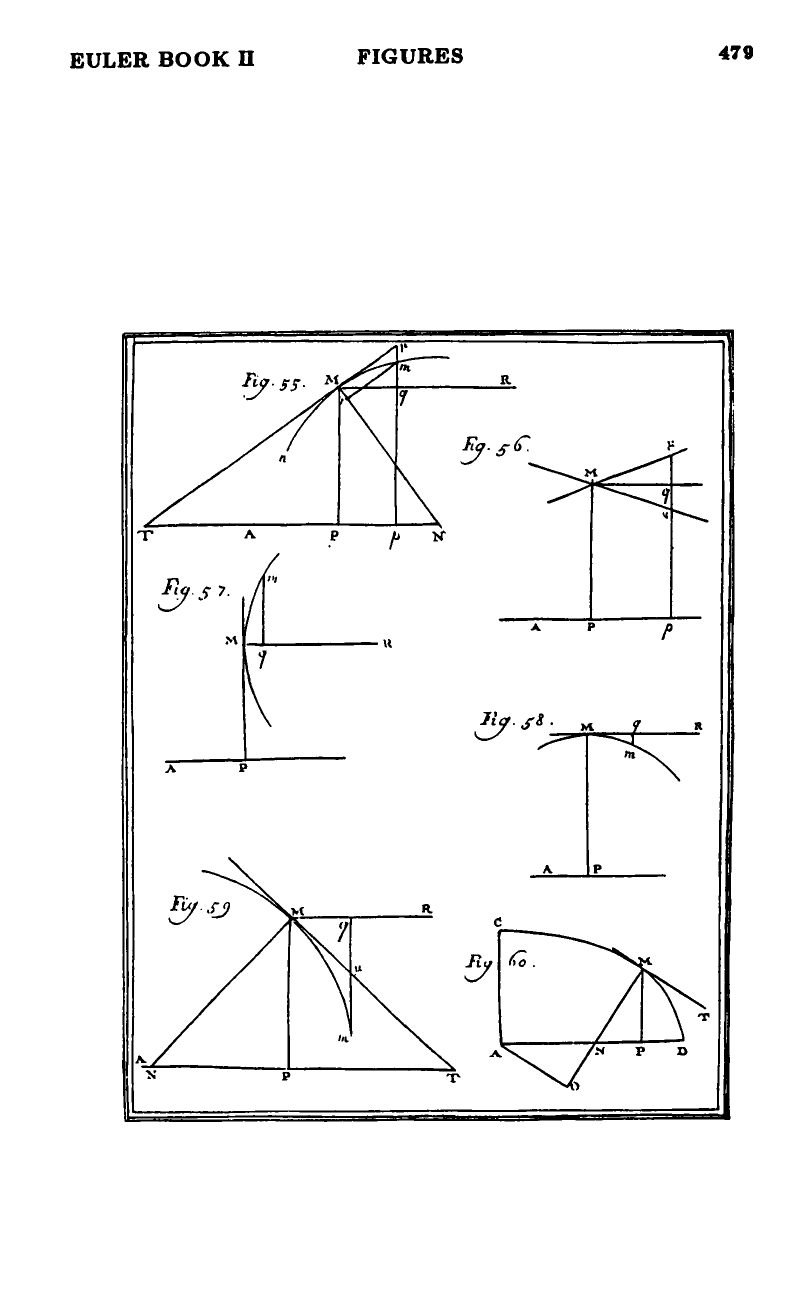 Figures 55–60
Related pages
- chapter-14-on-the-curvature-of-a-curve — chapter summary.
- osculating-circle — the unsigned formula.
- osculating-parabola — derivation that produces the same denominator.
- tangent-by-translation — origin of the special-case configurations and .
- inflection-by-vanishing-curvature — case where and the test is inconclusive at second order.