Osculating Circle
Summary: §§308–310, §318. Having found that a curve admits, at each non-singular point , an osculating parabola with latus rectum , Euler defines the curvature of the curve at to equal that of the parabola at its vertex, and replaces the parabola with the unique circle of the same curvature. Its radius — the radius of curvature — is This is the most consequential single formula of the chapter. Knowing at every point gives a complete approximate description of the curve as a chain of circular arcs.
Sources: chapter14 (§§308–310, §318).
Last updated: 2026-05-11.
From parabola to circle (§§308–309)
The osculating parabola has latus rectum
Since the curvature of a circle is uniform along its length and inversely proportional to its radius, the circle is the most convenient yardstick for curvature. Euler accordingly defines the curvature of any curve at to be the curvature of the circle that has the same curvature as the osculating parabola at the parabola’s vertex. He then derives that radius by inverting the algorithm: write down a circle of (unknown) radius , compute its osculating parabola via the §§305–307 procedure, and compare. For the circle ,
Comparison gives the conversion rule:
If a curve has an osculating parabola of equation , then it has an osculating circle of radius .
The radius of curvature formula (§310)
Combining the two steps,
This is the osculating radius (also called radius of curvedness or radius of curvature). It depends only on the coefficients of the lowest- and next-lowest-degree terms of the local expansion at ; the cubic and higher coefficients do not enter.
Direct algorithmic statement
Given a curve and a point on it, substitute , , drop the constant (it vanishes), and read off as the five coefficients of in the expansion. The osculating radius at is then .
Sign and convexity
The bare formula gives a signed radius. Euler addresses the sign separately (convexity-from-osculating-circle):
- and same sign curve concave toward (the center of the osculating circle lies on between and );
- opposite signs curve convex with respect to (the center lies on the extension of beyond ).
The unsigned radius is always .
Special cases of the formula
When the tangent direction is special, the formula collapses (convexity-from-osculating-circle §§313, 315):
| Configuration | Tangent | Osculating radius |
|---|---|---|
| (figure 57) | ordinate itself | |
| (figure 58) | parallel to the axis | |
| general (figure 55) | inclined |
Use of the osculating radius (§318)
If we know the osculating radius at every point of a curve, the nature of the curve is seen quite clearly. Indeed, if the curve is divided into miniscule arcs, each of these particles of the curve can be given as an arc of a circle whose radius is the osculating radius at that place.
This is Euler’s pre-calculus picture of a smooth curve as a chain of circular arcs glued together with continuous tangent and continuous radius — the geometric content that the modern formulation encodes as a function on the curve.
Continuous curvature and the absence of corners (§319)
Because a very small portion of the curve through coincides not only with the arc on one side but also with the arc on the other, both arcs lie on the same osculating circle. The arc thus has the same curvature as . Hence, whenever the osculating radius is finite, the curvature is uniform for at least a very small space, and there will be neither a cusp nor an inflection point at . Cusps and inflections require the osculating radius to be either zero or infinite — see inflection-by-vanishing-curvature and curvature-at-multiple-points. The general statement is the §332 trichotomy (three-genera-of-local-curvature).
Why the cubic and higher coefficients do not enter
The osculating circle is determined by three pieces of local data at : a point, a tangent direction, and a curvature. Linear coefficients pin down point and direction; quadratic coefficients pin down the curvature. Once these five are known, no further input from is needed for the osculating circle. Higher coefficients become relevant only when — that is, when the second-order data degenerates — which is the case treated in inflection-by-vanishing-curvature.
Figures
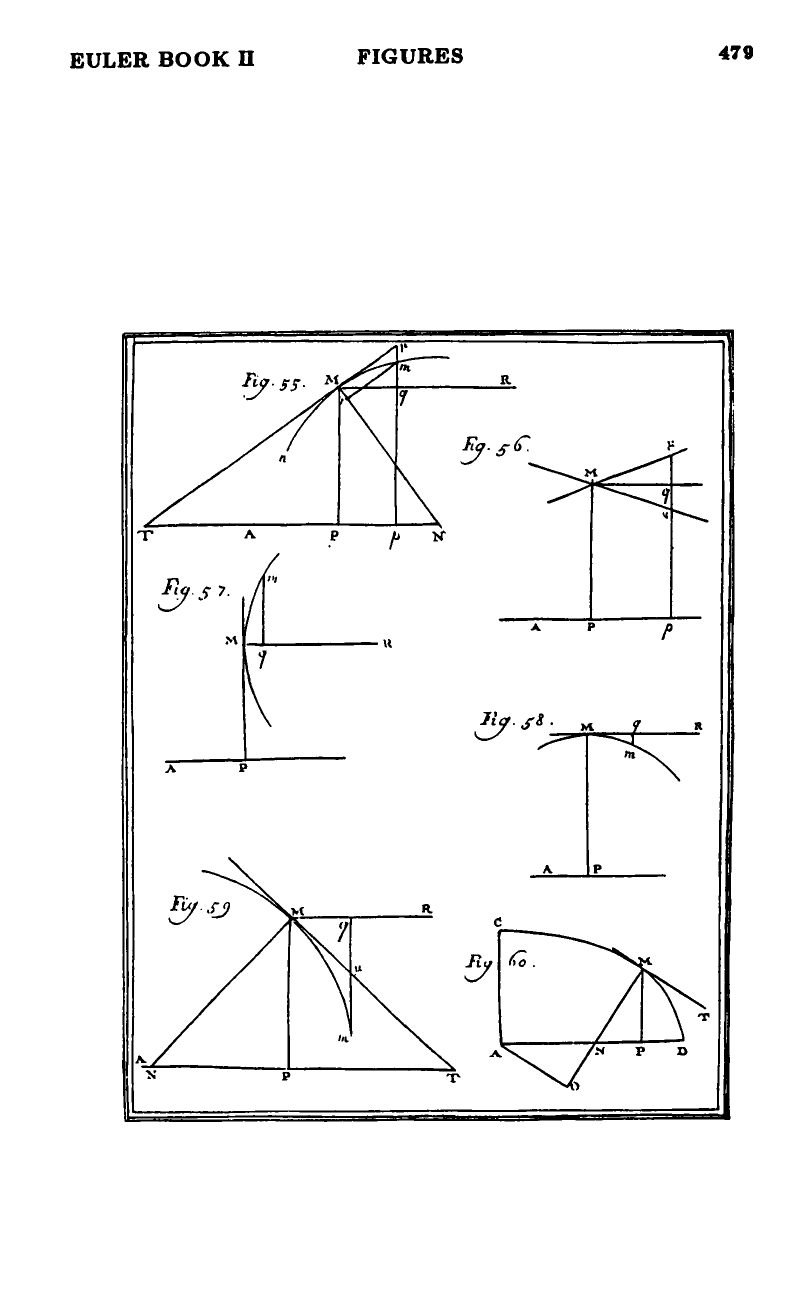 Figures 55–60
Related pages
- chapter-14-on-the-curvature-of-a-curve — chapter summary.
- osculating-curves — overall program of osculation.
- osculating-parabola — §§305–307: the second-order osculator from which the circle is derived.
- convexity-from-osculating-circle — §§311–315: signed analysis and special cases.
- osculating-radius-of-ellipse — §§316–317: worked example.
- inflection-by-vanishing-curvature — §§319–322: when , the radius is infinite and higher terms take over.
- parabola — the comparison curve used to anchor the formula.