Inflection by Vanishing Curvature
Summary: §§319–322. When the denominator of the radius-of-curvature formula vanishes, the osculating radius is infinite — the osculating circle degenerates into a straight line, and curvature alone cannot tell whether the curve has an inflection at or merely an arc with locally constant tangent direction. Euler resolves this by going to higher-order terms: in the rotated coordinates of §307, the curve satisfies , and the first non-vanishing coefficient among classifies the configuration. Odd exponent of in the leading term → inflection point (figure 61, serpentine). Even exponent → both branches on the same side of the tangent (figure 62), no inflection.
Sources: chapter14 (§§319–322). Figures 61, 62 (in figures61-67).
Last updated: 2026-05-11.
Continuous curvature requires no inflection (§319)
Recall that the local approximation in from §307 gives the same equation for both halves of the curve through — the arc on one side and on the other. Each abscissa has two corresponding ordinates, one positive and one negative. Hence both arcs have the same osculating circle and the same curvature.
Whenever the osculating radius — which equals — is finite, the curvature is uniform for at least a very small space. There will be no sudden formation of a cusp with the curve reflecting back, nor a sudden change of curvature with one portion convex with respect to and the other portion concave with respect to . — §319
Inflections — points of contrary bending in Euler’s terminology — therefore can occur only where the osculating radius is not finite.
The case of infinite radius (§320)
When , the formula yields and the osculating circle degenerates to the tangent line itself. At second order the curve appears to be straight — but the cubic and higher terms determine whether it is locally serpentine (curving one way then the other), arc-like (curving the same way on both sides), or something more exotic.
To analyze, substitute the rotation formulas
into the cubic terms as well, and (since all terms with vanish next to ) eliminate them in favor of pure powers of . The result is an expansion
valid as long as the second-order data alone vanishes. The osculating radius reads off the leading coefficient: .
The classification by leading exponent (§§321–322)
If , the radius is infinite and the leading term shifts to . The new local equation is
A negative now corresponds to a negative ; a positive to a positive . The curve has a serpentine configuration as in figure 61: the two halves of the curve swap sides of the tangent line as one passes through . Hence is a point of inflection.
If , the leading term is :
Each value of corresponds to two values of (one positive, one negative) but the abscissa cannot take both signs (it is determined positively by ). So both halves of the curve and lie on the same side of the tangent — figure 62. No inflection.
If , the leading term is and the configuration is again serpentine (figure 61): inflection.
If , the leading term is and both halves lie on the same side (figure 62): no inflection.
General rule (§322):
If the exponent on in the leading term is odd, then the curve has a point of inflection at . If the exponent is even, then the curve has no point of inflection at .
Summary table
| Leading term | Configuration | Inflection? | Figure |
|---|---|---|---|
| , | regular curvature | no | (osculating circle) |
| serpentine | yes | 61 | |
| both sides same | no | 62 | |
| serpentine | yes | 61 | |
| both sides same | no | 62 | |
| serpentine | yes | 61 | |
| both sides same | no | 62 |
Why parity is the sole criterion
Each value of near zero corresponds, via , to two values of if is even (since always so has fixed sign and both work) and to one continuous swap of sign if is odd (since takes the sign of , so positive positive and the curve crosses through the tangent). The parity of thus controls whether the local curve sits on one side of the tangent or crosses it.
Connection to the chapter-13 jet picture
The same parity-of-exponent rule appears in curvature-at-multiple-points for branches of order , where the local equation has the form . There, parity of relative to classifies inflection vs cusp at each branch. The simple-point case here is the special case .
In modern language: the leading exponent in is the order of contact of the curve with its tangent. A point of contact with even order is regular; with odd order is an inflection.
Figures
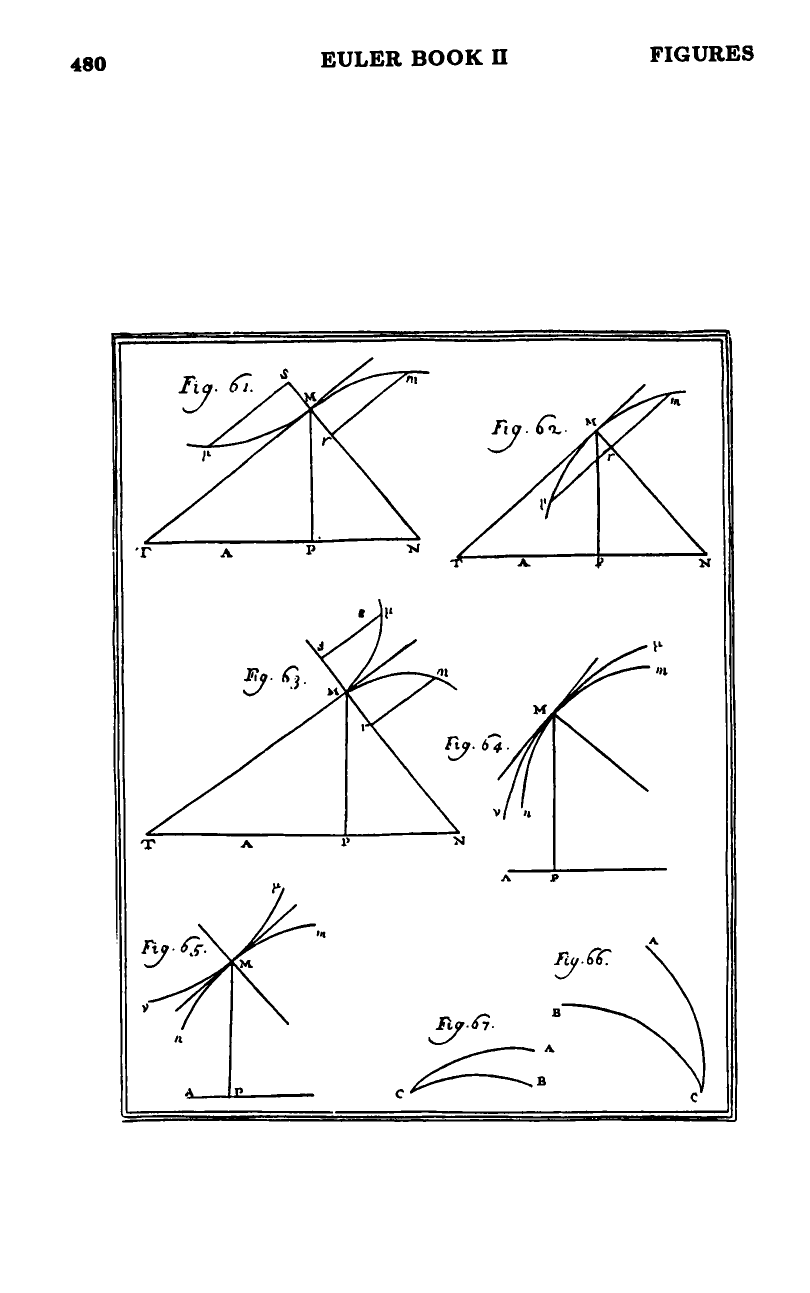 Figures 61–67
Related pages
- chapter-14-on-the-curvature-of-a-curve — chapter summary.
- osculating-circle — the formula whose denominator vanishing triggers this analysis.
- osculating-parabola — derivation of the rotation that produces the -versus- expansion.
- curvature-at-multiple-points — the parallel parity rule for branches of higher order.
- three-genera-of-local-curvature — the §332 trichotomy in which inflection is one of three possible local genera.
- singular-points-by-jet — chapter 13’s leading-jet classification of singular points.