Osculating Radius of the Ellipse
Summary: §§316–317. Worked example: the radius of curvature of the ellipse at an arbitrary point. With center , transverse semiaxis , conjugate semiaxis , and equation , Euler computes , , , , at a generic point and obtains the radius where is the normal length and is the perpendicular from the center to the tangent. The third form makes the formula symmetric between the two principal axes.
Sources: chapter14 (§§316–317). Figure 60 (in figures55-60).
Last updated: 2026-05-11.
Setup (§316)
Let the curve be the ellipse with equation , taken on the axis from the center (figure 60). Take an abscissa with corresponding ordinate , so . Substitute , :
so
Read off the local coefficients:
Tangent geometry from
The subtangent ratio gives (negative because the normal meets the axis on the other side of from the abscissa direction — a feature of the ellipse). Equivalently, , the classical Apollonian subnormal of the ellipse.
Because of the coefficients of and , the normal intersects the axis before . — §316
The discriminant denominator
Compute
Apply the ellipse equation to simplify:
This positive quantity confirms (via convexity-from-osculating-circle) that the curve is concave with respect to — as expected for the convex side of an ellipse arc.
The radius (§317)
Compute also
then
The two geometric reformulations
In terms of the normal length : from and ,
So , and
In terms of the central perpendicular : extend and drop the perpendicular from the center . By similar triangles and (right-angled at and respectively, sharing angle ), with ,
(Using .) Hence , and substituting back,
Why the form is preferred
This expression is accommodated to both of the axes, and . — §317
The form is symmetric in the two semiaxes: had Euler taken his abscissa along instead of , the same formula in would have resulted. The intermediate forms and each privilege one of the axes.
Endpoint values
- At a vertex of the major axis (, ): , . The radius equals half the latus rectum of the conic — recovering the classical fact that the osculating circle at the vertex matches the conic to fourth order.
- At a vertex of the minor axis (, ): (with swapped for in the perpendicular calculation), .
- At any point: scales as , i.e., grows as the central perpendicular shrinks — captures the obvious fact that the ellipse is “flattest” near the major-axis vertex when .
Figures
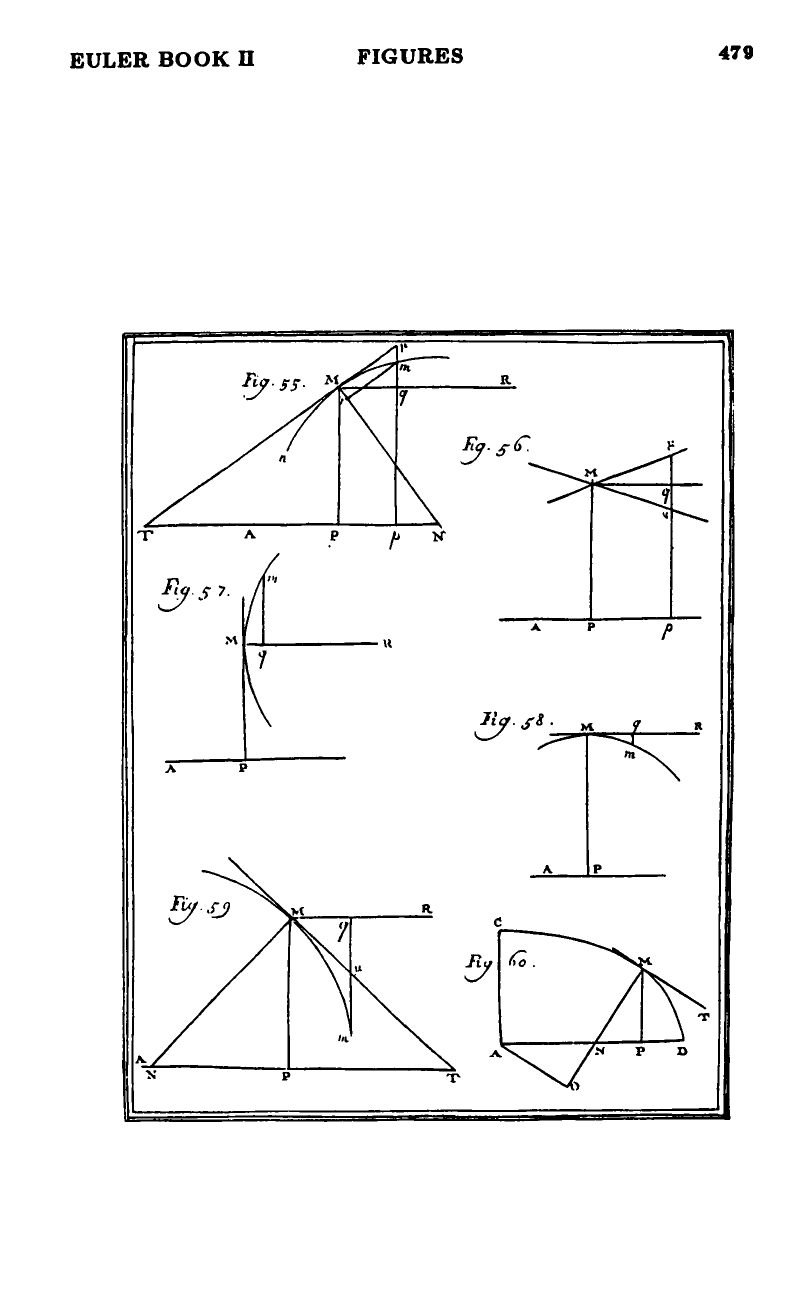 Figures 55–60
Related pages
- chapter-14-on-the-curvature-of-a-curve — chapter summary.
- osculating-circle — the general formula being applied.
- osculating-parabola — predecessor construction.
- ellipse — the underlying curve and its tangent properties.
- principal-axes-and-foci — the symmetric role of and that the -form exposes.