Osculating Parabola
Summary: §§305–307. The second-order analogue of the tangent line. After [[tangent-by-translation|translating the origin to a point ]] on the curve and rotating coordinates so that the new abscissa lies along the normal and the new ordinate is perpendicular to it, Euler keeps the quadratic terms of the local expansion and obtains the osculating equation which expresses a parabola with axis along and latus rectum . This parabola — the osculating parabola — kisses the curve at , agreeing in tangent direction and in second-order behavior.
Sources: chapter14 (§§305–307). Figure 55 (in figures55-60).
Last updated: 2026-05-11.
Setup: the local equation in (§305)
Take the equation of the curve in coordinates and pick a point with , . Substitute , as in tangent-by-translation. Since lies on the curve the constants drop and we are left with
referring to the new axis along the original -direction (figure 55). For very small the higher-degree terms are minute compared to the first two and may be neglected without error in the linear approximation.
The tangent line via (§306)
Unless both and vanish, the linear truncation defines the tangent at , with . To measure how much the curve deviates from the tangent , Euler introduces the normal as the new axis and drops a perpendicular ordinate from , with
The rotation from to is an exact rigid rotation through the angle whose tangent is , giving
Inversely,
Now since , the quantity is infinitely smaller than and , hence infinitely smaller than as well. (The argument: is expressed linearly in while is expressed by squares and higher powers.) This is the key inequality that drives all subsequent estimates.
The osculating equation (§307)
Keep terms up to second order in :
Substitute the rotation formulas for and on both sides. The left side is . On the right, expansion in powers of and gives
Because is infinitely smaller than , the terms in and vanish in relation to . We are left with
This is the equation of the osculating parabola at , in coordinates aligned with the normal and tangent at .
Geometric reading (§308)
The equation describes a parabola with axis and latus rectum ([[parabola|chapter 6’s ]] with ). Comparing,
The very short arc of the curve coincides with the vertex of this parabola. Since the parabola’s curvature at its vertex can be matched by a circle of a definite radius, Euler defines the curvature of the given curve at to be that of the osculating parabola at its vertex. This sets up the osculating circle of the next section.
Why second-order suffices
If only the linear terms are kept, all that is captured is the direction at — the tangent. To know the curve “much more accurately” near , the second-degree terms must be brought in. Together they fix not only direction but also the bending: a unique parabola tangent to at with the same second-order contact. Higher than second order would over-determine — a circle, the standard yardstick of curvature, has only one free parameter (its radius), and that single parameter is what the second-order coefficients pin down.
Worked check: a circle of radius (§309)
For the circle , set , with , then substitute , :
Read off , , , , . Then
so the osculating-parabola equation is — a parabola with latus rectum . The sign indicates the parabola opens toward , that is, with the curve concave toward . Conversely (Euler’s argument): if a curve has osculating parabola , its osculating circle has radius . The chain is consistent.
Figures
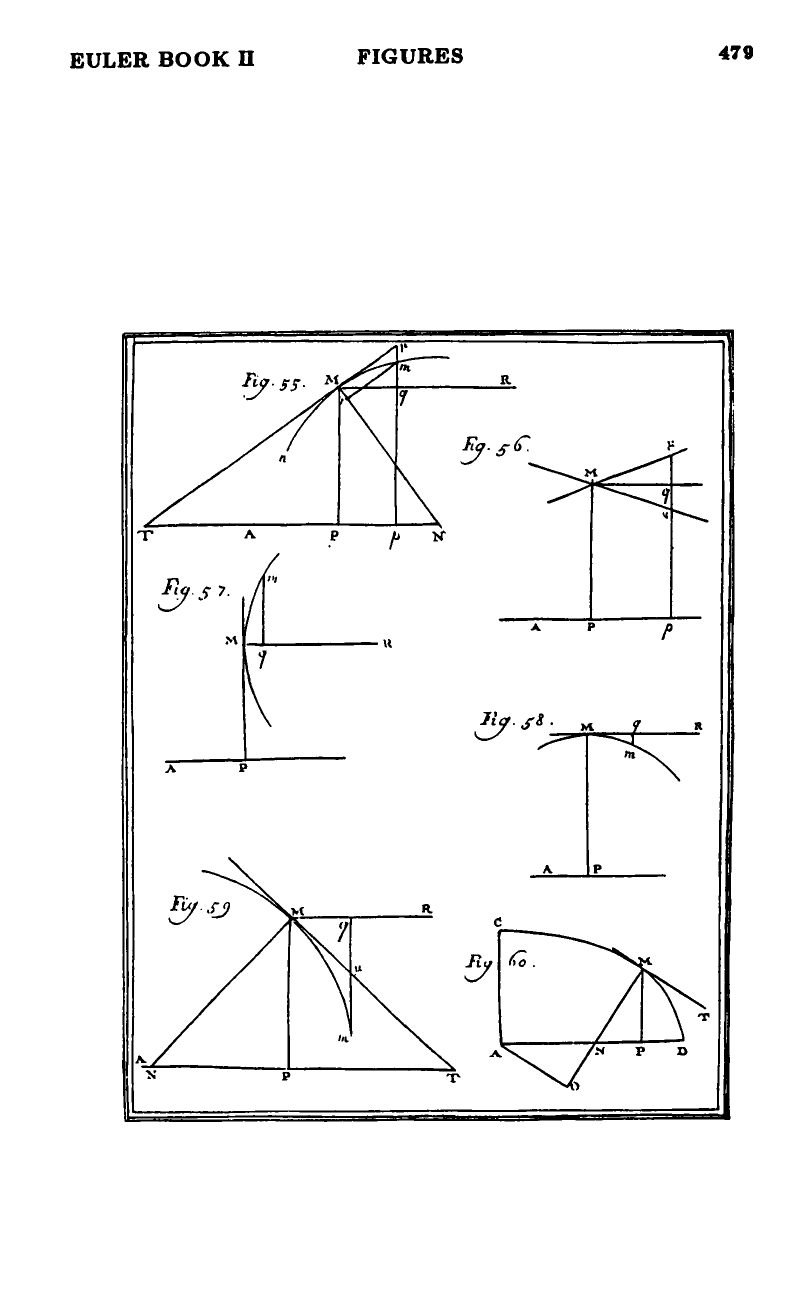 Figures 55–60
Related pages
- chapter-14-on-the-curvature-of-a-curve — chapter summary.
- osculating-curves — what “kissing” means; place of the parabola in the program.
- osculating-circle — §§308–310: replace the parabola with a circle of the same vertex-curvature.
- tangent-by-translation — the chapter-13 linear truncation that this construction extends.
- parabola — the canonical form used here for the osculating curve.
- convexity-from-osculating-circle — sign analysis of .