Hyperbola
Summary: With the centre as origin and the principal axis as -axis, the hyperbola has equation — exactly the ellipse equation with replaced by . The curve has four branches going to infinity and no real conjugate axis; the foci on the principal axis at distance from the centre satisfy for every point . The tangent at bisects the angle between the focal radii. Every other ellipse property transfers by the same substitution.
Sources: chapter6 §§153-157; figure 33 (in figures33-34)
Last updated: 2026-04-26
Set-up: centre as origin (§153)
A hyperbola has in . Translating to the centre kills the linear term, leaving . Without loss of generality (one can swap and to switch sign), take , write where , and obtain
The ordinate is imaginary for , so the curve has no points on the axis between and . For the ordinate grows continuously and reaches infinity, giving the four branches — the principal property of the hyperbola (source: chapter6, §153).
No real conjugate axis; imaginary semiaxis (§154)
Setting in gives , so the centre does not lie on the curve and there is no real conjugate axis. To preserve formal similarity with the ellipse equation, take the conjugate semiaxis to be (purely imaginary): then , so , and
This is the ellipse equation with . Every algebraic manipulation valid for the ellipse remains valid for the hyperbola under this substitution. Euler exploits the affinity throughout.
Foci and the difference-of-distances property (§§154-155)
In the ellipse the focus-centre distance is . With this becomes :
For on the curve, the focal radii are
so
The difference of focal distances is constant and equal to the principal axis — the hyperbolic counterpart of the ellipse’s (source: chapter6, §154).
Tangent and the bisected focal angle (§155)
The tangent at meets the principal axis at with (the conic tangent ratio is independent of the species). Using , one gets
The crucial proportion is and , so and
The tangent at bisects the angle between the focal radii (source: chapter6, §155). (For the ellipse the corresponding tangent bisects the external angle, since is constant; for the hyperbola, since is constant, the tangent bisects the internal angle. The reflection law in either case sends a focal ray off the curve through the other focus, with the appropriate inward/outward sign.)
The extended diameter is the oblique diameter bisecting every chord parallel to the tangent at .
Auxiliary tangent properties (§§156-157)
Drop the perpendiculars from the centre and from the foci to the tangent at . Then by direct calculation:
- — the rectangle on the focal-tangent feet equals the rectangle on .
- — the rectangle on the perpendiculars from the two foci to the tangent equals (the same identity as in the ellipse!).
- and — the segment from centre to has length .
- If is drawn from the focus parallel to the tangent meeting at , then .
Erecting perpendiculars at the vertices to meet the tangent at :
The product of the vertex-perpendicular intercepts equals — the four perpendiculars (two from foci, two from vertices) have the same constant rectangle, an invariant generalising the ellipse identity (source: chapter6, §157).
Notable points
- The substitution is a unifying device. Every ellipse property has a hyperbola counterpart obtained by this single sign change. Distances become differences ( becomes ); becomes ; the bounded curve becomes the unbounded one. This is the analytic statement of the well-known projective fact that ellipse and hyperbola are the same curve over the complex projective plane, distinguished only by the reality of intersections with the line at infinity.
- No conjugate axis on the curve. Since the centre lies between the two branches and the conjugate “axis” never meets the hyperbola, is not a length on the curve. Euler retains the symbol because controls every other quantity (semilatus rectum , focal distance , conjugate semidiameters), and because the substitution from the ellipse demands it. The geometric meaning of emerges only in the asymptote analysis of §158, where and the asymptote slope is .
- Internal vs. external angle bisection. The tangent to an ellipse bisects the external angle of the focal radii (so a billiard ball at bounces off the wall to ); the tangent to a hyperbola bisects the internal angle (so a ray toward reflects as if continuing from ). Both are consequences of differentiating along the curve.
- is universal among conics with foci. The same identity holds for the ellipse. Together with , this is the projective core of the focal apparatus, surviving the genus split.
- No infinite-axis limit yet. Unlike the parabola (which Euler obtains as the limit of the ellipse), there is no comparable degenerate limit of the hyperbola in §§153–157. The unique structural feature of the hyperbola — the asymptotic behavior — is treated separately in §§158-165.
Figures
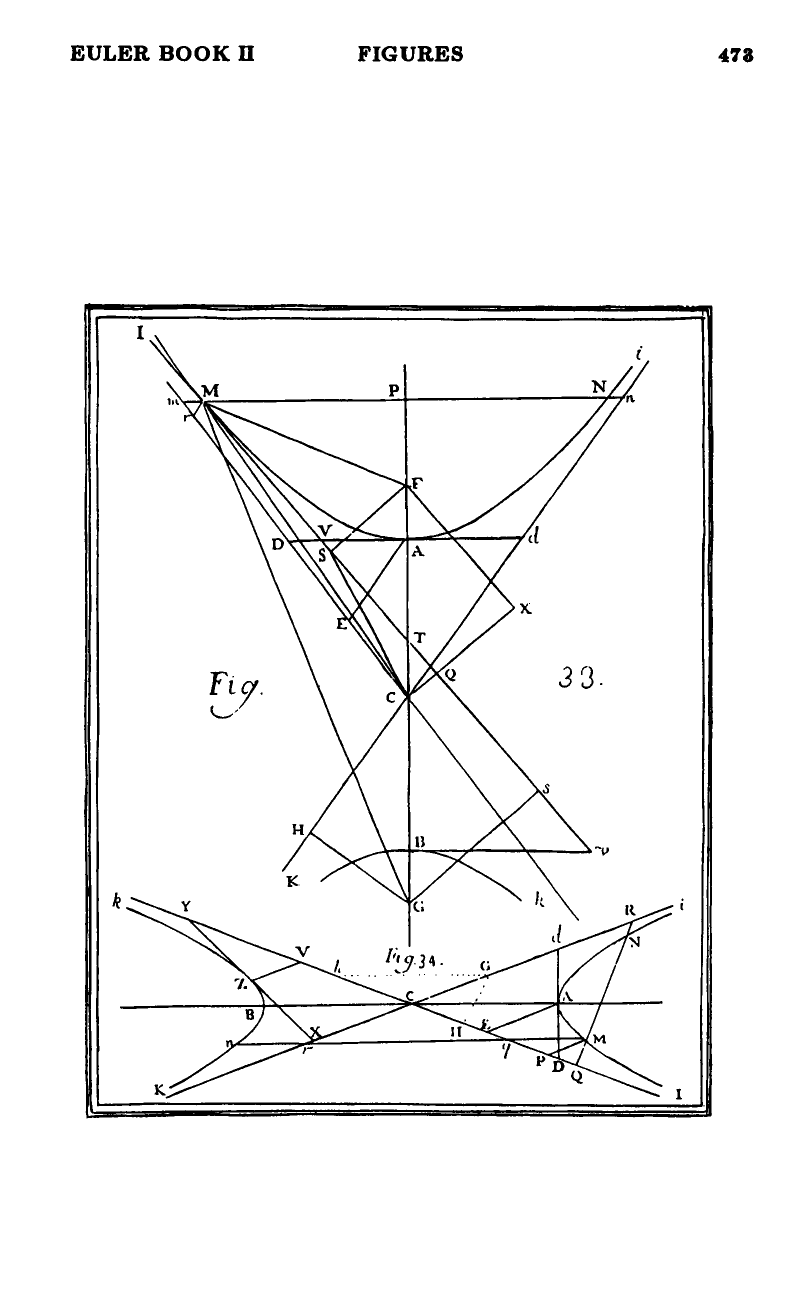 Figures 33–34