Hyperbolic and Lemniscate Spirals
Summary: §527. Two spirals related to the spiral-of-archimedes by analogy with the conic curves. The hyperbolic spiral approaches a straight-line asymptote at infinite distance — John Bernoulli’s name, after the hyperbola–asymptote relationship. The lemniscate spiral is bounded; it has the figure-eight shape tangent to two lines making angle with the axis. Drawn as figure 110.
Sources: chapter21 §527, figures109-110 (figure 110).
Last updated: 2026-05-12
Hyperbolic spiral (§527)
The equation , which is similar to an equation for the hyperbola related to its asymptotes, gives a spiral which John Bernoulli called a hyperbolic spiral. (source: chapter21, §527)
Bernoulli’s analogy: the rectangular hyperbola has asymptotes parallel to the axes; the polar relation produces a curve where:
- As , — infinitely many turns close to the axis, at infinite distance.
- As , — spirals inward to the center, never reaching it.
The asymptote. After infinitely many turns, the curve approaches a straight line as asymptote (the line in the asymptotic direction , at infinite distance). This is the polar counterpart to the hyperbola’s rectilinear asymptote.
A square-root variant
Euler also considers :
For negative angles there are no corresponding real distances . For each positive angle we obtain a pair of values for , one positive and the other negative. The curve spirals about an infinite number of times. (source: chapter21, §527)
The double-valuedness gives a paired-spiral structure: two arms emerging from the center, each spiraling outward.
Lemniscate spiral (§527, figure 110)
For , is imaginary — no real points. For , the spiral is bounded by .
If the two straight lines and make an angle equal to with the axis through the center then they will be tangent to the curve at and the curve has the form of the lemniscate . (source: chapter21, §527)
Reading figure 110: a horizontal axis with center ; two diagonal tangent lines crossed at making angle with the axis; the curve is a figure eight, both lobes passing through , tangent to the diagonals there. The full path traces .
This is the lemniscate of Bernoulli shape (though Euler’s parametrization is not the classical form).
Place in the chapter
These two spirals, together with the Archimedes spiral, illustrate the four basic algebraic-in- relations: (line), (hyperbola), (parabola-like), (ellipse-like, hence bounded). Just as the chapter-6 classification-of-conics organized by sign of , the polar quadratic in gives ellipses/parabolas/hyperbolas of spirals.
In a similar way we obtain an infinite number of other transcendental curves which it would take too long to develop. (source: chapter21, §527)
Figures
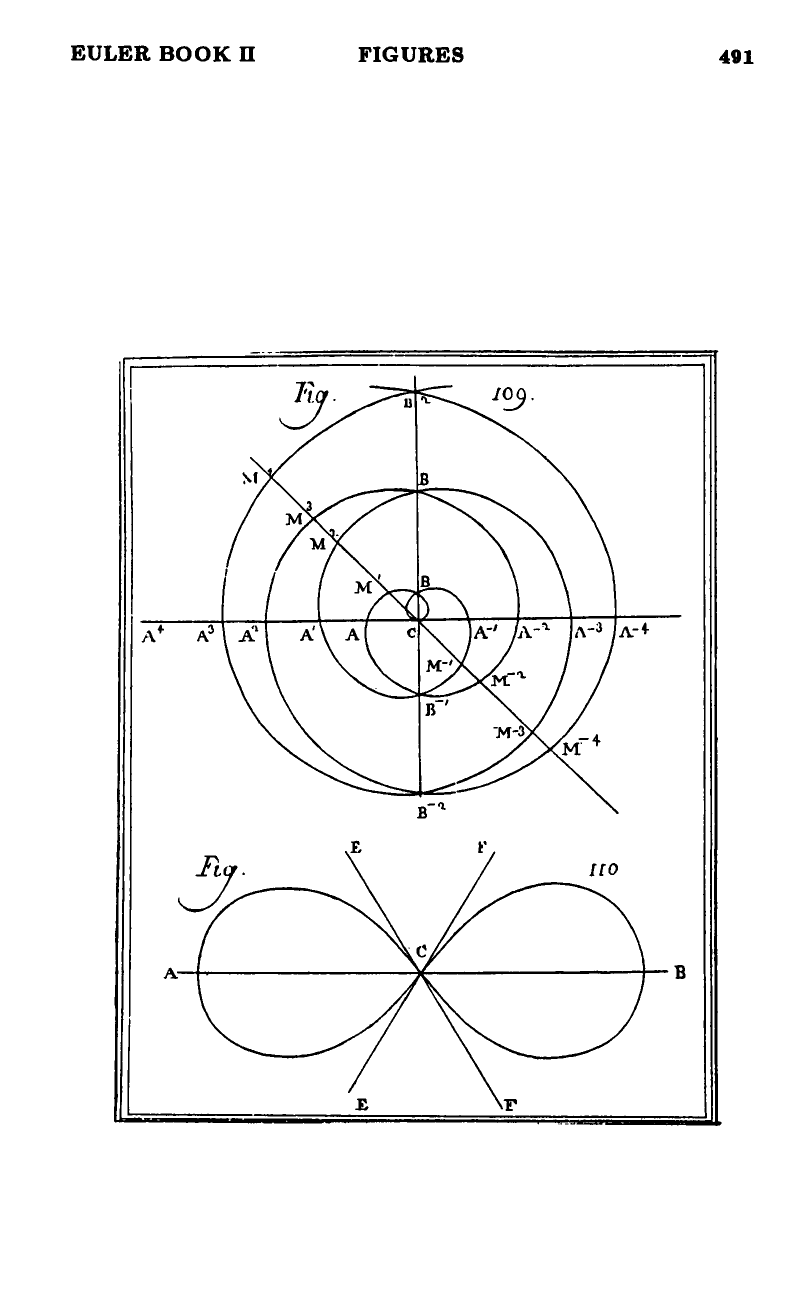 Figures 109–110
Related pages
- chapter-21-on-transcendental-curves
- spirals — general spiral setup.
- spiral-of-archimedes — the linear sibling.
- logarithmic-spiral — the transcendental-equation case.
- hyperbola — Bernoulli’s motivating analogy.
- classification-of-conics — the rectangular-coordinate parallel.