Spirals
Summary: §526. The general transcendental-curve family expressed in polar coordinates (distance from center), (angle, measured as the arc on a unit circle). Any equation in and defines a spiral. Multi-valued in the same way as the sine-line: and all represent the same position of the radius , so the line extended cuts the curve in infinitely many points.
Sources: chapter21 §526, figures106-108 (figure 108).
Last updated: 2026-05-12
Setup (§526)
A spiral is a curve expressed in polar coordinates around a fixed center :
- — distance from center to a point on the curve.
- — angle made by with a fixed axis , measured as the unit-circle arc.
Any equation in these variables defines a spiral. The same point can be described by for any integer , and (on the negated radius) by , so for any radius position there are infinitely many -values to substitute into the equation. Each substitution can give a different , so the straight line extended intersects the spiral in infinitely many points (or none, if becomes complex). This is the polar version of sine-line multi-valued-ness.
The setup figure (§526, figure 108)
Figure 108 shows the generic situation: a point on a curve at distance from the center , angle .
Relation to chapter 17
Chapter 17’s curves-from-polar-coordinates used polar coordinates to describe algebraic curves: equations rational in rationalize to polynomial in . The spirals of chapter 21 are precisely the polar curves where the equation in does not rationalize — typically because appears not just inside but as a free variable (linear, polynomial, or under a ).
The four headline examples
Euler catalogues four spirals:
| Spiral | Equation | Page |
|---|---|---|
| Archimedean | spiral-of-archimedes | |
| Hyperbolic | hyperbolic-and-lemniscate-spirals | |
| Lemniscate | hyperbolic-and-lemniscate-spirals | |
| Logarithmic | logarithmic-spiral |
The first three are “algebraic in ” (the equation between and is polynomial), but transcendental as curves because is fundamentally a transcendental function of the rectangular coordinates. The fourth is transcendental in the polar equation itself.
Place in the chapter
The spirals close chapter 21 as a fifth, distinct cluster of transcendental curves, characterized by polar formulation. Euler notes that “transcendental equations in could vastly extend this discussion” — but he singles out only the logarithmic spiral from that broader family, due to its equiangular property.
Figures
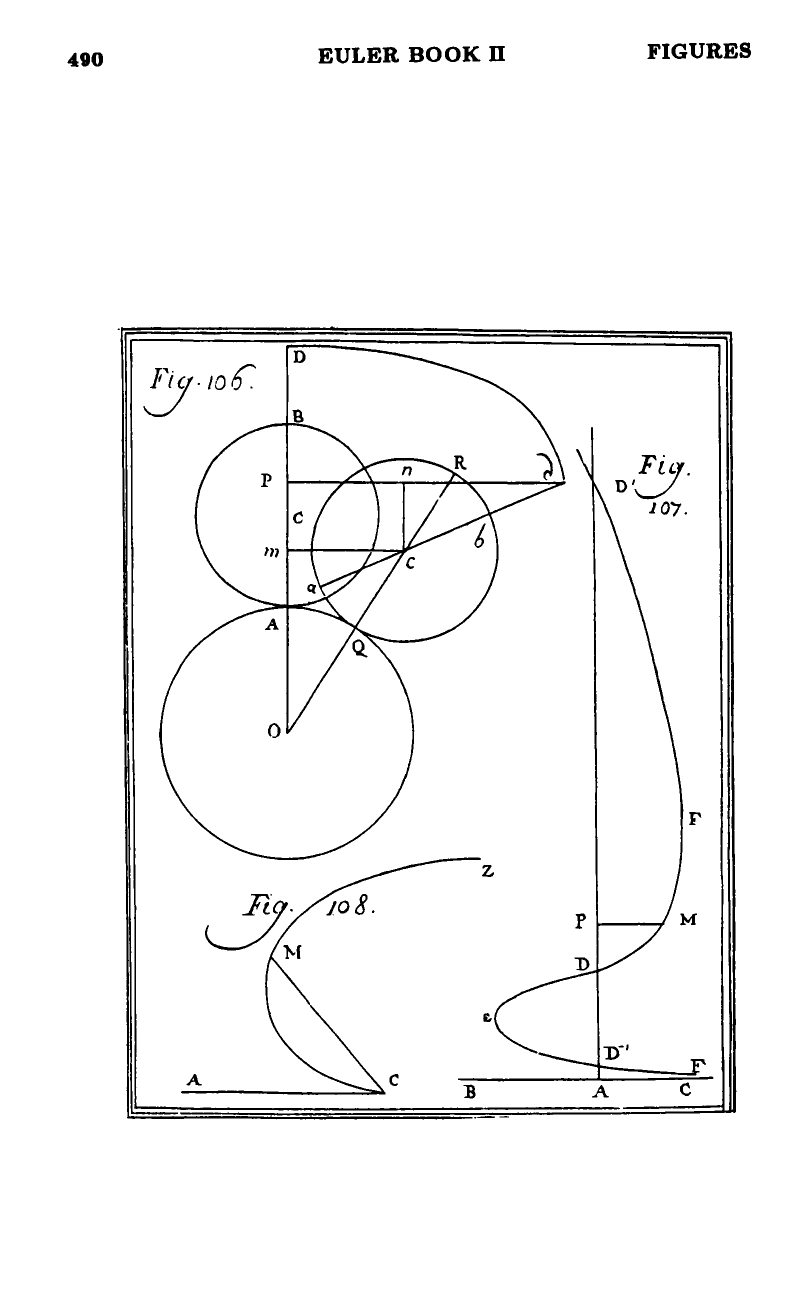 Figures 106–108
Related pages
- chapter-21-on-transcendental-curves
- spiral-of-archimedes — simplest spiral.
- hyperbolic-and-lemniscate-spirals — variants in and .
- logarithmic-spiral — equiangular spiral, transcendental in equation.
- curves-from-polar-coordinates — chapter 17 polar setup, here reused.
- transcendental-curves