Spiral of Archimedes
Summary: §526. The simplest spiral, in polar coordinates: distance proportional to angle. Tangent to the axis at ; intersects and at right angles infinitely many times as it spirals outward. is the curve’s diameter. Drawn as figure 109.
Sources: chapter21 §526, figures109-110 (figure 109).
Last updated: 2026-05-12
The equation (§526)
The distance from the center is proportional to the arc on a unit circle measuring . Just as would give a straight line in rectangular coordinates, this equation gives an infinitely-coiled spiral in polar.
Multi-valued
For a fixed direction of , the angle can be or Substituting all of these:
Each gives a point on the spiral, distinct, separated by along the same ray. Hence the spiral has infinitely many turns and meets any radius from in infinitely many points, going out to infinity.
Figure 109 features (§526)
- = center.
- = axis, tangent to the spiral at .
- = perpendicular axis.
- Spiral intersects at at distances on one side and on the other.
- Spiral intersects at at distances
- Crossing or is at right angles.
- is a diameter — the spiral is symmetric across it. (The line through perpendicular to the tangent direction.)
Discoverer
This curve is usually called by the name of its discoverer, the spiral of Archimedes. (source: chapter21, §526)
Once the equation is known, all intersections of the spiral with any straight line (through or elsewhere) become calculable: substitute the line’s polar equation and solve.
Place in the chapter
Archimedes’ spiral is to the spiral family what the straight-line-equation is to the algebraic-curve family: the simplest case, where one of the two polar variables is a linear function of the other. The §527 hyperbolic spiral is the next-simplest algebraic-in- relation, by analogy with the hyperbola.
Figures
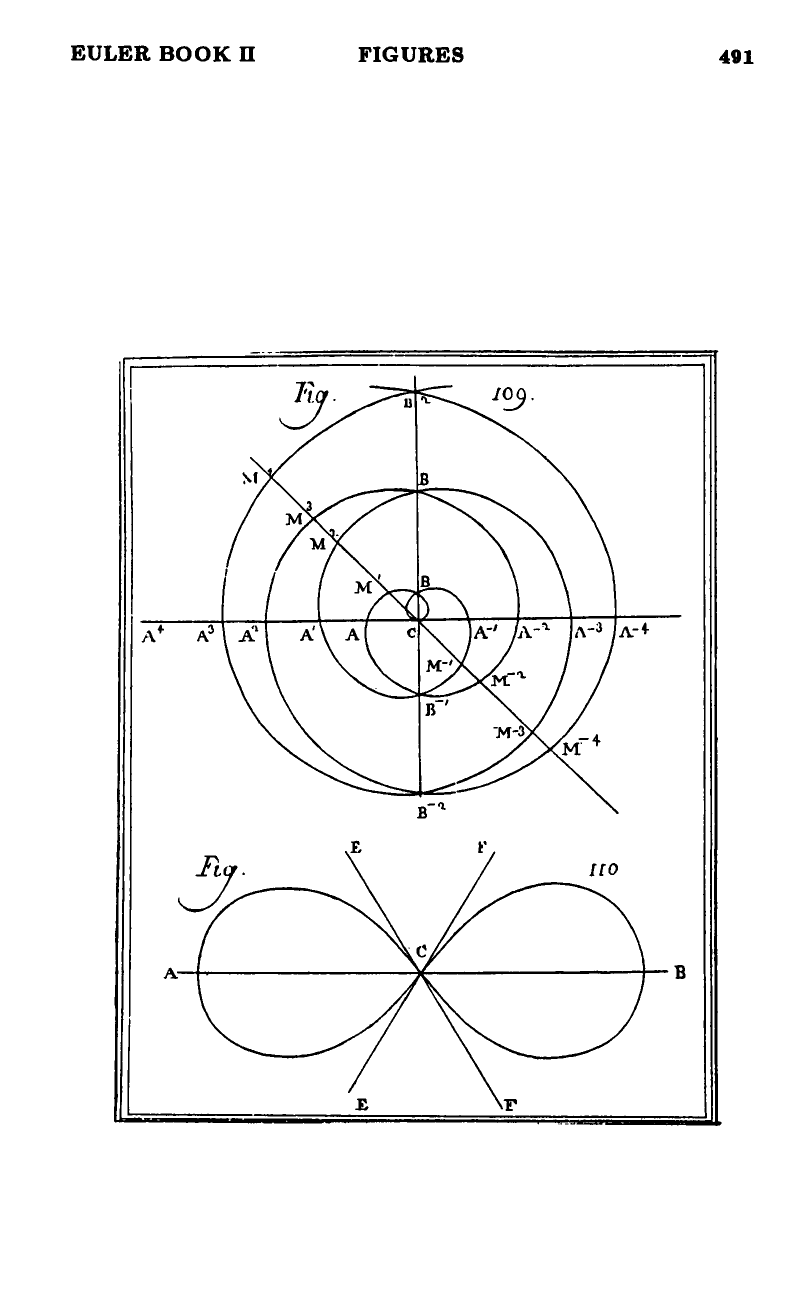 Figures 109–110
Related pages
- chapter-21-on-transcendental-curves
- spirals — overview.
- hyperbolic-and-lemniscate-spirals — sibling examples.
- logarithmic-spiral — the genus’ transcendental equation.
- curves-from-polar-coordinates — chapter 17 polar setup.
- straight-line-equation — rectangular analogue ( vs. ).