Logarithmic Spiral
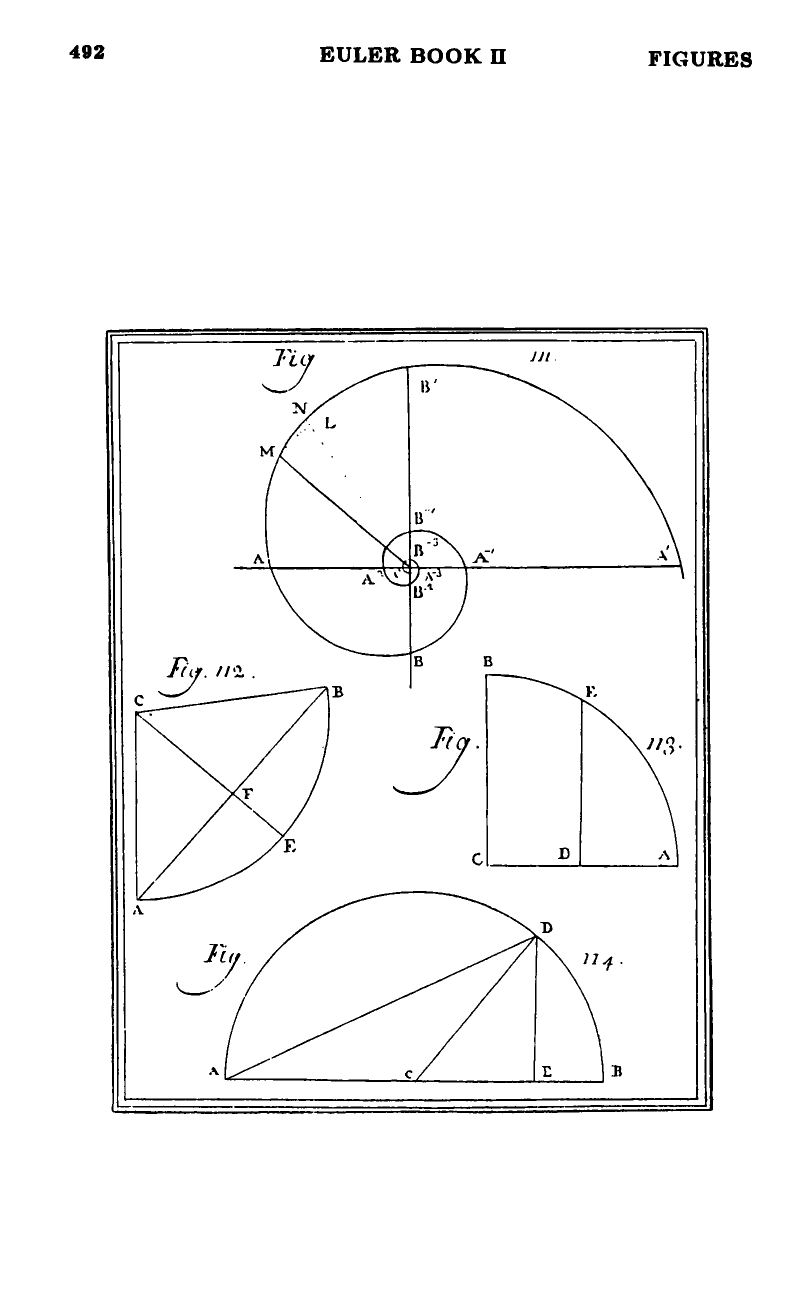
Summary: §528. The polar curve , equivalently . The single transcendental-equation spiral Euler singles out. Equiangular property: every radius from the center meets the curve at the same angle, . For the angle is (the semi-rectangular logarithmic spiral). Drawn as figure 111.
Sources: chapter21 §528, figures111-114 (figure 111).
Last updated: 2026-05-12
The equation (§528)
The polar angle is proportional to the logarithm of the radius. Equivalently, the radius grows exponentially with the angle — geometric progression of radii for arithmetic progression of angles, exactly mirroring the logarithmic-curve’s rectangular property.
The angle is proportional to the logarithm of the distance . For this reason the curve is called a logarithmic spiral and because of many important properties it is especially noteworthy. (source: chapter21, §528)
This is the only curve in §§526–528 whose polar equation is itself transcendental (the others are algebraic in , transcendental only because is). Euler singles it out for its uniqueness.
Equiangular property (§528, figure 111)
The principal property of this curve is that any straight line from the center intersects the curve in equal angles. (source: chapter21, §528)
Derivation. Take a radius at angle , and a nearby radius at angle . Then . Draw the circular arc from to the new radius, of length (since arc = radius × angle in unit-circle convention). The remaining segment from to along the radius:
Now ML/LN = \tan(\text{angle between curve and radius at L, in the limit}):
As (so converges to along the curve), the ratio tends to :
The angle is constant, independent of or . This is the equiangular (or isogonal) property.
Semi-rectangular case (§528)
If , the angle will always be half of a right angle. For this reason such a curve is called a semi-rectangular logarithmic spiral. (source: chapter21, §528)
, hence the name. This particular spiral is closely related to the curve of similar curves and to self-similar growth in nature (nautilus shell, hurricane arms, galaxy spirals).
Figure 111 features
The figure shows the spiral coiling outward from the center , indefinitely. The radii all make the same constant angle with the curve at their intersection points. mark points where the curve crosses two perpendicular reference axes through .
Why “logarithmic”
The name comes from the form : the polar angle is a logarithm of the radius. Some sources call it the equiangular spiral for the property, or the Bernoulli spiral — Jacob Bernoulli was so taken with its self-similarity under inversion that he asked for one to be carved on his tombstone (eadem mutata resurgo — “though changed I rise again the same”).
Place in the chapter
The logarithmic spiral is the closing example of Euler’s transcendental-curve catalogue. Picked out for two reasons:
- It is the only spiral in §§526–528 whose polar equation is itself transcendental (the others are algebraic in ).
- Its equiangular property — pre-calculus derivation included in §528 — is “especially noteworthy” and prefigures the differential-geometric notion of constant geodesic curvature.
Figures
 Figures 111–114
Related pages
- chapter-21-on-transcendental-curves
- spirals — general setup.
- spiral-of-archimedes — linear sibling.
- hyperbolic-and-lemniscate-spirals — algebraic-in- siblings.
- logarithmic-curve — rectangular cousin (same geometric–arithmetic correspondence in different coordinate frame).
- similar-curves — chapter 18 framework, here realized as self-similarity under dilation about .