Principal Axes, Foci, and the Latus Rectum
Summary: Among the infinitely many conjugate-diameter pairs of a conic, exactly one is orthogonal — the principal diameters or principal axes (§§125–126). With them as coordinate axes the equation reduces to , equivalently , where are the principal semidiameters; when the curve is a circle (§127). On the principal (transverse) axis there exist two distinguished points at distance from the center such that the distance from to any point on the curve is rationally expressible in — the foci or navels (§§128–129). The ordinate at the focus, , is the semilatus rectum, doubled to give the latus rectum (parameter). The focal-polar equation (with = focus-to-vertex distance, = semilatus rectum, = angle from the transverse axis) is the form Newton uses for orbital mechanics (§130).
Sources: chapter5 §§125–130, figures26-29 (figure 29)
Last updated: 2026-04-25
Existence of an orthogonal conjugate pair (§125, figure 27)
Take any conjugate pair at angle . We seek a conjugate pair that meets at a right angle — i.e., . Setting , (Euler’s notation), the orthogonality condition gives and .
From conjugate-diameters §119:
Using , and rearranging:
This is one equation in one unknown ; for any conjugate pair at any angle , it has a solution. So the orthogonal conjugate pair exists.
Furthermore the formula combined with (from §119) and (the equal-parallelogram theorem of §117), gives explicit lengths:
It follows that the two conjugate diameters are indeed orthogonal. (source: chapter5, §125)
That is, given any conjugate pair, one can compute the unique pair that is also orthogonal.
Naming and the equation (§126, figure 29)
Let and be two orthogonal semidiameters of a conic section, as in figure 29. These are usually called the PRINCIPAL DIAMETERS, and they meet at the center in a right angle. (source: chapter5, §126)
Take them as the coordinate axes, with , . The center-form equation (from center-of-conic §110) specializes to: at , , so , giving ; and at , gives , so , giving .
Symmetry: the equation is unchanged under and , so the conic has four congruent quadrants — symmetric across each principal axis.
Circle as a special case (§127)
If , or , then . In this case all straight lines which join the center to the curve are equal to each other. This is the property of a circle. (source: chapter5, §127)
When the two principal semidiameters are equal, every diameter is its own conjugate, every diameter is principal, and every radius equals . The equation collapses to — the circle.
So a circle is a conic for which the center-form equation in any coordinate frame has with the same constant, i.e., its conjugate pairs are all equal-length and orthogonal — collapsed.
Foci (navels) and the rationality miracle (§128)
For , the distance from the center to a point on the curve, , is not rational in in general — the radical does not simplify.
But there is a translation that makes it work. Pick a point on the principal axis at distance from the center (with sign). The distance from to is
For this to be a perfect square in (to make rational), we need which matches if , simplifying to , i.e., , so
Two such points exist on the principal axis, at distance from the center. From either of them, is rational in :
The vertices, latus rectum, semiparameter (§129)
Due to the special properties which these points possess, these points on the principal diameter are worthy of the most careful attention. They have many other outstanding properties and for this reason they have been given particular names. They are called either the FOCI or the NAVELS of the conic section. (source: chapter5, §129)
Names introduced in §129:
- The principal diameter on which the foci lie is the principal or transverse axis.
- The orthogonal principal diameter is the conjugate axis.
- The chord through a focus perpendicular to the transverse axis has length . This is called the parameter or latus rectum.
- — half this chord — is the semilatus rectum or semiparameter.
- The conjugate semiaxis is the geometric mean of the semiparameter and the transverse semiaxis :
- The endpoints of the transverse axis on the curve are the vertices. The tangent at a vertex is perpendicular to the principal axis (a corollary of the §111 tangent-at-diameter-endpoint rule, applied to orthogonal conjugates).
When , the formula gives
The focal polar equation (§130)
Take the focus as origin and the principal axis as the polar axis. With = focus-to-nearest-vertex distance, = semilatus rectum, then and — the conic is determined by .
Setting , the formula from §128 in terms of becomes
If now (angle from the principal axis to the focal radius), then , so
This is the conic in focal polar form. Expanding:
- Ellipse (, equivalently → bounded curve): and varies in — denominator always positive — bounded.
- Parabola (, the focus-to-vertex distance equals the semilatus rectum): denominator becomes — — a circle? No, the limiting case where the constant term swamps, but actually here the formula degenerates and one returns to a different parametrization. (Chapter 7 will address the parabolic case separately.)
- Hyperbola (): — the denominator can vanish at , which is where the curve recedes to infinity along the asymptote.
. (source: chapter5, §130)
This is the equation that — almost word-for-word — appears in Newton’s Principia as the description of an orbit. With as the gravitating body’s location, as the true anomaly, and the ratio acting as the eccentricity, this is the orbit equation of Keplerian dynamics.
Why exactly two foci
The condition has two solutions , one on each side of the center along the transverse axis. Both produce rational in . The conic is symmetric about the conjugate axis (because the equation is even in ), so the two foci play symmetric roles — geometric reflections of each other.
When (circle), — both foci coincide with the center. This is consistent: in the circle, itself is rational in (in fact constant), so the center is the focus.
When (ellipse oriented differently — but Euler defines as the transverse semiaxis, by convention the longer one for ellipses), the formula does not produce real foci on this axis; the foci lie on the other axis instead, with .
Summary of intrinsic invariants
By the end of chapter 5, Euler has assembled the full invariant data of a (centered) conic, all derivable from the equation alone:
- Center (center-of-conic) — a single point through which all diameters pass.
- Conjugate pairs (conjugate-diameters) — infinitely many; each generates a parallelogram of fixed area and conjugate-sum-of-squares .
- Principal axes — the unique orthogonal conjugate pair; lengths and .
- Foci — two distinguished points on the principal axis at distance from the center.
- Semiparameter / latus rectum — at each focus.
- Eccentricity (implicit in §130) — .
- Focal polar equation — , the form Newton uses.
What chapter 6 will do with these
Chapter 6 splits the case-analysis by the discriminant of the original general equation, which (after going to center coordinates) reduces to the sign of in :
- : ellipse (closed; both real principal semidiameters; foci on the longer principal axis).
- : parabola (no center; the analysis above degenerates; chapter 7 will rebuild).
- : hyperbola (axis-semidiameter imaginary; two branches; foci between the branches).
The principal-axes / focus / latus-rectum framework of §§125–130 carries over to ellipse and hyperbola unchanged; the parabola is the limiting case where the center recedes to infinity.
Figures
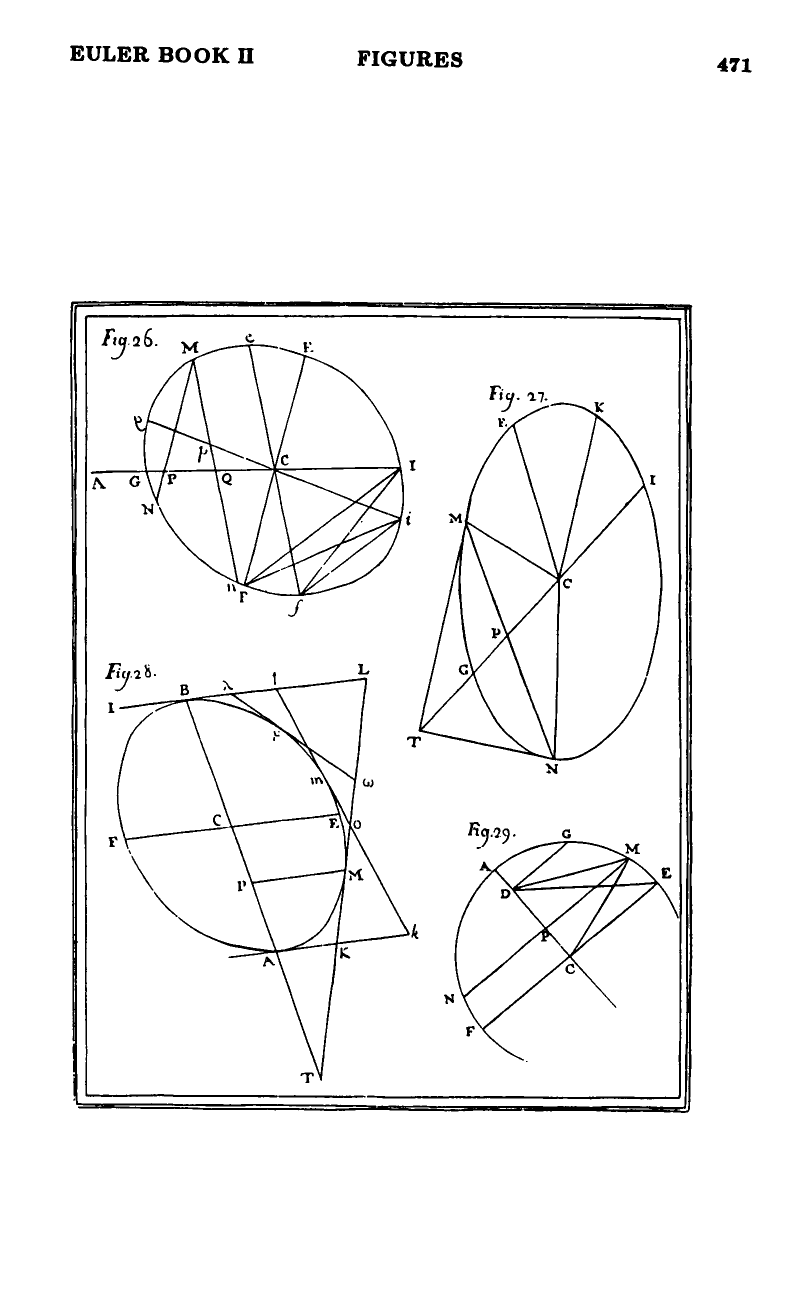 Figures 26–29
Related pages
- chapter-5-on-second-order-lines
- conjugate-diameters — the orthogonal pair is one conjugate pair among many; existence in §125 follows from the conjugate-pair calculus
- center-of-conic — the center is the origin of the principal-axis frame
- chord-rectangle-property — the rectangle ratio at the principal axes becomes
- tangent-properties-conic — Newton uses these focal/principal properties together with for the Principia
- diameter-of-conic