Abscissa and Ordinate
Summary: The basic coordinate apparatus of Book II. The variable is represented by an interval (the abscissa) cut off along a fixed line (the axis or directrix) from a chosen origin ; the value of a function of is represented by a perpendicular (the ordinate) erected at . The pair, when the ordinate is perpendicular to the axis, are the orthogonal coordinates.
Sources: chapter1
Last updated: 2026-04-24
From variable to interval (§§1–3)
A variable quantity is “a magnitude considered in general, and for this reason, it contains all determined quantities” (source: chapter1, §1). Euler represents such a magnitude by a straight line of indefinite length, with a chosen point on it. A determined value of is then an interval beginning at :
- represents ;
- to the right of represents positive , with farther-right meaning greater;
- to the left of represents negative .
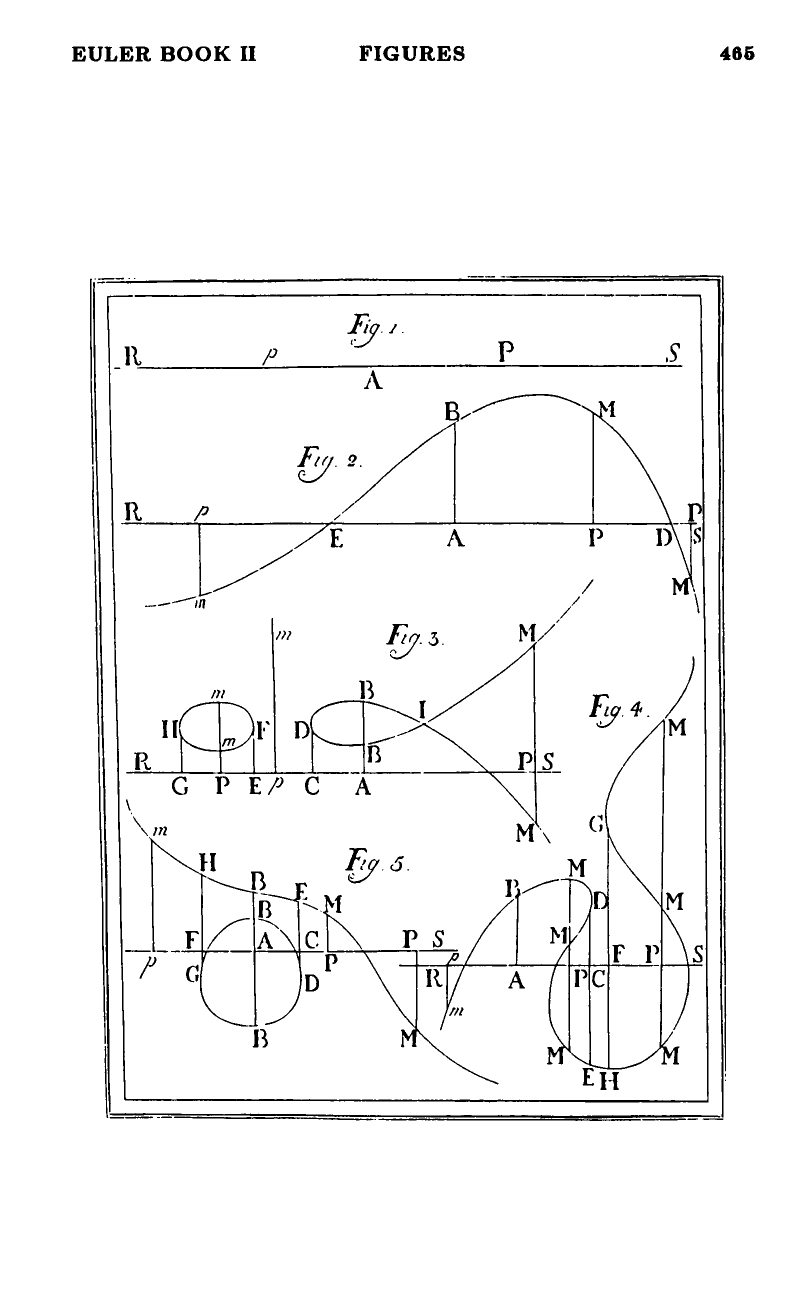
The choice of which direction is positive is arbitrary, but once chosen the opposite direction represents negative values (source: chapter1, §3). See figure 1.
From function to perpendicular (§§4–6)
Given a function of , at each determined abscissa the corresponding ordinate is erected perpendicular to the axis — above the axis when , below when , and coincident with the axis (i.e., lies on ) when (source: chapter1, §4). As sweeps along the axis, the locus of extremities is a line — straight or curved — called the curve of the function. “Thus any function of is translated into geometry and determines a line” (source: chapter1, §6).
Conversely, each point on the curve projects orthogonally to a unique on the axis, and so the curve is fully known once the function is known (source: chapter1, §7).
Standard vocabulary (§11)
Euler fixes the following terms, in use throughout Book II:
- axis or directrix: the line along which is measured;
- origin of the abscissas: the point from which is measured;
- abscissa: the directed interval representing a determined value of ;
- ordinate: the perpendicular representing the corresponding value of the function ;
- orthogonal ordinate: the case when ; otherwise oblique ordinate.
“We will always explain the nature of curves with orthogonal ordinates unless we expressly indicate the contrary” (source: chapter1, §11).
Orthogonal coordinates and the equation of a curve (§§12–14)
When the ordinate is orthogonal, the pair is called the orthogonal coordinates (source: chapter1, §14). The curve is then defined in either of two equivalent ways:
- explicitly, by giving as a function of , or
- implicitly, by an equation in and from which is determined by .
Positive abscissas lie on the part of the axis, negative on ; positive ordinates above, negative below (source: chapter1, §12). To trace a curve from a given function, Euler (§13) sweeps from to to build one part of the curve ( in figure 2), then from to for the other ().
Relation to later chapters
This page pins down the vocabulary and reference frame; every subsequent chapter of Book II assumes it. The classification of curves by the kind of function is developed in algebraic-and-transcendental-curves and continuous-and-discontinuous-curves; the case where is not single-valued in is developed in multi-valued-curves.
Figures
 Figures 1–5