Multi-valued Curves
Summary: When is defined implicitly by a polynomial equation of degree in with single-valued coefficients in , each abscissa gives up to ordinates. Euler works through the two-, three-, and four-valued cases (figures 3–6) and derives a parity principle: the number of real ordinates per abscissa is either , , , … — so the parity of intersections is the same for every ordinate.
Sources: chapter1
Last updated: 2026-04-24
Set-up (§16)
A single-valued case: with a single-valued function of . Each abscissa gives one ordinate, so every vertical line cuts the curve in one point . Figure 2 illustrates: the curve extends without interruption alongside the axis.
Two-valued curves (§§17–18)
Let satisfy , i.e.
For each abscissa :
- If : two real ordinates , on either side of .
- If : no real ordinate; no point on the curve at this abscissa (see the region near in figure 3).
- If : the two ordinates coalesce; . Geometrically the curve “bends back” — points , , , , , , in figures 3 are the boundary locations between real-ordinate regions and complex-ordinate regions.
The two-valued curve may consist of visibly separated pieces (e.g., and in figure 3) but is one curve: “these parts taken together are to be considered as one continuous or regular curve, since all the different parts come from a single function” (source: chapter1, §18). Every ordinate cuts the whole curve in 0 or 2 points, except at the coalescence locations , , , where it meets the curve in a single point (tangent from above).
Three- and four-valued curves (§§19–20)
If satisfies (single-valued ), each abscissa gives 3 real ordinates or 1 (the complex roots come in pairs). Since the count is always at least 1, the curve necessarily extends indefinitely in both directions with the axis. It may be one connected branch (figure 4) or split into multiple pieces (figure 5).
If satisfies , each abscissa gives 4, 2, or 0 real ordinates (figure 6). The 0-case is possible, so the curve need not extend to infinity on both sides — a purely closed component is possible, enclosing a finite area (source: chapter1, §20).
The parity principle (§21)
Let be the largest power of in the defining equation (with single-valued coefficients in ). For any given abscissa, the number of real ordinates is
never or . In particular, the parity of the intersection count of a vertical line with the curve is independent of : if one ordinate meets the curve in an even number of points, every ordinate does; if one meets it in an odd number, every ordinate does (source: chapter1, §21).
Consequence for branches at infinity (§22)
If some ordinate cuts the curve in an odd number of points, then no ordinate can miss the curve. Hence the curve has at least one branch extending indefinitely in each direction of the axis, and the number of branches going to (respectively ) must itself be odd. If one ordinate cuts the curve evenly, then on each side the branch count is even (possibly zero). In every case the total number of branches extending indefinitely, summed over both directions, is even (source: chapter1, §22).
Relation to Book I
This is the geometric face of Book I, chapter 1’s single-valued-and-multi-valued functions. The algebraic content — the degree- polynomial equation in with single-valued coefficients — is the same; Book II adds the picture (intersections of vertical lines with the curve) and extracts the parity theorem from the algebraic fact that complex roots of a real polynomial come in conjugate pairs.
Figures
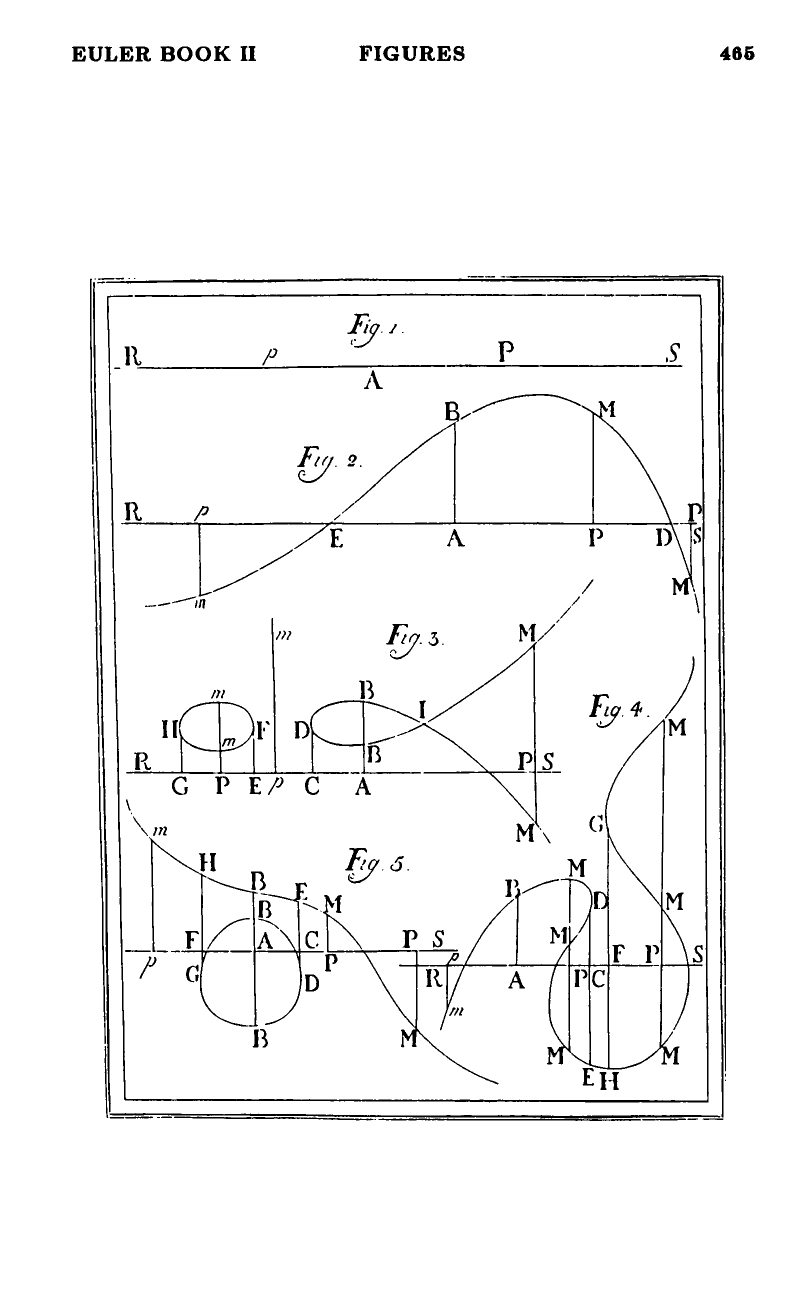 Figures 1–5
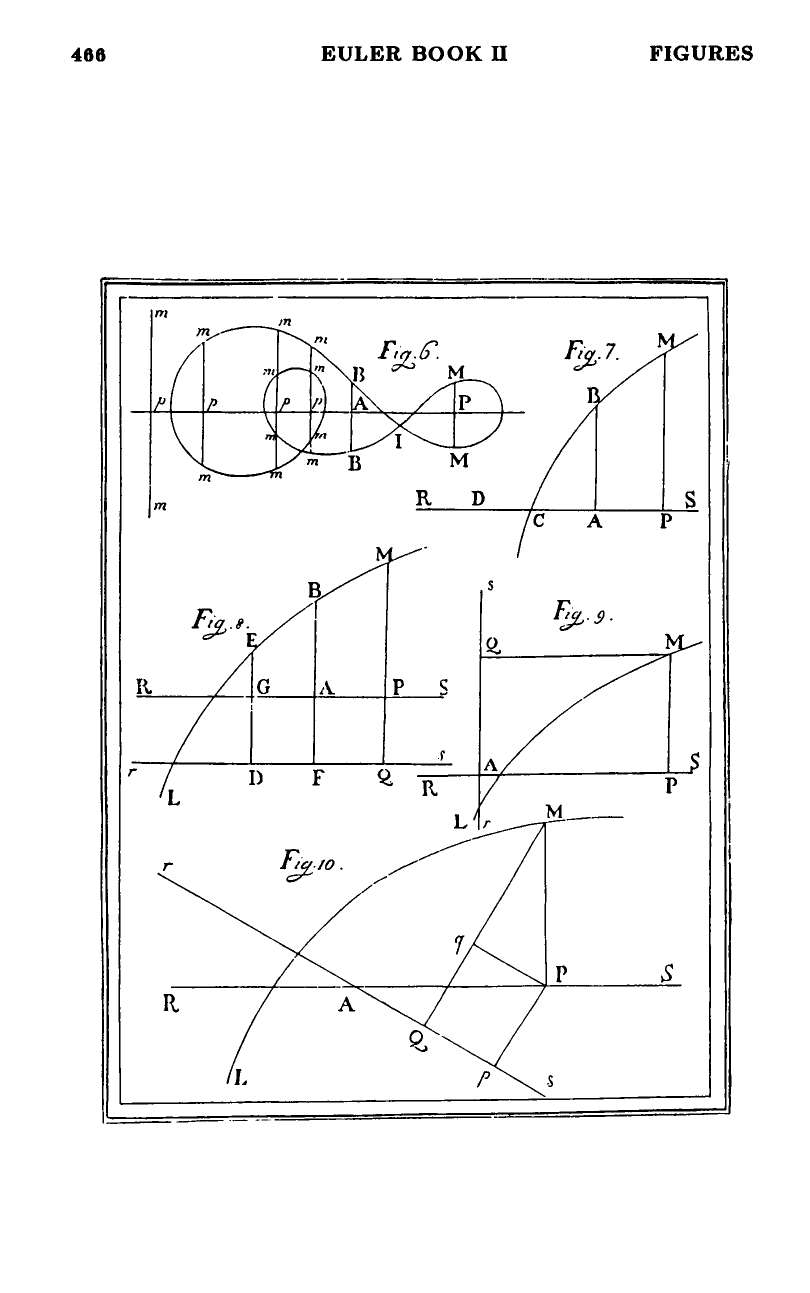 Figures 6–10