Three Genera of Local Curvature
Summary: §§332–335. Euler’s classification claim: every local phenomenon on an algebraic curve falls into one of three genera. (1) Continuous curvature with no inflection and no cusp: osculating radius finite. (2) Inflection point: osculating radius infinitely large or infinitely small, with odd-exponent leading term. (3) Cusp (or reflex point): osculating radius infinitely large or infinitely small, with even-exponent leading term, two branches mutually tangent. Two configurations are not possible: a finite-angle corner like figure 66, and a “smooth-cusp” like figure 67 where two branches with a common tangent are one concave and one convex. The latter prohibition leads Euler into a discussion of L’Hospital’s “cusps of the second species” and the subtle question of what counts as a continuation of an arc.
Sources: chapter14 (§§332–335). Figures 63, 64, 66, 67 (in figures61-67).
Last updated: 2026-05-11.
The classification (§332)
Three local phenomena exhaust the possibilities:
| Genus | Local equation | Osculating radius | Configuration |
|---|---|---|---|
| 1. Continuous curvature | in general with leading | finite (or harmlessly at isolated points where curvature is constant) | smooth arc, no inflection, no cusp |
| 2. Inflection point | , and both odd, | infinitely large (if ) or infinitely small (if ) | curve crosses through its tangent (figure 61) |
| 3. Cusp (reflex point) | , even, odd | infinitely small or infinitely large | two branches concave to each other, meeting tangentially at (figure 63) |
(Genus 1 includes the special arcs where is odd, is even, — both branches lie on the same side of the tangent without an inflection: figure 62.)
What is not possible (§333)
Two configurations Euler explicitly rules out:
Figure 66 — a curve with a finite-angle corner at where is a definite non-zero angle. There is no algebraic local form that produces this: the lowest-jet classification (singular-points-by-jet, curvature-at-multiple-points) generates only smooth arcs, inflections, cusps, and crossings — never a kink.
Figure 67 — two arcs and meeting at with a common tangent there, but with concave and convex toward the same side. Euler argues that algebraic curves cannot generate this either: at a cusp the two branches must preserve the same convexity (be concave toward each other), as Case I of curvature-at-multiple-points (figure 63) shows.
If a curve is given completely in accord with an equation, then there may be a configuration like that given in figure 64. There are methods of describing curves according to which cusps arise, and these have been called cusps of the second species by L’HOPITAL. — §333
Cusps of the second species (§§333–335)
A cusp of the second species is a configuration where two branches meet at a common point with a common tangent, on the same side of the tangent, but with one concave and the other convex with respect to that side — exactly the figure-67 picture. L’Hospital had named these and Euler had been understood to deny their algebraic existence. He now corrects himself.
In spite of these arguments which would seem to discredit the existence of a cusp of the second species, there are innumerable algebraic curves endowed with such cusps. Among these is one which is even a line of the fourth order, contained in the equation which results from the formula . Although the first term is , the sign is not ambiguous; it is necessarily positive. — §333
The example: and are two branches sharing the common tangent direction at the origin. Both are real for . Their difference goes to zero faster than the leading term, so they meet tangentially at . Squaring the formula gives , then squaring again , expanding gives the printed equation. The first is necessarily positive: assigning a negative sign would make the second term complex, contradicting the algebraic real branch. Hence both branches are on the same (positive) side of the tangent, and one bends concavely and the other convexly relative to it.
The “continuation” question (§§334–335)
Why does Euler’s three-genus classification miss the second-species cusp? Because the classification implicitly assumes that, when two branches meet at with a common tangent and are described by different algebraic equations, each pair of arcs separated by (one to the left, one to the right) is a continuation of the corresponding arc on the other side. With two branches , , , emanating from as in figure 64:
- If and come from one branch’s equation and and from another’s, there is no doubt that continues to and to .
- If both pairs come from the same algebraic equation, then may equally well be considered the continuation of rather than . We can pair them differently — and now continues to , with two cusps of the second species and at the same point.
This phenomenon can occur not only when two branches without a point of inflection have a common tangent at and are expressed by the same equation, but the same idea of continuity applies no matter what the genus might be of the two branches which are mutually tangent at , provided that they are both expressed by the same equation. This occurs whenever the equation in and reduces to the form . In that case both branches are expressed by the same equation . — §335
So the second-species cusp is real and algebraic, but it is a feature of how arcs are paired into continuous curves, not a feature of the curve as a set of points. Mechanical descriptions (drawing devices, parametrizations) often produce only one pair of arcs, so they may yield a second-species-cusp picture even when the underlying algebraic equation contains both pairs.
Summary
The three-genus classification is correct as a classification of curve-shapes-as-point-sets. Cusps of the second species are not new shapes — they are the figure-64 (or figure-65) shape of two tangentially meeting branches read with a different choice of which arc continues which. The L’Hospital nomenclature persists in mechanical and parametric contexts.
Figures
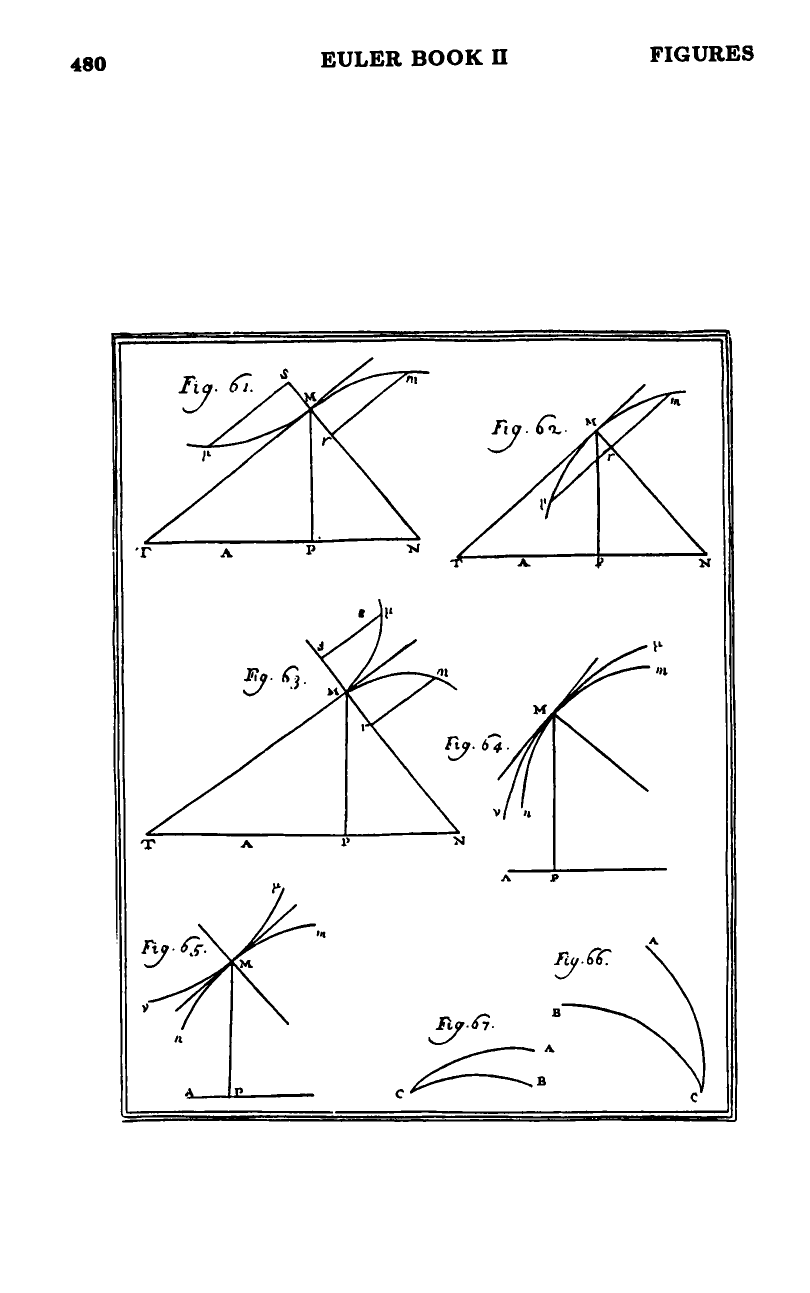 Figures 61–67
Related pages
- chapter-14-on-the-curvature-of-a-curve — chapter summary.
- curvature-at-multiple-points — Case I (cusps with infinitesimal radius) and Case II (tangentially meeting arcs) of the local zoo.
- inflection-by-vanishing-curvature — how inflection arises in genus 2.
- osculating-circle — when the radius is finite (genus 1).
- singular-points-by-jet — chapter-13 jet classification consistent with this trichotomy.
- multiple-points-on-curves — chapter-12’s discriminant view of the same singularities.