Curvature at Multiple Points
Summary: §§323–331. The §305 derivation of the osculating parabola assumes a simple point: and not both zero. When — the case of a multiple point, figure 56 — Euler treats each branch through separately. For a double point, each branch reduces to a leading equation and the simple-point analysis applies branch-by-branch. When two or more branches share the same tangent, the leading equation is with . The branch is then of order , and the relation between and classifies the local picture into a small zoo: cusps (figure 63), pairs of internally or externally tangent circular arcs (figures 64, 65), and higher-order analogues.
Sources: chapter14 (§§323–331). Figures 56, 63, 64, 65 (in figures55-60, figures61-67).
Last updated: 2026-05-11.
Branch-by-branch reduction (§§323–324)
If both and , the curve has two or more branches intersecting at (figure 56), as treated in chapter 13’s jet analysis. Suppose is the equation of the tangent of one of the branches. Look for the equation of that branch in the rotated coordinates where is taken on the normal to that tangent. As before is infinitely small compared to . With
substitute into the local equation and eliminate the infinitesimal terms. For a double point this gives
dividing by :
For a triple point the analogous reduction gives , so — same leading shape. In every case where the branch has its own distinct tangent, the reduced single-branch equation is
identical in form to the simple-point case. The osculating radius of this branch at is , and the leading-exponent parity rule decides inflection vs no inflection.
In this way we judge individually each branch passing through the point , provided each such branch has a different tangent. — §324
When two branches share a tangent (§325)
If two or more branches have the same tangent at , both and vanish and the second-degree form has two equal factors. Suppose . Change to coordinates as above. We obtain an equation of the form
Terms in which has degree vanish next to , but terms with one and many also vanish next to when slowly enough — Euler keeps only the dominant ones case by case.
Case I: — cusp (§326, figure 63)
If the term is present, it dominates all the others, so the leading balance is
Then . The osculating radius of each branch at is . Since vanishes at , the radius is zero there, i.e., curvature is infinitely large — the branch becomes an arc of an infinitely small circle. Since the ordinate has the same sign for positive and negative , both halves are on the same side; the two branches and are tangent to a common line at and lie on the same side of it, separated by their mutual tangent. Cusp at (figure 63).
Case II: , — tangent arcs (§327, figures 64, 65)
If and the term is present, the leading balance becomes
provided the discriminant . (If , no real branches and is a conjugate point — an isolated double point.) Otherwise the equation factors into two:
each describing a parabolic-vertex branch. The osculating radii of the two branches at are and respectively — both finite and generally unequal.
- If and have the same sign (both branches concave the same way): two internally tangent circular arcs (figure 64).
- If and have opposite signs: two externally tangent circular arcs (figure 65).
Higher-order branches (§§328–331)
If even vanishes — and the equation does not factor over the reals into two equations — then the branch is no longer “first-order.” The leading non-trivial form is one of
i.e., with odd, . Each such branch has a cusp at (figure 63 again), and the osculating radius is infinitely large (in contrast to the case, where it is infinitely small).
Euler’s classification (§§328–331):
- Branches of the first order: . These cover all cases where the branch reduces single-valuedly.
- Branches of the second order: , odd, . All have a cusp at (figure 63). Osculating radius is infinitely small if and infinitely large if — except the borderline case.
- Branches of the third order: , an integer not divisible by . These arise when three tangents of branches at coincide. If is odd, is an inflection point on this branch; if is even, it is not. Osculating radius infinitely small if , infinitely large if .
- Branches of the fourth order: , odd, . Cusp at , like the second-order branches. Osculating radius infinitely small if , infinitely large if .
- General order : with and . Odd branches behave like first-order branches (inflection or no inflection by parity of ); even branches behave like second-order (cusp at ). Osculating radius is infinitely small if , infinitely large if .
Why three coincident tangents do not always give a third-order branch
If three tangents of branches passing through coincide, there are several possibilities (§329):
- three branches of the first order, all mutually tangent at ;
- one branch of the second order (cusp) and one branch of the first order, mutually tangent;
- one branch of the third order ().
Similarly for four coincident tangents (§330): four first-order branches, or two first + one second-order (cusp), or two second-order, or one first + one third, or finally one branch of the fourth order. The branch order is always at most the multiplicity of the coincident tangent direction.
The recipe in capsule
Given a multiple point on a curve:
- Find each branch’s tangent direction (equivalently, factor the leading homogeneous form of singular-points-by-jet).
- For each distinct tangent direction, rotate so the new abscissa lies along the normal to that tangent and reduce the local equation to where is the multiplicity of that tangent factor.
- Read off the branch type from :
- : simple branch on this tangent — apply the simple-point parity rule to .
- , : cusp with infinitely small osculating radius (figure 63).
- , odd: cusp with infinitely large osculating radius.
- higher : cusp-like (even ) or first-order-like (odd ), with giving small radius and giving large.
- Sum the local picture across all distinct tangent factors.
Figures
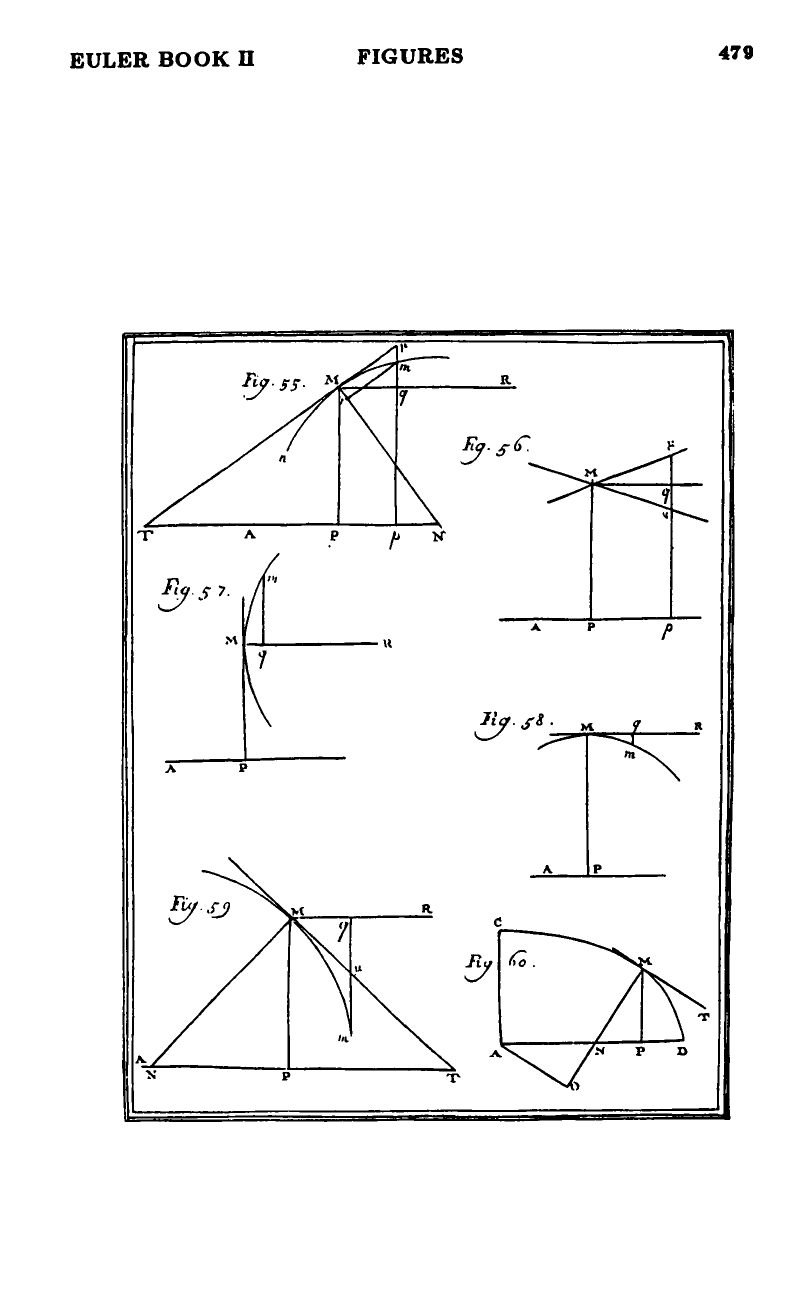 Figures 55–60
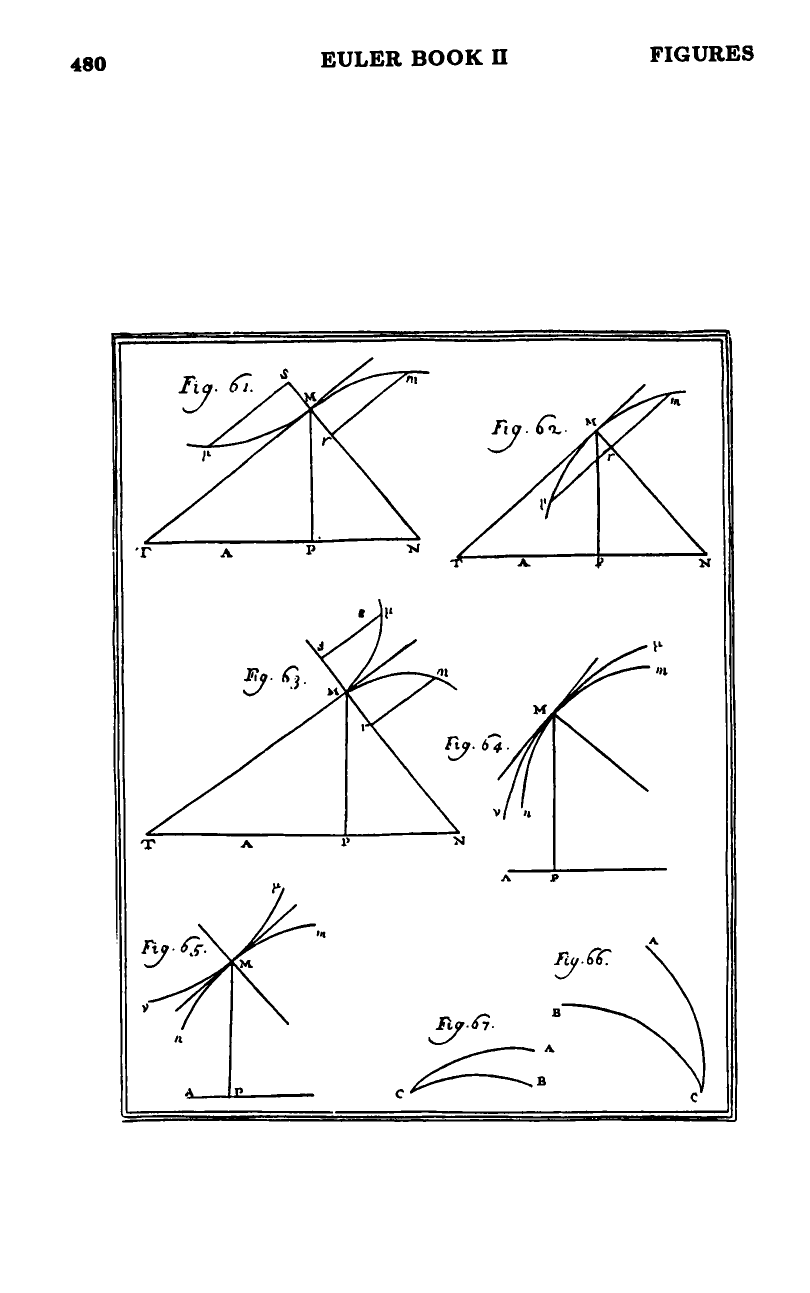 Figures 61–67
Related pages
- chapter-14-on-the-curvature-of-a-curve — chapter summary.
- singular-points-by-jet — chapter-13 classification of multiple points by lowest-jet form, prerequisite to this analysis.
- osculating-parabola — the simple-point algorithm extended here to each branch.
- osculating-circle — the radius formula whose case-by-case behavior is catalogued.
- inflection-by-vanishing-curvature — the parity rule for branches reused here for higher .
- three-genera-of-local-curvature — the §332 master classification subsuming all cases here.
- multiple-points-on-curves — chapter 12’s classification of multiple points.