Chapter 3: On the Classification of Algebraic Curves by Orders
Summary: Euler tries three candidate principles for carving the infinite family of algebraic curves into classes. The first two — genus (number of ordinates per abscissa) and number of terms in the equation — both fail because they depend on the arbitrary choice of axis and origin. The third — degree of the equation — succeeds, thanks to the degree-invariance theorem of chapter 2. Euler therefore defines the order of an algebraic curve as the degree of any equation for it, and then surveys what each order contains: first-order lines are only straight lines; second-order lines are conic sections; higher orders have progressively more species, with arbitrary constants at order . The chapter closes with the distinction between simple and complex (reducible) curves.
Sources: chapter3, figures15-18 (figure 16)
Last updated: 2026-04-24
Why this chapter
chapter-1-on-curves-in-general gave a first cut at classification — algebraic vs. transcendental, continuous vs. discontinuous, single-valued vs. multi-valued. Those divisions are too coarse: the algebraic class alone contains an infinite variety of curves, and “the mind is aided in its examination of the curves” only if that class is sub-divided further (source: chapter3, §47). Chapter 3 is Euler’s systematic search for the right sub-division. Because all information about an algebraic curve lives in its equation, the classifying principle must be extracted from the equation — but it must also be invariant under the coordinate changes of chapter-2-on-the-change-of-coordinates, lest the same curve land in two different classes.
Structure of the chapter
§§47–48 — why we need to classify, and the constraint that the classifying quality must come from the equation itself.
§§48–49 — the first candidate: genus = number of values of per (first genus for single-valued, second for two-valued, etc.). Rejected, because genus depends on the axis. Euler’s counter-example: is first genus; interchanging coordinates gives the equivalent equation , which is fourth genus. See order-of-an-algebraic-curve.
§50 — the second candidate: number of terms in the equation. Also rejected. Euler reuses the §36 worked example from chapter 2: is two-term, but the same curve in different coordinates has the five-term equation . “With a different choice of axis and origin we could have made the genus be the second, third, or fifth.”
§51 — the third candidate: degree of the equation. Works, because degree-invariance guarantees that the degree is preserved under every change of axis, origin, and obliquity. “Hence the classifying property is the degree of the equation in the coordinates.”
§§52–57 — the general equation of each order, and the term-count pattern.
- §52: order 1 is the general first-degree equation — i.e., precisely the straight-line-equation.
- §§53–54: order 2 is the general second-degree equation (6 terms). These are the conic sections, to be resolved in a later chapter: circle, ellipse, parabola, hyperbola.
- §55: order 3 has 10 terms; Euler credits the classification to Newton.
- §56: order 4 has 15 terms. Euler notes a naming confusion: some authors, observing that order 1 contains no curved lines, shift the names down by one (“order 2 is the first-order curve, order 3 is the second-order curve, …”). Euler does not adopt this convention.
- §57: the general equation of order has terms — the triangular numbers (3, 6, 10, 15, 21, 28, …) — and the same number of arbitrary constants. See general-equation-of-order-n.
§58 — a caution. Because the same curve has infinitely many equations (chapter 2), two equations of the same degree with different constants may still describe the same curve. Counting “how many species of order ” requires care to avoid double-counting.
§59 — determining the order of a given equation: clear radicals, clear fractions, then read off the highest total degree.
- → order 2.
- → squaring yields , order 4.
- → clearing the fraction gives a third-degree equation, order 3.
§60 — the same equation may describe different curves in rectangular vs. oblique coordinates (e.g., is a circle rectangularly, an ellipse obliquely), but both lie in the same order. The order is stable; the curve is not.
§§61–65 — complex (reducible) curves. See complex-curves.
- §61: for a curve to be properly of its order, the equation must not factor into rational factors. If it does factor, the equation bundles several independent curves, each with its own equation.
- §62: factors as — two straight lines, not a conic. Similarly a fourth-degree factorable equation can be three “discrete lines.”
- §§63–64: worked example with figure 16. A circle (center , radius ) and a straight line through ; with the diameter at to , taking the axis along and origin at , the line is and the circle is . Their product is a genuine third-degree equation that contains both curves “as if they were one line.”
- §65: counting lemma — a complex curve of order decomposes into simple curves whose orders sum to . In any order, curves of all lower orders can appear as components. Fourth-order complex curves, for instance, decompose as , , , or .
Notable points
- The rejection of genus in §49 is the chapter’s pivot. Genus is the obvious first guess: it is what chapter 1 used informally when classifying two-valued, three-valued, four-valued curves. But precisely because the multi-valued-curves analysis fixes an axis, its notion of “valuation” is not a property of the curve alone, and so cannot serve as a classifying quality.
- Degree wins because chapter 2 worked. The §37 / §46 invariance theorem is not just a technicality of chapter 2 — it is the theorem that makes the entire classification-by-order enterprise coherent. Without it, this chapter has nothing to build on.
- The triangular-number formula is the count of monomials with . Euler presents it by tabulation (3, 6, 10, 15, 21, 28) and then the closed form.
- The “complex curves” discussion is, in modern language, the distinction between a reducible and an irreducible variety: a factorable polynomial equation describes a union of varieties, one per factor. Euler arrives at this through the older lens of “continuous vs. non-continuous” (a continuous curve is given by a single algebraic expression; a complex one is a product of several and so counts as several curves pasted together — see continuous-and-discontinuous-curves).
- Two terminological traps:
- Order in this chapter is not the same as the genus of §48. Euler uses “genus” loosely for both the failed -valuation classification of §48 and, later, for sub-divisions within an order.
- Some authors shift the name of every order down by one. Euler does not, but the reader of later literature should be warned (§56).
What this buys for the rest of Book II
- Conic sections are now definable intrinsically as “curves of order 2” — a single algebraic criterion rather than the Apollonian plane-cuts-a-cone construction. Later chapters deduce the four species (circle, ellipse, parabola, hyperbola) from the general second-degree equation.
- The programme for higher orders is clear. Each order has a general equation with free parameters, and the task is to enumerate the inequivalent species it contains. Book II carries this out for orders 2 and 3 in detail; the theory of quartics is harder and largely deferred.
- The distinction between simple and complex curves is fixed once and for all, and lets later chapters restrict attention to the irreducible case without losing generality — complex curves are trivially reconstructed from their simple components.
Figures
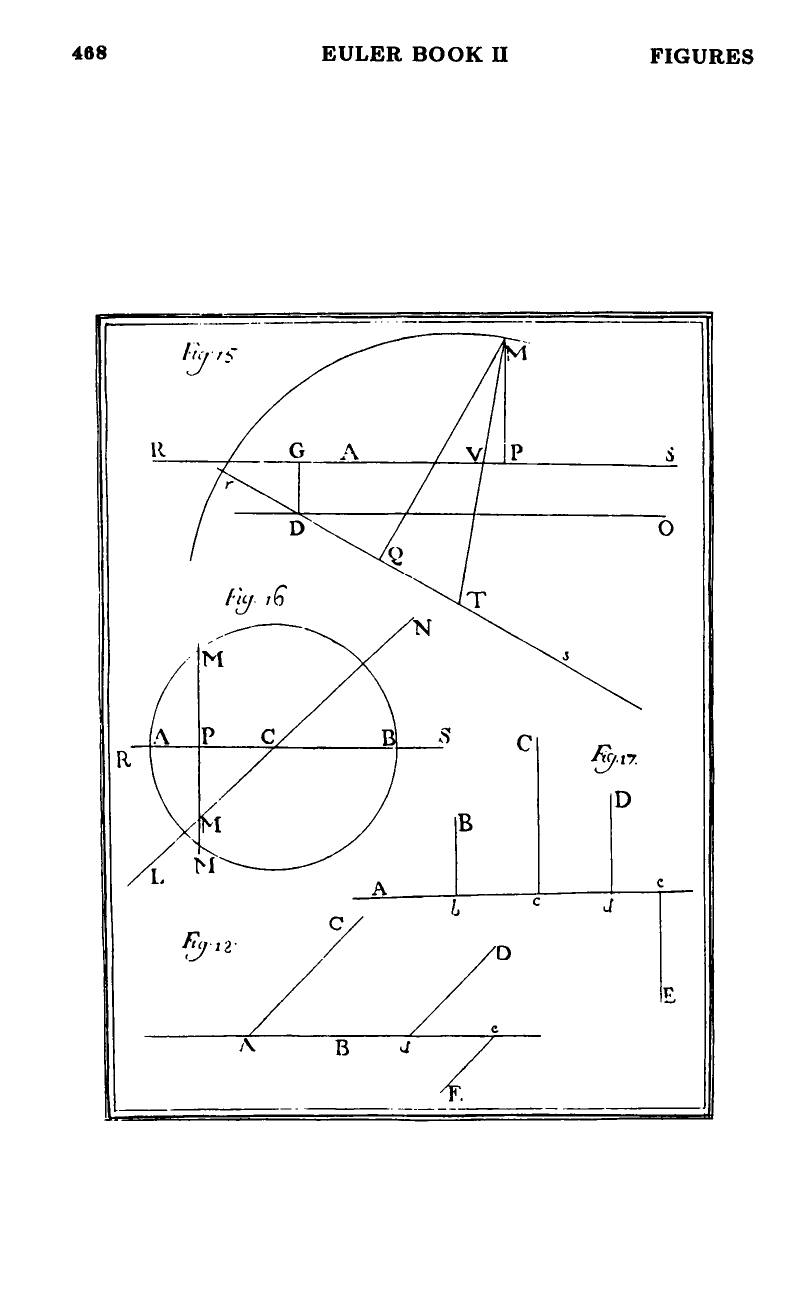 Figures 15–18
Related pages
- order-of-an-algebraic-curve
- general-equation-of-order-n
- complex-curves
- chapter-2-on-the-change-of-coordinates
- chapter-4-on-the-special-properties-of-lines-of-any-order
- line-curve-intersection-bound
- determinations-of-a-general-equation
- curve-through-given-points
- degree-invariance
- straight-line-equation
- multi-valued-curves