Chord Rectangle Property of a Conic
Summary: The product of the two ordinate roots of a conic’s equation, , factors as , where are the abscissas at which the axis cuts the curve. Hence for any two transverse-chord systems on the same conic, is a fixed constant — the conic’s “rectangle ratio” (§§92–93). When the chord becomes a tangent, , giving the tangent rectangle property (§94). Iterating with inscribed quadrilaterals and trapezia (§§96–99) produces the classical projective property that is constant for any point on the curve — the property Newton calls upon throughout the Principia.
Sources: chapter5 §§92–100, figures19-22 (figures 19, 20, 21, 22), figures23-25 (figures 23, 24)
Last updated: 2026-04-25
Product of roots and its factorization (§92)
From the conic’s quadratic-in- form the product of the two ordinate roots at abscissa is
The numerator is a quadratic in . If the axis crosses the curve at two points (figure 19), then setting gives with roots , so Substituting , since and (with sign convention),
The rectangle on the two halves of any chord is in the constant ratio to the rectangle on the corresponding piece of the axis.
The fundamental ratio is universal (§93, figure 21)
The choice of axis was arbitrary in §92, so the same ratio governs the relation between any chord-of-the-curve and the chord drawn parallel to it through any other point.
Pick any straight line that intersects the conic at and any two ordinates parallel to a fixed direction (figure 21): By symmetry of the role “axis vs. ordinate,” taking a different chord direction as axis:
This is our second general property of a second order line. (source: chapter5, §93)
The first general property is the diameter property (sum of roots → bisection locus, see diameter-of-conic); this is the second.
The tangent-rectangle property (§94, figure 24)
When the two points on the curve coincide, the chord becomes the tangent through that point, and becomes a square: the square of the segment from to the point of contact .
Apply §93 with the chord through tangent and another transverse chord:
If is any ordinate which is extended to the tangent and meets it with a given angle, then the ratio of the square of the straight line to the rectangle is always constant. (source: chapter5, §94)
Equation along a diameter (§95)
When the diameter is taken as axis (figure 20), with the contact point of the tangent and the second intersection, half the chord becomes the new ordinate , and , where . The product law is constant:
This is the diameter-form equation of any second-order line. It will be the workhorse for chapters 6–8: parabola when scales appropriately, ellipse when the right side is positive over a finite range, hyperbola when negative.
Inscribed quadrilateral with parallel sides (§§96–98, figure 22)
Take any two parallel chords — call the resulting figure a quadrilateral inscribed in the conic. From any other point of the curve, draw parallel to (and ); this chord meets at and at . Claim: and .
The reason: the diameter through the midpoints of and also passes through the midpoint of (because all three chords are parallel). By elementary geometry, the same line through the midpoints of opposite sides of the trapezium also bisects the segment . Two segments and that share a midpoint must satisfy and .
So in addition to the four points on the conic, a fifth point on the conic determines a sixth point on the conic, with .
Now combine with the tangent-rectangle property: extending the inscribed-quadrilateral construction (§§96–98) yields for any point of the curve, where are the segments from to the four sides of an inscribed parallelogram (or, more generally, the four sides of an inscribed trapezium — see §99).
The general projective form (§99, figure 23)
Let be any four points on a second order line, and let the points be joined by straight lines to form the inscribed trapezium . We will deduce from what has gone before the property of conic sections. That is, if from any point of the curve, the straight lines , and are drawn so as to meet the four sides of the trapezium with the same angle, then the products of the lengths of the two lines to opposite sides are always in a constant ratio. (source: chapter5, §99)
Concretely: pick any four points on the conic; their joining lines form an inscribed trapezium with four sides. From any other point on the conic, drop four lines to the four sides — all at the same fixed angle to those sides. Call the foot-of-perpendicular distances . Then where the products pair opposite sides against each other. The constant depends on the trapezium and the angle, not on .
This is the anharmonic / projective-cross-ratio statement of “the locus is a conic.” Any locus of points for which this rectangle ratio against four fixed lines is constant is a conic — Euler will use this in subsequent chapters.
Geometric mean construction (§100, figure 24)
A consequence of : if is the point on chord such that (geometric mean), then which means , , and are collinear.
In other words: pick two parallel chords; on each, mark the point that is the geometric mean of its two halves; the line through those geometric-mean points passes through the contact point of the tangent parallel to the chords. Equivalently, every line drawn from parallel to a fixed direction cuts each chord parallel to that direction in its geometric mean — this line is the “tangent diameter” in modified form.
Why the rectangle ratio is the right invariant
The diameter property (§§87–91) tells us where the midpoint of a chord lies; the rectangle property tells us how big the product of half-chords is. Together, sum and product determine the chord completely (one is , the other is , and the chord lengths are roots of ). So the two strands are not independent geometric facts — they are the two coefficients of the conic’s quadratic-in- equation, in geometric guise.
This is also why the projective form (§99) is unavoidable: any algebraic locus whose points satisfy a fixed bilinear ratio in distances to four fixed lines must satisfy a degree-2 equation in the coordinates — i.e., must be a conic.
Connection to Newton’s Principia
The rectangle-ratio property is the hinge on which Newton hangs his geometric proofs of Kepler’s laws. Euler will say so explicitly when he reaches the tangent-construction theorem (§122; see tangent-properties-conic): “These are the main properties of conic sections from which NEWTON found the solution to many important problems in his Principia” (source: chapter5, §122). The §99 form is the most general statement; the §94, §122 forms are the specializations Newton actually applies.
Figures
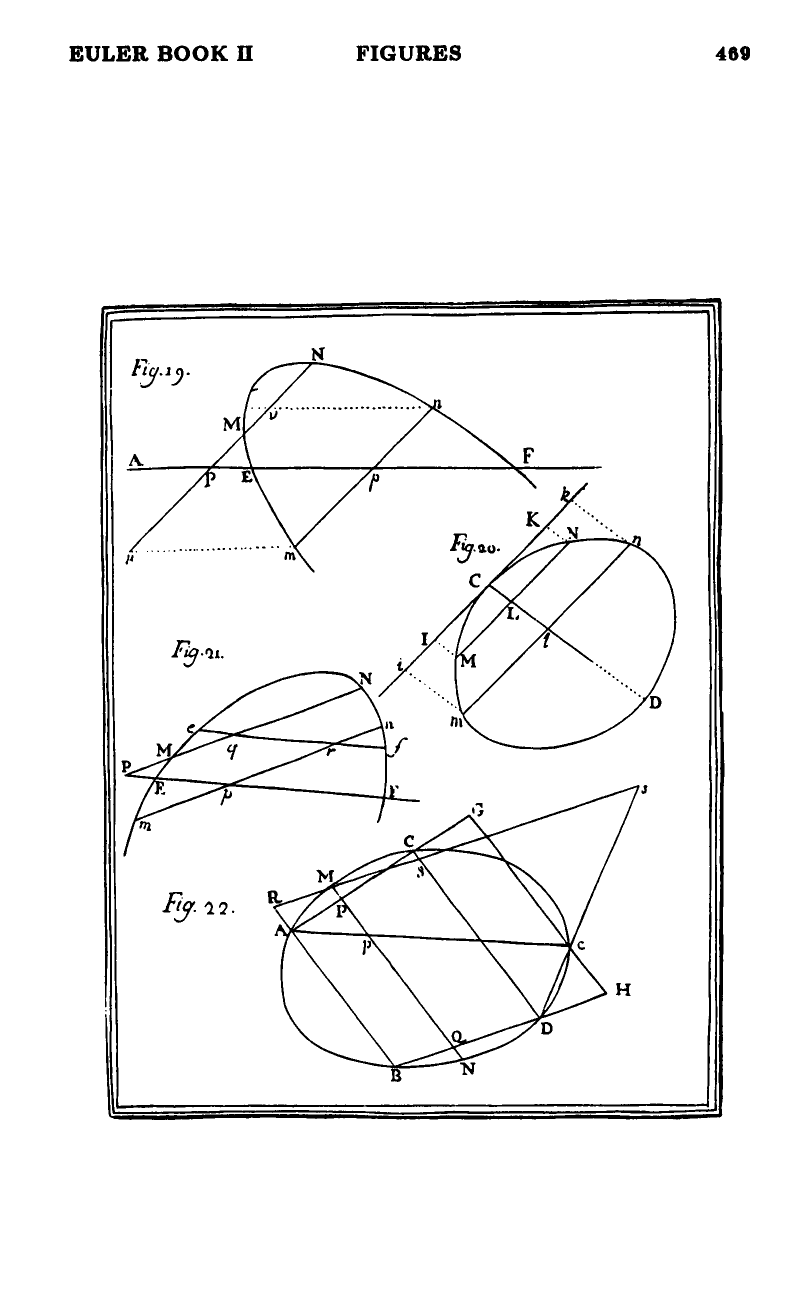 Figures 19–22
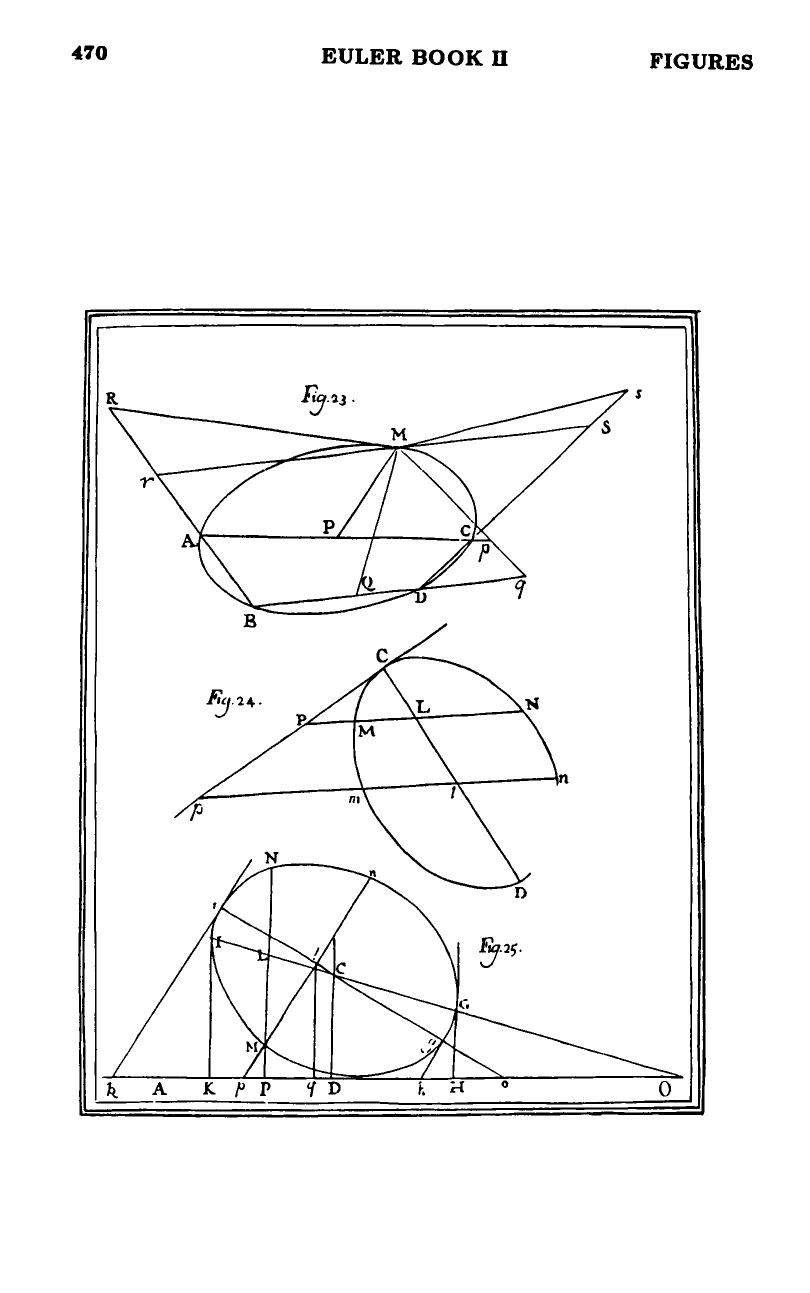 Figures 23–25
Related pages
- chapter-5-on-second-order-lines
- diameter-of-conic — companion property: the sum of roots gives the diameter locus
- tangent-properties-conic — , the tangent-rectangle property used by Newton
- conjugate-diameters — diameter-form specializes to at the center
- curve-through-given-points — five points fix a conic; here we see how four points + projective ratio fixes a fifth
- oblique-coordinates