Center of a Conic Section
Summary: All diameters of a second-order line meet in a single point, the center. Computed by intersecting the diameter equations for two different chord directions, the center lies at independent of the obliquity of the coordinate system (§§106–107). Each diameter is bisected by the center (§108). Euler defines the center in §107: “Since this point in any second order line is unique and all diameters pass through it, it is usually called the CENTER of the conic section.”
Sources: chapter5 §§101–110, figures23-25 (figures 25, 26)
Last updated: 2026-04-25
The diameter equation in the rectangular case (§101, figure 25)
For an ordinate of slope relative to the axis, the diameter is the locus of midpoints of chords at varying abscissa. Letting and applying the sum-of-roots formula, so the diameter equation is
This is a straight line in , confirming that the diameter is straight (which §90 already asserted from a different angle).
Length of the diameter (§102)
Where the diameter meets the curve — at points — the chord collapses ( point on curve), so , equivalently . Using and ,
So the abscissas at which the diameter meets the curve satisfy yielding The diameter length squared (in rectangular coordinates):
Euler simplifies this to in a special calibration (§102 final line).
Diameter equation in oblique coordinates (§§103–105)
Now substitute an oblique coordinate change: ordinate at angle to the axis with sine and cosine , new abscissa , new ordinate , so and . Then the original equation becomes
The diameter equation for this new ordinate direction (sum-of-roots = for midpoint at , with foot-of-perpendicular adjustments via , ) reduces algebraically to the linear relation or, dividing by ,
This is the diameter equation in coordinates for the oblique direction .
Intersection of two diameters: the center (§106)
The center is the simultaneous solution of two diameter equations — say, the “axis-perpendicular” diameter for one direction, and a different diameter for another obliquity. Drop a perpendicular from to the axis, with foot and let , . Then satisfies both and
Multiply the first by and subtract:
The factor has dropped out — the resulting equation contains no obliquity parameter. Combining with the first equation: so and
In these calculations the quantities and do not appear; the obliquity of the ordinate depends on these, so that it is clear that the point remains the same no matter how the obliquity varies. (source: chapter5, §106)
This is the key fact: every diameter — whatever its associated chord direction — passes through this single point .
All diameters pass through the center (§107)
It follows that all diameters and pass through the same point . Once this point is found, all diameters pass through it, and conversely, all chords which pass through the point are diameters which bisect all chords drawn with a certain angle. (source: chapter5, §107)
This justifies Euler’s naming:
Since this point in any second order line is unique and all diameters pass through it, it is usually called the CENTER of the conic section. (source: chapter5, §107)
The “conversely” is significant: any chord through the center is a diameter — it bisects all chords parallel to some direction (namely, the direction whose diameter is that chord). So through the center there is a one-parameter family of diameter–chord-direction pairings. We will see in conjugate-diameters that for each diameter, the chord direction it bisects is itself a diameter — its conjugate.
The center bisects each diameter (§108)
From §102, the abscissas of the two endpoints of a diameter on the curve satisfy So the midpoint of the segment on the axis is at abscissa — that is, exactly under the center .
Since the diameter is a straight line and the center lies on it (§107), and the projection of onto the axis is the midpoint of on the axis, is the midpoint of on the diameter itself. Hence:
Not only do all diameters pass through the same point , but they are also bisected by that point. (source: chapter5, §108)
Choosing the center as origin (§§109–110)
Once the center is identified, take any diameter as the new axis with chord ordinates at angle (figure 26). Now (the two ordinates of the same chord are equal in length, opposite in sign), so the sum , forcing the linear-in- term to vanish:
Setting gives the diameter’s intersections with the curve at : The center , midpoint of , is at .
Now translate the origin to : let , then (or , by sign convention), and substituting,
Renaming constants (, with sign), Euler obtains the center-form equation
This is the workhorse equation for the rest of the chapter. It is what every conic looks like when (i) any diameter is taken as the axis and (ii) the origin is at the center.
In this form:
- The diameter length on the axis is .
- The chord through the center perpendicular (in the oblique sense — see §111) is .
- and depend on which diameter was chosen as axis, but encodes the diameter length.
The center as a coordinate-invariant point
The remarkable feature of the §106 calculation is that the obliquity cancels out. This means: if we change the coordinate system arbitrarily — different obliquity, different angle, different units of or — and then recompute the center from the new coefficients, we land at the same physical point on the curve.
This is a coordinate-invariance theorem analogous to degree-invariance (the degree of the equation is preserved under all coordinate changes). The center is intrinsic to the conic, not to the equation.
The point remains the same no matter how the obliquity varies. (source: chapter5, §106)
Three intrinsic invariants of a second-order line have now been identified: order (order-of-an-algebraic-curve), the diameter family (chapter 5 §§87–91), and the center (this page). Foci, latus rectum, and principal axes are upcoming intrinsics in principal-axes-and-foci.
Figures
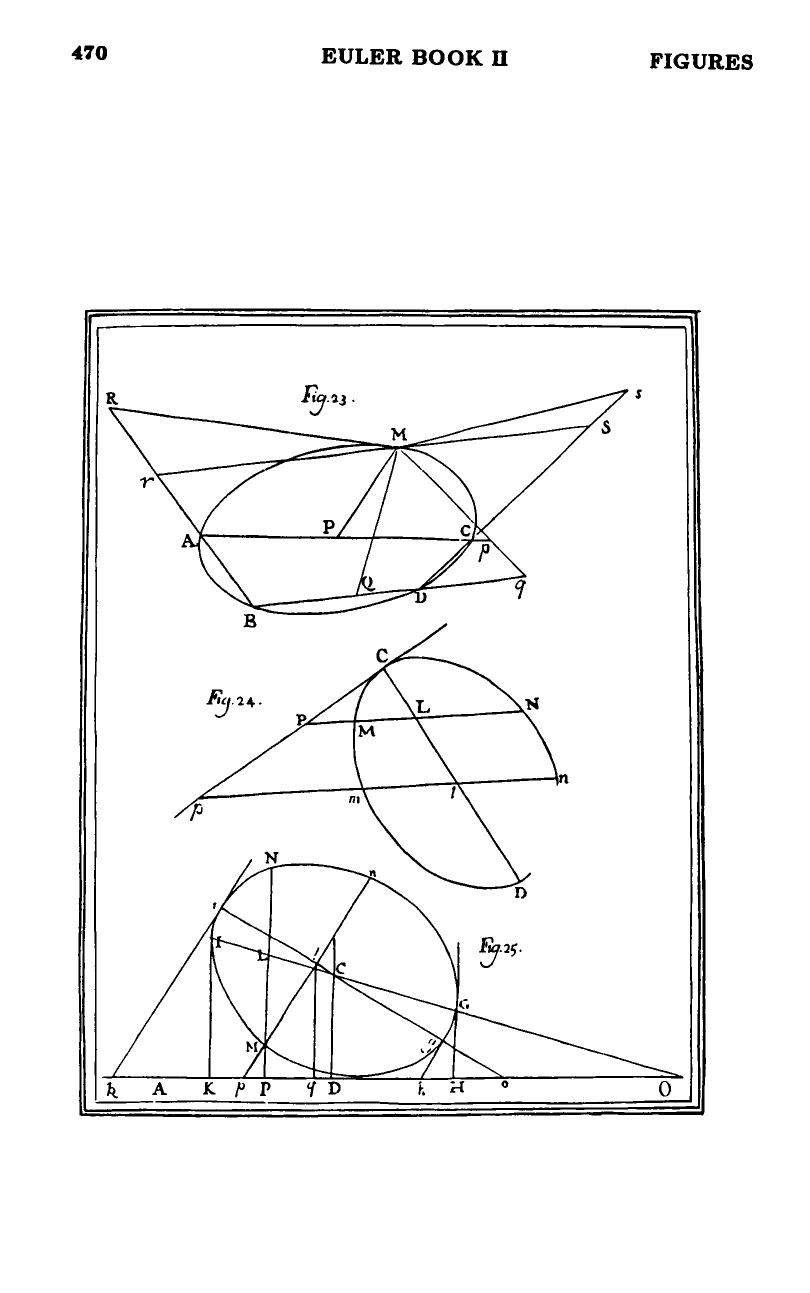 Figures 23–25
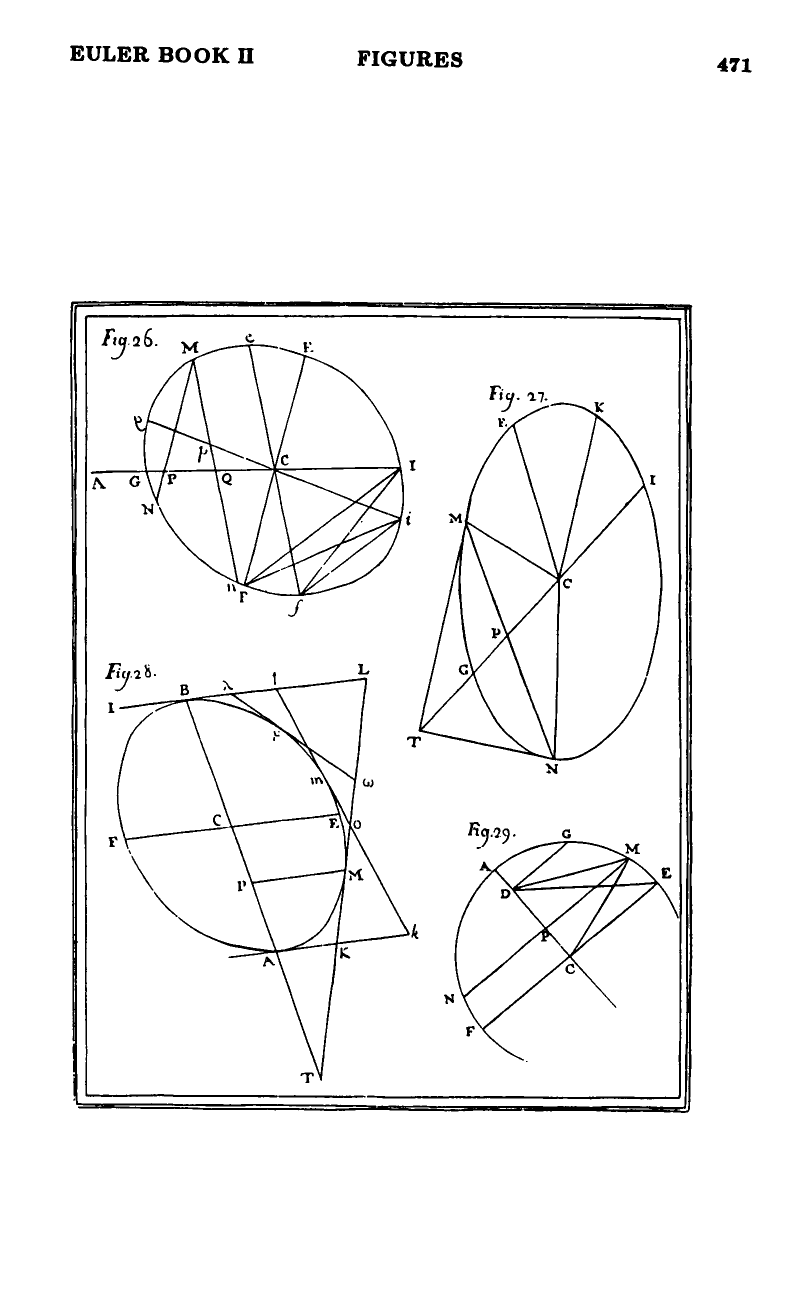 Figures 26–29
Related pages
- chapter-5-on-second-order-lines
- diameter-of-conic — diameters are the lines whose intersection defines the center
- conjugate-diameters — once the center is the origin, every diameter has a partner
- principal-axes-and-foci — among all conjugate pairs at the center, exactly one is orthogonal
- coordinate-transformations — the §103–105 oblique transformation
- degree-invariance — analogous coordinate-invariance result