Relations at Symmetric Abscissas
Summary: §§380–390 of chapter-16-on-finding-curves-from-properties-of-the-ordinate. The previous strands related ordinates corresponding to the same abscissa; this strand relates ordinates at and at — i.e., at symmetric abscissas. Decomposing the equation into even and odd parts gives the dictionary: , , and higher symmetric functions of are even or odd functions of in patterns determined by parity. Equal-sum (centered at a point) and equal-product (“alternately equal”) families are derived. §388 unifies them under the invariance principle “equation unchanged under simultaneous and .” §390 tabulates the resulting curves of orders 1, 2, 3.
Sources: chapter16 (§§380–390). Figure 80 (in figures76-80).
Last updated: 2026-05-11.
The parity dictionary (§380)
For a curve (single-valued for clarity; multi-valued follows analogously), let at and at . Two extreme cases:
| Parity of | Relation between and |
|---|---|
| even, | (curve symmetric about the perpendicular through the origin) |
| odd, | (curve point-symmetric about the origin) |
More generally, decompose with even functions of and odd. Then
since flipping the sign of flips the sign of and . Symmetric polynomials of split into even-and-odd combinations of along the same lines.
Equal-sum: (§381)
A curve (figure 80) has center on the axis if for some constant (equivalent to the midpoint being constant). The simplest sufficient form is
with an odd function of , giving , and so . Geometrically, the curve has equal parts on either side of center , located in opposite quadrants — a -rotation symmetry about , the rotational (“alternately equal”) symmetry of diameter-and-center-from-equation.
Letting recasts the equation as with odd in and odd in . The two general equations (§382) for curves with rotational symmetry about in coordinates are:
Form I (odd in both and ):
Form II (even constants only, odd-degree mixed terms):
Setting converts each form into an equation in with center at . The form II case includes any central conic (with center at ); for the hyperbola, the ordinate is taken parallel to one asymptote, giving two pairs of ordinates per pair of symmetric abscissas.
Equal th-power sum: (§383)
The same idea generalized: with odd in . Then , , and the sum is for all . Substituting recovers the same forms I and II in coordinates.
Equal product: (§§384–386)
Letting with even and odd in , we have , , so requires . Hence the curve
The sign ambiguity in the radical gives two ordinates per abscissa, located one positive and one negative — “equal parts alternately placed about as center.” It is essential that not be chosen so that is a perfect square (e.g., gives , an odd function unfit to be the even ), since that would degrade the curve to one ordinate.
The th-power version (§386): with odd in produces .
The §387 mixed case
When both are even and are odd, gives and . Setting or avoids the radical and ensures only one ordinate per abscissa. The simplest second-order example: , a hyperbola.
The §388 unifying invariance principle
The equation for a curve with should be unchanged under the simultaneous substitution and — the first flips the abscissa to the symmetric one, the second exchanges the two ordinate values whose product is . Building blocks invariant under this combined substitution have the form
with even in and odd. (The first kind picks up two sign flips and is overall invariant; the second kind picks up no sign flip in the factor but a flip in , so we need the corresponding building block to flip overall — confused; let me state the result Euler actually wrote.) The general equation is:
with any even functions of and any odd functions. Multiplying through by an odd function of swaps the role of even and odd, giving a second equivalent general form. Clearing fractions yields (§388 displayed equation):
and an analogous form II with sign-flips on the lower row.
Fractional exponents (§389)
Substituting into the master forms spontaneously eliminates the apparent irrationality, yielding equations such as
which after clearing the denominator becomes polynomial in .
Low-order solutions (§390)
The §388 general forms, specialized to low orders, recover concrete curves:
| Order | Equation type I (n=1) | Equation type II (n=0) |
|---|---|---|
| 1 (line) | (vacuous in form I) | (no curve from first eq) |
| 2 | from | |
| 3 | ; or | ; or |
(There is a typographical issue in the printed §390 first-order row: the form-I-first-equation “gives no curves,” and the first explicit curve is the second-order hyperbola. Verified against the §387 derivation.)
The straight line const parallel to the axis through is the trivial order-1 solution. All conics with center at — including the hyperbola with ordinate parallel to an asymptote — solve the order-2 case. The third-order patterns extend the dictionary.
What this strand really does
Strand 5 is the chapter’s most substantial conceptual contribution. Where strands 1–4 are inverse-direction Newton-identity expansions, strand 5 introduces an invariance group: the cyclic-of-order-2 group generated by . Building the equation from invariants of that group recovers all “equal product about symmetric abscissas” curves at once. This is exactly the chapter 15 polar-coordinate symmetry analysis (chapter-15-on-curves-with-one-or-several-diameters) recast in rectangular coordinates — a foreshadowing of modern invariant-theoretic curve classification.
Figures
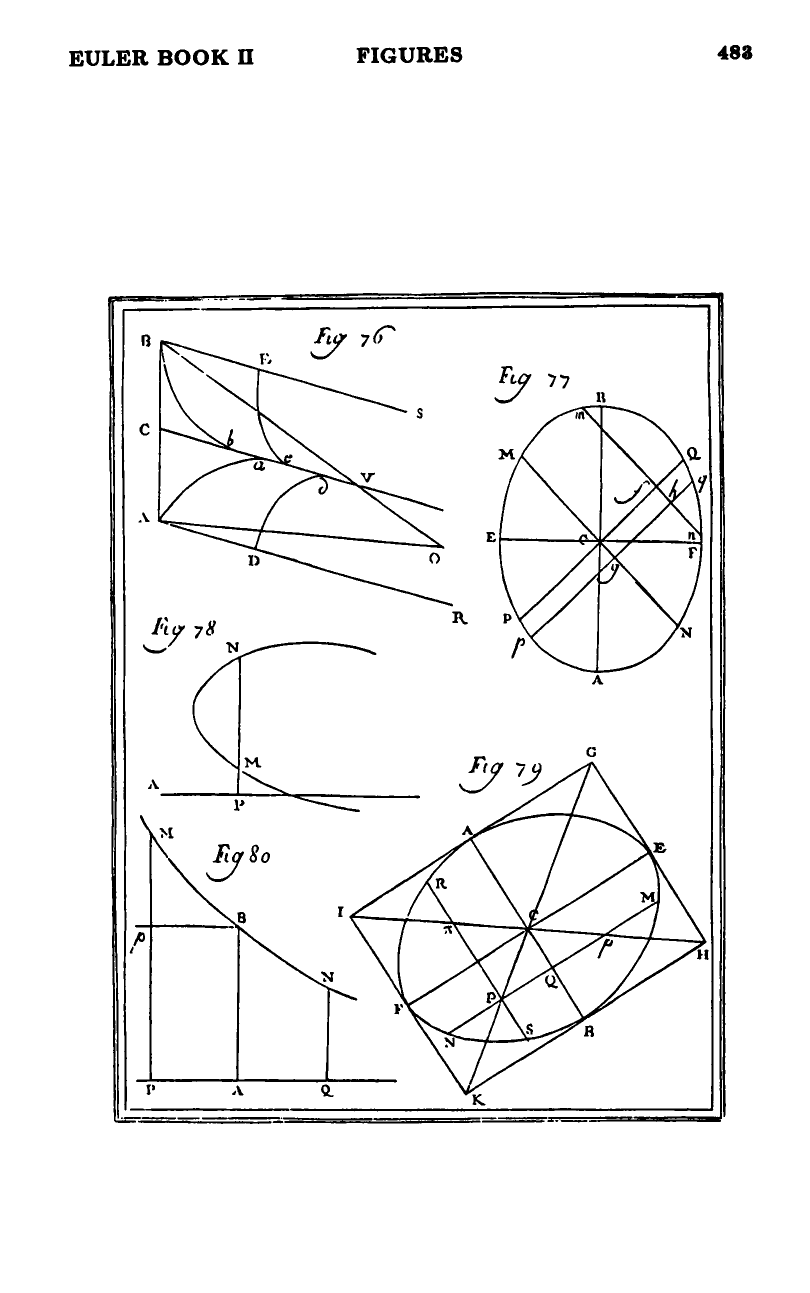 Figures 76–80
Related pages
- chapter-16-on-finding-curves-from-properties-of-the-ordinate — chapter summary.
- diameter-and-center-from-equation — chapter 15 parity-of-exponents version: the same idea for .
- equal-parts-without-diameter — chapter 15 alternately-equal classification.
- concurrence-of-diameters — chapter 15 angle-quantization version of “equal parts.”
- two-ordinate-sum-and-product — strand 1 same-abscissa counterpart.
- sum-of-ordinate-powers-curves — strand 2 same-abscissa power-sum counterpart.