Appendix Chapter 3 — On Sections of Cylinders, Cones, and Spheres
Summary: Algebraic confirmation, surface by surface, of the classical Apollonian theorem that every plane section of a cone is a conic. Worked through for the three elementary quadric solids — cylinder, cone, sphere — using the oblique-plane-section-method of chapter 2 §§47–50. Climax is the §64 Theorem: for any plane -inclined to the base of a cylinder, the product of the conjugate semiaxes of the elliptical section equals the product of the base semiaxes divided by . The cone gets the parabola/ellipse/hyperbola trichotomy by sign of , with the §74 subcontrary-circle condition. The sphere gives a circle in every section, radius .
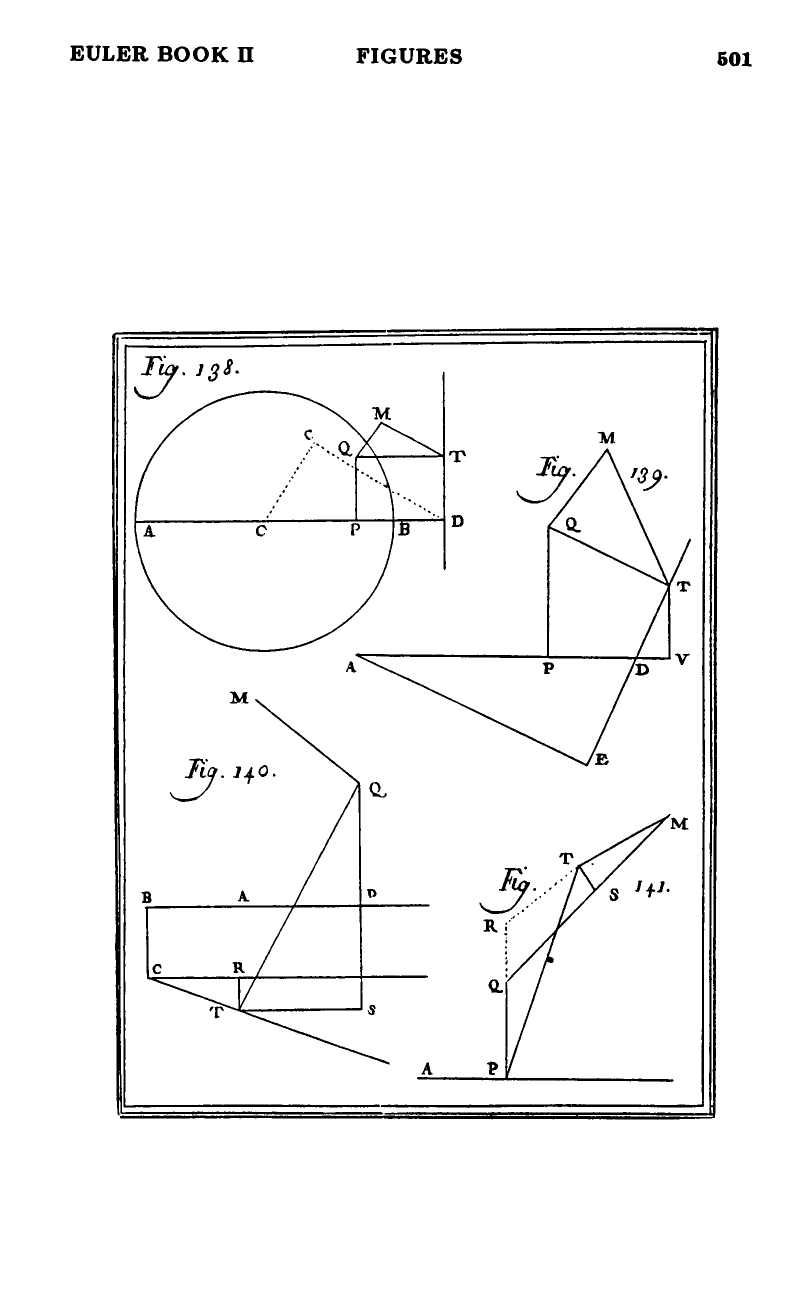
Sources: appendix3, §§52–85. Figures 130–139 in figures128-130 and figures131-132, figures133-134, figures135-137, figures138-141.
Last updated: 2026-05-12.
§§52–67 — The cylinder
Right vs scalene cylinders (§52, Euclid’s distinction). Equation of an elliptical-base cylinder with axis perpendicular to the base (figure 130):
The variable is absent — confirming the chapter 2 §31 / §33 cylindrical-surface property.
Sections by planes parallel to base = base ellipse (or circle); sections parallel to the axis = pair of parallel lines or empty (§54); section by a plane -inclined whose base intersection is parallel to one conjugate axis = ellipse with semiaxes and (§§55–56). Subcontrary-section circle when — the deeper reason for “scalene cylinder” (§57).
The §§58–63 derivation handles a general oblique section; the calculation is heavy but the climax is one beautiful identity.
§64 — Theorem
If any cylinder is cut by any plane, then the product of the principal axes of the section is to the product of the principal axes of the base of the cylinder as is to the cosine of the angle made by the plane of the section with the plane of the base.
In symbols, . All inscribed parallelograms on conjugate axes therefore preserve area to the base ellipse in the same ratio. See cylinder-sections.
§§68–80 — The cone
Cone with vertex at origin, axis perpendicular to base in the table top (figure 134):
The equation is homogeneous in — confirming the chapter 2 §34 conical-surface property.
Sections perpendicular to the axis are ellipses (§69) — base for the trichotomy of all other sections. Sections perpendicular to one of the base axes are hyperbolas (§§69–71); the asymptote angle is computable. The general oblique section (§§72–80, figures 134–137) is the heart of the chapter:
- → ellipse (§74), with subcontrary-circle when ;
- , i.e. → parabola (§73);
- → hyperbola (§75), with equilateral case computed.
This is the algebraic Apollonius. See cone-sections.
§§81–85 — The sphere and the general method
Sphere has all three principal-plane sections as great circles (§28 already). For an arbitrary cutting plane at perpendicular distance from the center and inclination (figure 138), the section equation is
a circle of radius centered at the foot of the perpendicular from (§§82–83). Every plane section of a sphere is a circle.
§§84–85 close the appendix by re-deriving the general oblique-section method of §§47–50 with explicit attention to figure 139 — the universal algorithm: given any solid and any plane , substitute
(rephrased in this chapter’s conventions) to obtain the section equation . See sphere-sections.
Cross-references
- All three sections relate back to Book II’s plane-conic chapters chapter-5-on-second-order-lines, chapter-6-on-the-subdivision-of-second-order-lines-into-genera — chapter 6’s -sign trichotomy and the §74 subcontrary-circle condition here are two faces of the same Apollonian classification.
- The §51 universal-quadric-section theorem of appendix-2-on-the-intersection-of-a-surface-and-an-arbitrary-plane is verified case by case here.
- The general algorithm (§§84–85) repeats oblique-plane-section-method.
Figures
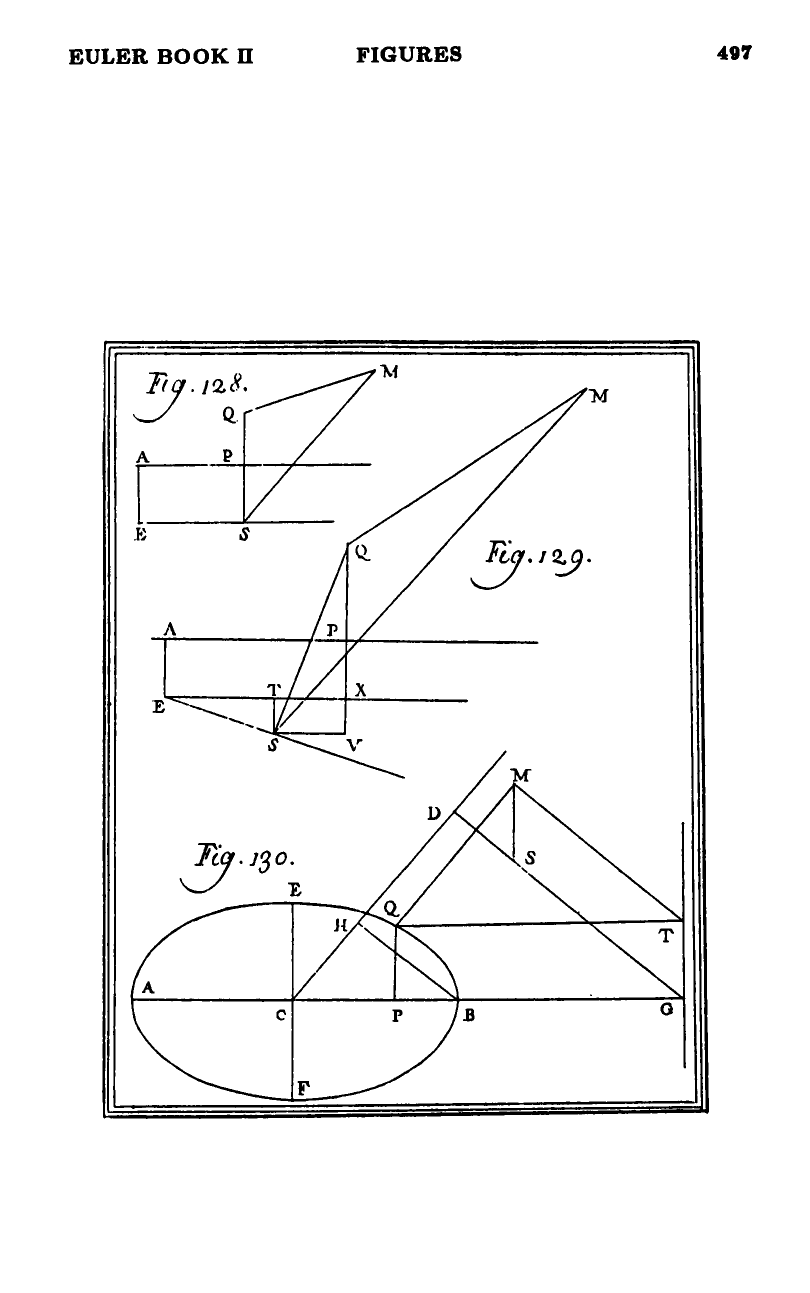 Figures 128–130
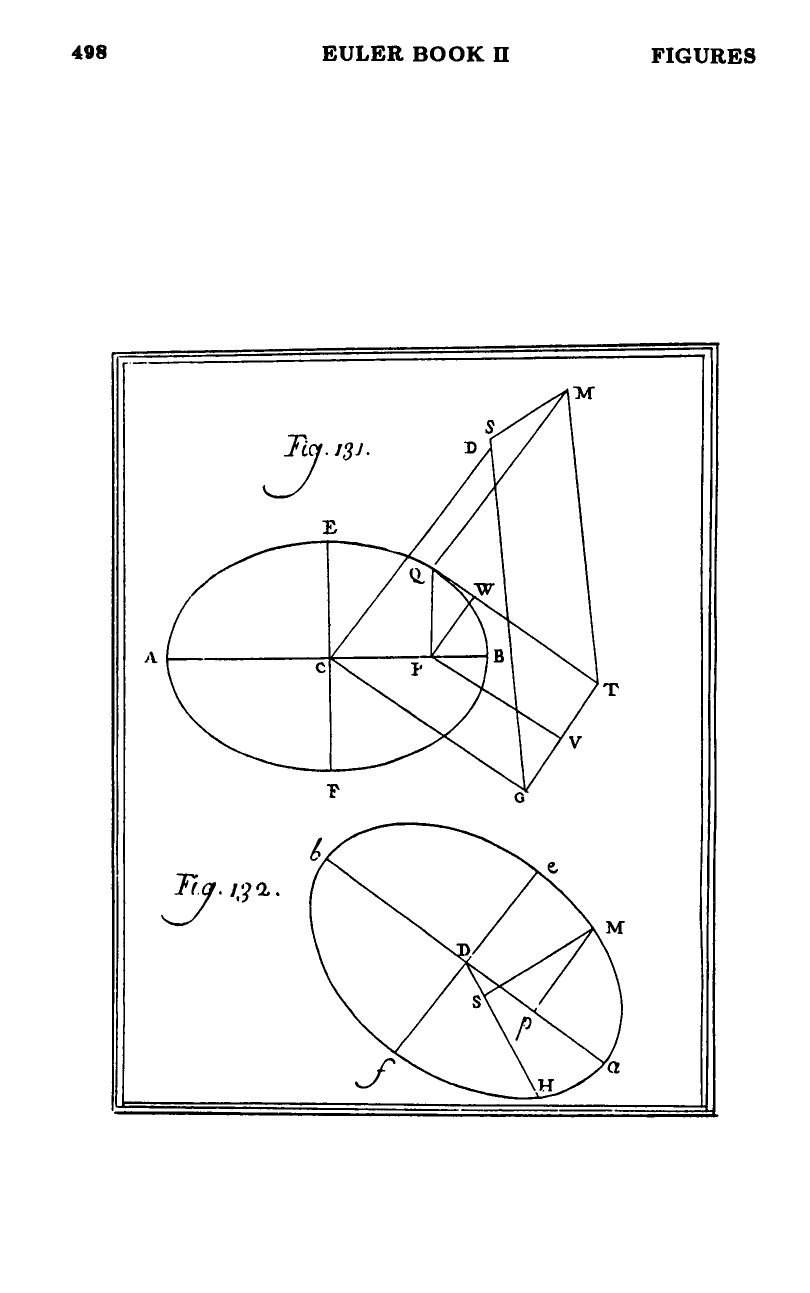 Figures 131–132
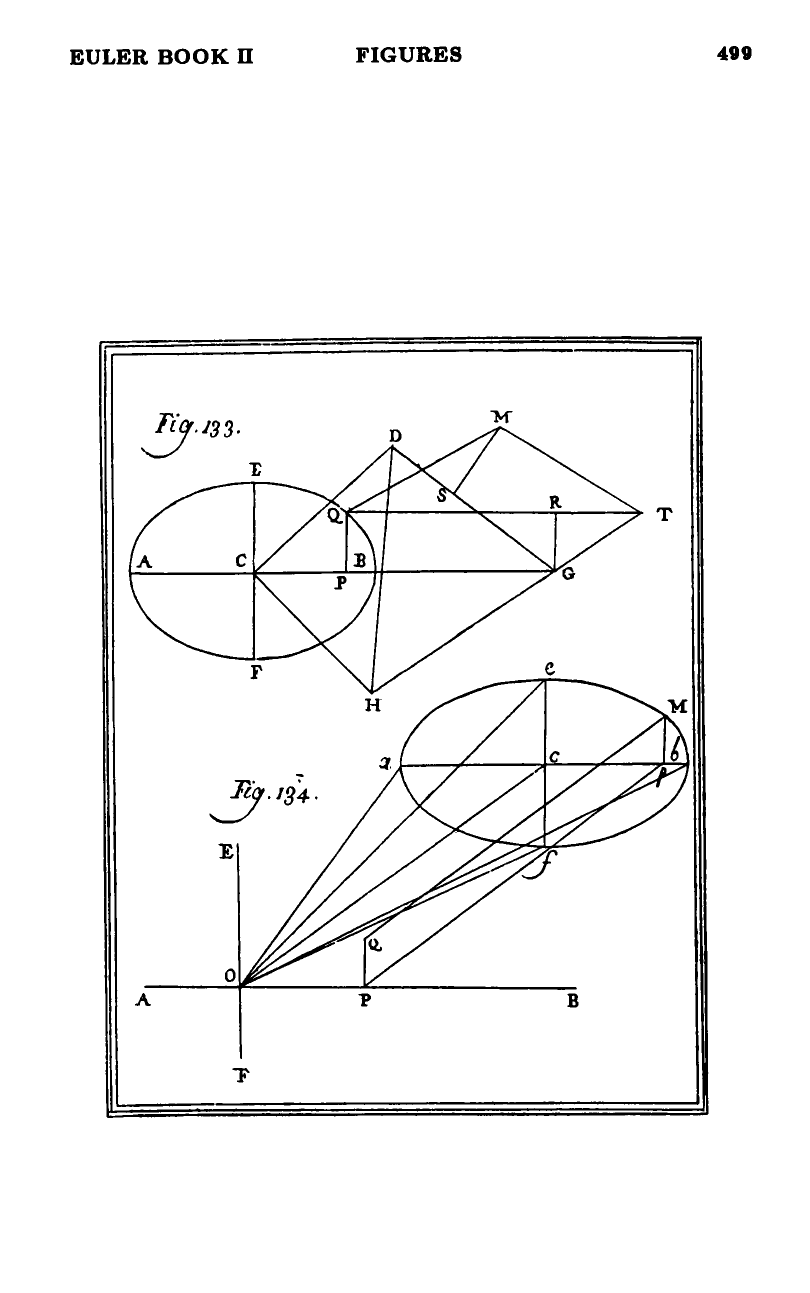 Figures 133–134
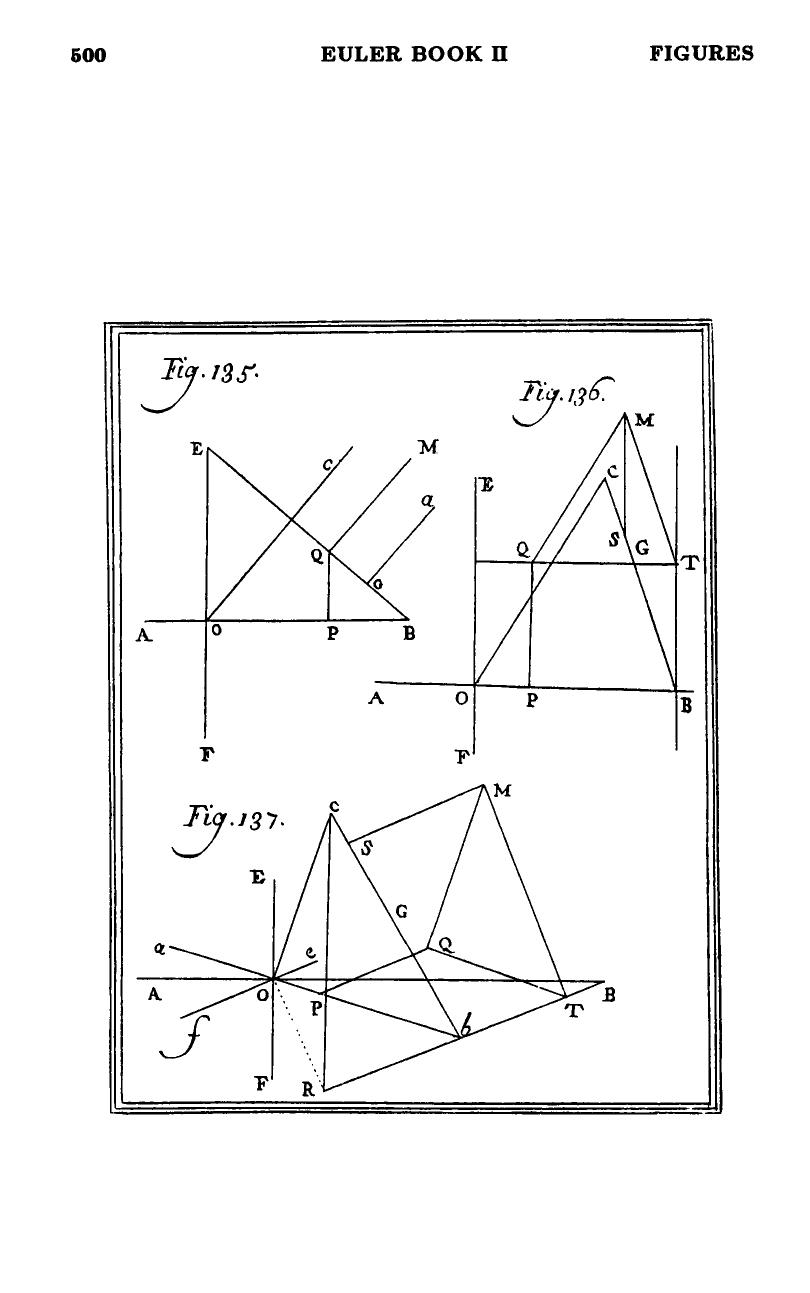 Figures 135–137
 Figures 138–141