Chapter 6: On the Subdivision of Second Order Lines into Genera
Summary: Having established in chapter-5-on-second-order-lines every property that all conics share, Euler now splits them into three genera by the sign of the leading coefficient in the orthogonal-diameter form : hyperbola (, four infinite branches), ellipse (, bounded), parabola (, two infinite branches). Each genus is then developed in turn — ellipse around the central form , parabola as the limit case , hyperbola as the ellipse with , and the asymptotes of the hyperbola as tangents at infinity, leading to the asymptote-coordinate equation . Throughout, every property of one species is read off as the analogue or limit of properties of another, making the chapter a unified treatment rather than three independent treatises.
Sources: chapter6, figures30-32, figures33-34
Last updated: 2026-04-26
Why this chapter
chapter-5-on-second-order-lines derived from the general equation everything that is common to second-order lines: diameter, centre, conjugate diameters, tangent rectangles, principal axes, foci, focal polar equation. But conics nevertheless differ in shape — bounded vs. unbounded, one piece vs. two, with or without asymptotes. Chapter 6 takes the next step: classify them into species and study what is proper to each.
The classification rests on a single invariant: the number of branches that escape to infinity. From the orthogonal-diameter form , the dominant term as is , so the sign of controls the count:
| Sign of | Genus | Branches at |
|---|---|---|
| Hyperbola | 4 | |
| Parabola | 2 | |
| Ellipse | 0 |
classification-of-conics develops this in detail.
Structure of the chapter
§§131-137 — the trichotomy. classification-of-conics.
- §131-132: the orthogonal-diameter form .
- §133: not every change in produces a change in genus or species — translation and magnification leave shape invariant.
- §134: → four infinite branches → hyperbola.
- §135: → curve fully bounded → ellipse.
- §136: → two infinite branches → parabola (the boundary case).
- §137: summary; rest of chapter studies each genus in turn.
§§138-147 — the ellipse. ellipse.
- §138 (figure 31): centre as origin, canonical equation with for the major axis.
- §139: gives the circle; foci at ; semilatus rectum .
- §140: (sum of focal distances = principal axis); pin-and-string drawing method.
- §141: tangent line, , .
- §142: tangent makes equal angles with focal radii.
- §143: where meets the tangent.
- §144: on the focal perpendiculars to the tangent.
- §145: conjugate-diameter laws and .
- §146: orthogonal pair (principal axes) is the unique pair maximising ; equal-conjugate pair found explicitly.
- §147: vertex-origin form with semilatus rectum and vertex-focus distance.
§§148-152 — the parabola. parabola.
- §148 (figure 32): set in vertex form to get . Focus at , semiparameter .
- §149: parabola = ellipse with infinite semiaxis; all ellipse properties continue with . Focal property .
- §150: tangent meets axis at with ; as .
- §151: axis, so every diameter of a parabola is parallel to the principal axis. Diameter form — each diameter has its own latus rectum .
- §152: triangle isosceles (); (focal perpendicular = geometric mean); subnormal constant.
§§153-157 — the hyperbola. hyperbola.
- §153 (figure 33): equation with four branches .
- §154: no real conjugate axis (centre off curve); imaginary semiaxis . Equation = ellipse equation with . Foci at .
- §154-155: (difference of focal distances = principal axis).
- §155: tangent bisects between focal radii.
- §156: on focal perpendiculars to tangent (same as ellipse).
- §157: on perpendiculars at vertices to tangent.
§§158-165 — asymptotes of the hyperbola. asymptotes-of-hyperbola.
- §158: tangent at infinity passes through centre with slope — the asymptotes; defined as lines never meeting the curve but coinciding with it at infinity.
- §159: angle between asymptotes ; right angle for equilateral hyperbola .
- §160: chord parallel to conjugate axis: — Apollonius’s principal asymptotic property.
- §161 (figure 34): asymptote-coordinate equation where .
- §162: tangent bisected at the point of contact in asymptote coordinates; gives quick tangent construction .
- §163: rectangle on the curve-intercepts of any chord parallel to a fixed direction is constant.
- §164-165: same constant rectangle property holds for chords crossing both branches.
Notable points
- One algebraic invariant, three genera. The trichotomy of conic sections — known since Apollonius — falls out of one algebraic fact: the sign of in the principal-axis equation. Euler shows that nothing about cones, planes, or projection is needed to read off the genus from the equation. This is the analytic-geometric reduction of the classical synthetic classification.
- Each species is derived from the others. The chapter is structured so that the three genera are not three separate developments. The parabola (§§148-152) is the ellipse with — every parabola property is read off from the corresponding ellipse property by sending the major axis to infinity. The hyperbola (§§153-157) is the ellipse with — every hyperbola property is read off from the corresponding ellipse property by this single sign change. The ellipse is the master.
- Asymptotes are tangents at infinity. §158 makes precise what an asymptote is: the limit of the tangent line as the point of contact recedes to infinity. This is the projective definition implicit in Euler’s calculation as . Modern projective geometry will eventually make this a theorem about the line at infinity.
- Asymptote coordinates collapse two parameters to one. In the principal-axis form the hyperbola needs and . In the asymptote frame, needs only . This is the simplest possible equation for a hyperbola, paralleling for the parabola and the circle’s .
- Apollonius in three lines. The principal asymptotic property of the hyperbola — that the rectangle on the intercepts between curve and asymptote is constant — was the lengthy centerpiece of Apollonius’s Conics. Euler derives it (§160) from the asymptote slope and the curve equation in three lines of algebra. This is the chapter’s most striking demonstration that analytic geometry has superseded the synthetic tradition.
- The equilateral hyperbola pairs with the circle. Both are the “round” species of their respective genera ( in both cases); both have the simplest equations within their species (, ); and both have unique symmetries (rotational invariance for the circle, hyperbolic-rotation invariance for the equilateral hyperbola).
What this buys for the rest of Book II
- Chapters 7-9 investigate parabolas, ellipses, and hyperbolas individually in much greater depth. The classification, vertex equation, and asymptote machinery established here are the starting points for those treatments.
- Chapter 10 onwards moves to higher-order curves; the methods used in chapter 6 — case-split by leading coefficient, derivation of one species as a limit of another, recognition of behavior at infinity as the classifying invariant — are the templates for the analogous treatments of cubic and higher curves.
- The asymptote concept introduced for the hyperbola in §158 will reappear for higher-order curves (especially in chapter 10’s classification of cubic curves), where curves can have multiple asymptotes (parallel, oblique, or curved) and the asymptotic structure is one of the principal classifying tools.
Figures
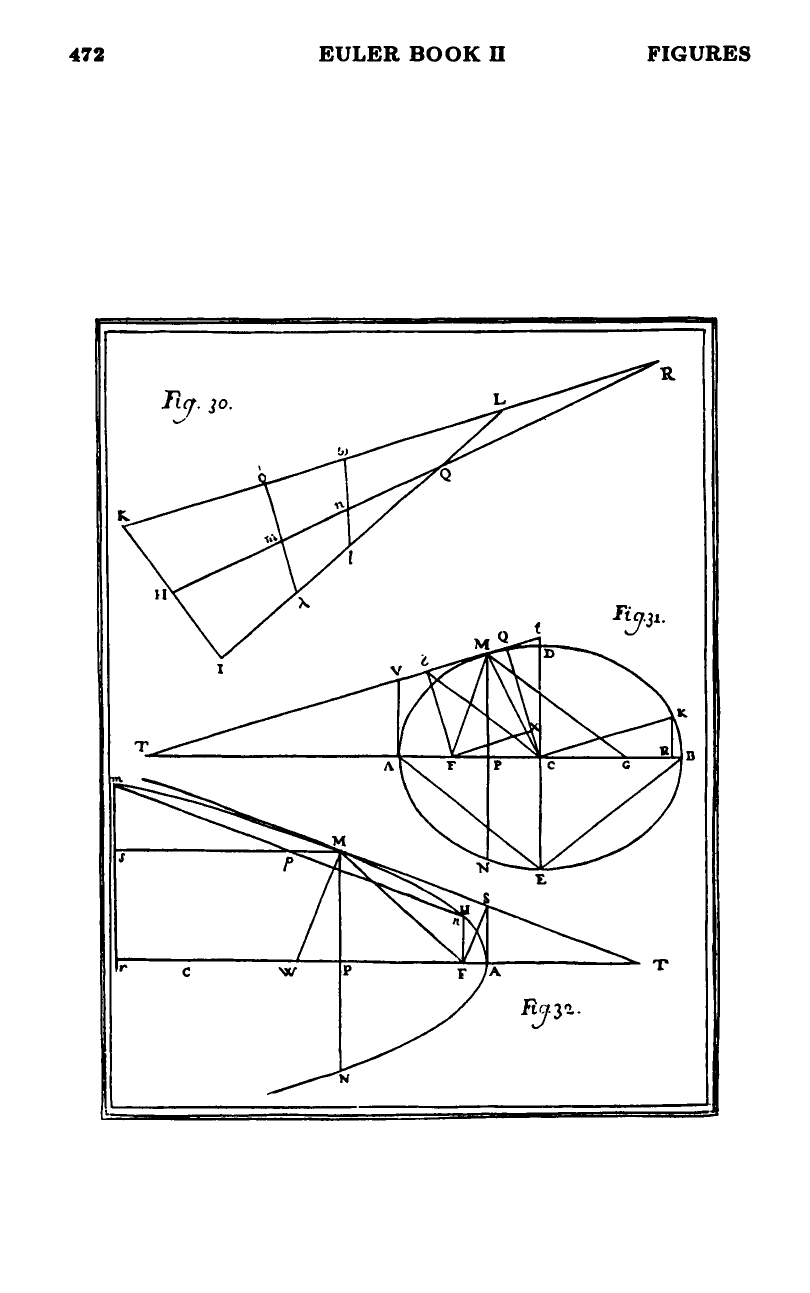 Figures 30–32
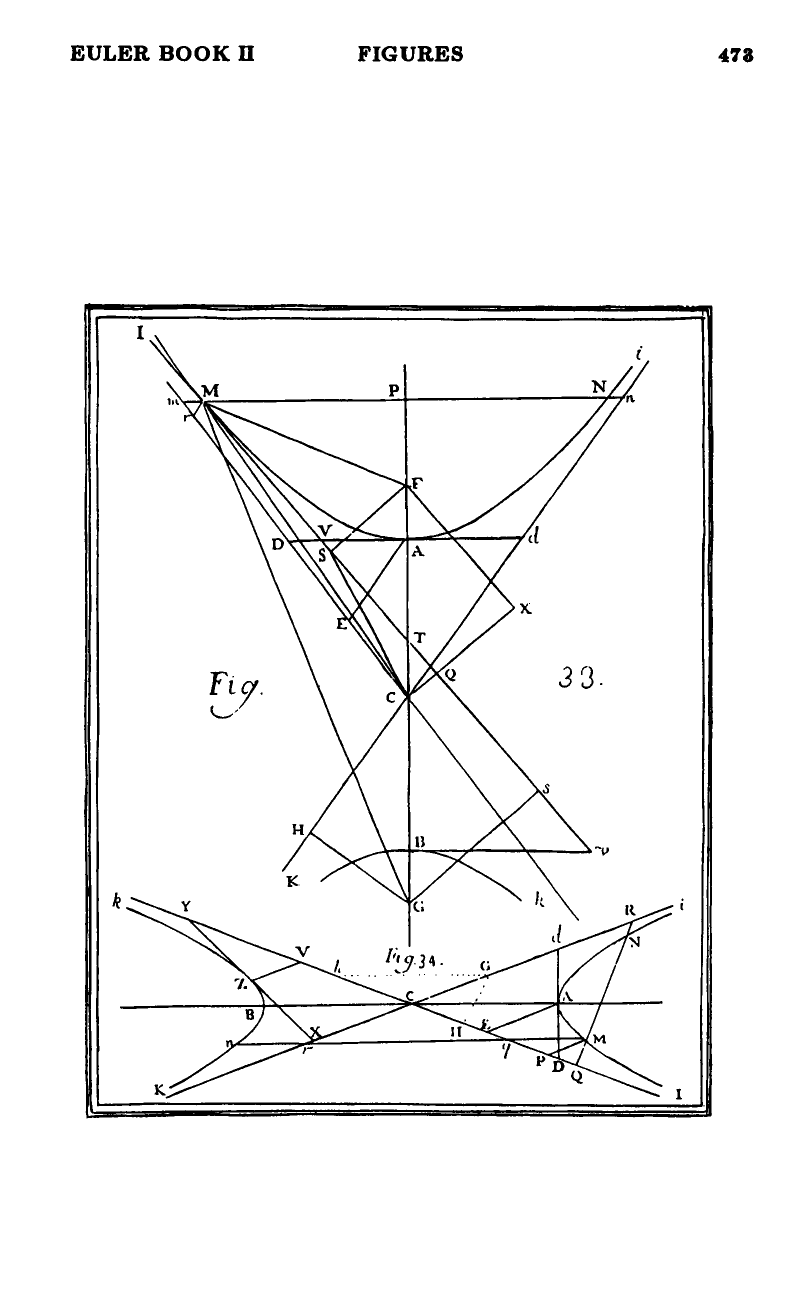 Figures 33–34